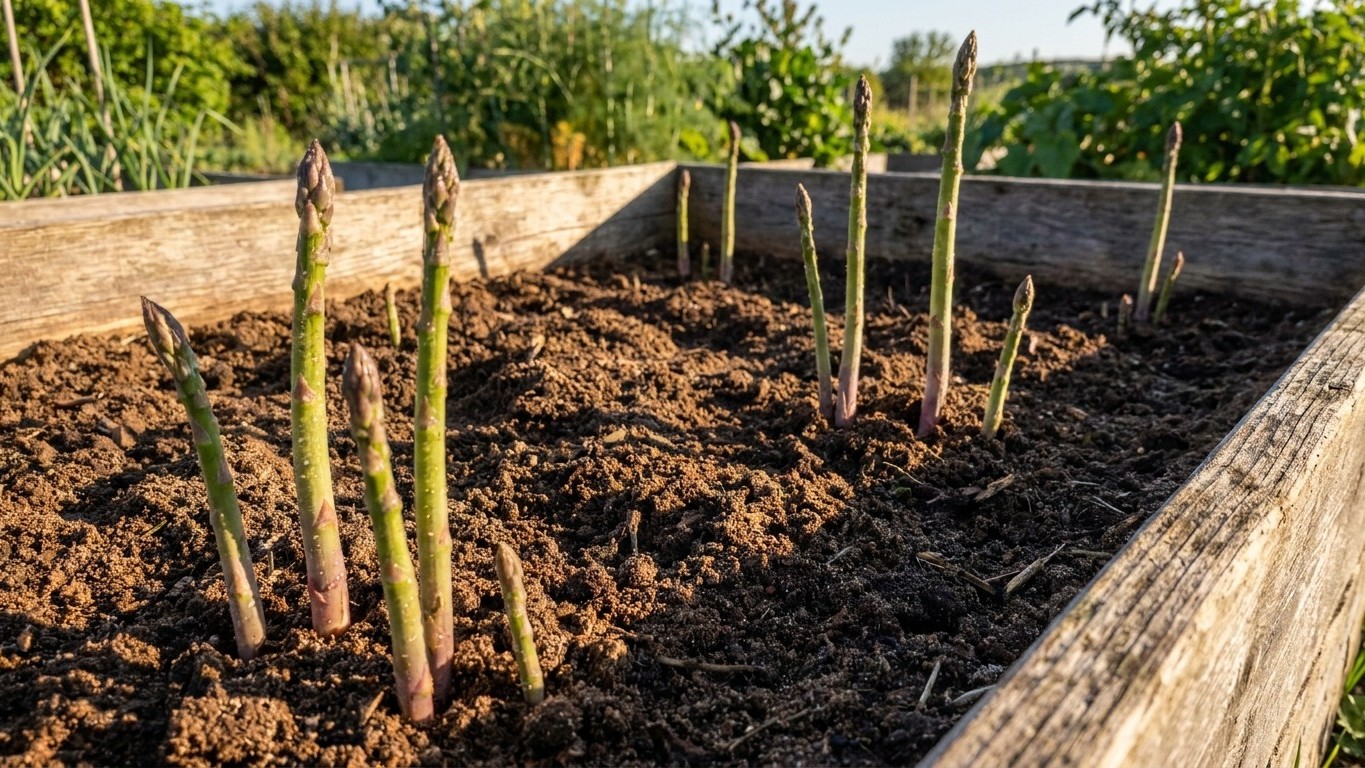

The honest answer starts with a gap. No verified list of Illinois asparagus pests came with the facts this page is built on, so it names no insect. A wrong name sends you to the wrong fix. What it can do is tie trouble to the plant’s calendar, from crowns set in early spring to fern in summer, show how to tell chewing damage from look-alikes, and point you to the office that keeps the real list for your county.
Which pests attack asparagus in Illinois
The list is the part this page cannot hand you. A page like this should open on named species and the service that documents them, and for Illinois that list is not on file here. Filling it from memory would be easy and worthless. Ask University of Illinois Extension for its documented list instead of matching a photo to a name yourself. Extension keeps that list; this page does not.
Even without the names, the sorting rule holds. A statewide list is written for every crop, tree and lawn in Illinois, so most of its entries have nothing to do with a vegetable bed. An insect that develops in a maple trunk has no reason to visit your asparagus, and a pest of field corn does not necessarily eat your spears. When a list runs long, cross off the tree pests, the turf pests and the field-crop pests first, and you are left with a short stretch of the page that concerns you.
What remains are things that feed on the three parts of the plant: the spears in spring, the fern through summer, and the crown underground. That framing is more useful than a species name, because it tells you where to look. It also matters for a plant this long-lived. Asparagus goes in as crowns, set in 8-inch furrows in early spring. It is not harvested until year 3, and then it produces for 10 to 15 years. Whatever settles into that bed has a stable address for a decade or more, and so does anyone trying to keep it from settling.
When each one shows up, and what it does first
Species-by-species timing is the other thing not published here, so the calendar below hangs on the plant and on the frost window. At the NOAA NCEI reference station, the last spring freeze falls between April 11 and April 22 (the 30 to 70 percent probability band for 32°F). That is an airport figure. Suburban and rural gardens usually see the last frost one to two weeks later, so your own date is probably later than that band.
Crowns go in early spring, close to that window, and the first thing you can watch for is whether they come up at all. Spears that never appear, or come up in patches with gaps between, point below ground, and that is a symptom to write down rather than a verdict. Nothing is harvested until year 3, so for two seasons the fern is all there is to look at. That makes fern the place where a first-year or second-year gardener will see trouble first: thinned foliage, stripped stems, or color going wrong on plants that were green a week earlier.
From year 3 on, spring adds a second place to look, at the spear itself. Harvest runs four weeks the first year, then six, then eight in the seasons after. Anyone picking through that window sees the damage in the hand: tips that look chewed, surfaces that look scarred, spears bent or missing tissue. When most spears come up thinner than a pencil, harvest is over, and the fern is left to grow. That rule is an object, not a date, so the spear stage ends on the plant’s schedule rather than the calendar’s.
Summer then brings its own confusion. Rain across June, July and August adds up to about 12.1 inches at the reference station (June 4.1, July 3.71, August 4.25, with 37.9 inches over the year). July is the driest month, though 3.71 inches is hardly a drought. Still, a fern that yellows in July may be short of water, waterlogged, or eaten, and the three look alike from the driveway. Those are normals for one station, not a forecast for your plot.
The practical move is a log. Note the date of the first symptom and count the days from your own last frost. Three years of dates tell you more about your bed than any generic calendar, and they are exactly what a county Extension educator will ask for.
Telling the damage apart from everything else
Misdiagnosis costs more than the damage does. Gardeners see a yellow fern, assume an insect, and treat a bed that was simply sitting in water. The Drummer series, the state’s representative soil, is poorly drained and clayey (8 percent sand, 31 percent clay, 61 percent silt). That describes the state’s typical ground, not yours, but it shows why wet-feet trouble is a real candidate in much of Illinois. Asparagus wants well-drained soil, and the soil and drainage question for a bed that lasts fifteen years is covered in Will Illinois Soil Hold an Asparagus Bed for Fifteen Years?
| What you see | Possible causes | What separates them |
|---|---|---|
| Ragged edges, scarred or chewed spear tips | Insect feeding, or mechanical damage from a hoe, mower or hail | Insects leave missing tissue in irregular patterns and sometimes droppings or the insects themselves. Mechanical damage is clean or bruised and follows where a tool or storm passed. |
| Fern yellowing across the whole bed | Water stress, poor drainage, nutrient shortage, disease | No missing tissue, and it tracks the weather or the low spot in the yard rather than moving plant to plant. A soil test and a rain gauge narrow it down. |
| Yellowing or dieback on a few plants only | Disease, crown damage, an insect working one spot | Digging gently near an affected plant, then comparing it with a healthy neighbor. A county office can examine a sample. |
| Spears thin, few or missing | Crowns set too shallow or too deep, wet soil, a young bed, feeding at the crown | Bed age and drainage first. Year 1 and year 2 beds are supposed to be thin. |
What actually works here, and what is a waste of time
A physical barrier put up at the right moment beats a treatment applied late. In the two years before harvest, when the plants are small and nothing is being picked, a fine cover over the bed while plants are young is the kind of measure Extension typically discusses. Whether it suits your bed and your pests is a question for your county office, because the right barrier depends on what is actually there.
Calendar discipline does more than any product on a short season. Harvest to the schedule, four weeks, then six, then eight, and stop when most spears come up thinner than a pencil. Never pick before year 3, and never stretch a harvest window because the bed looks strong. A stressed, overpicked plant is a weaker plant, and weak plants are the ones that show up in every gardener’s damage photos.
Routine bed care also counts. The furrow is backfilled gradually across the year, two inches every other month, not all at once. That is bed management, not pest control. Drainage, though, cannot be undone once a bed is planted: on wet clay, a bad site is a problem you carry for the life of the planting.
Here is what wastes time. Treating on a hunch, before anyone has identified what is feeding, is the first item. A product chosen for the wrong insect does nothing to the right one, and it does not undo the damage. Spraying on a calendar because a neighbor does is the second. Pulling out plants at the first sign of yellowing is the third, since the cause may be water. And no variety on this page carries a published claim of pest resistance, so choosing among Jersey Giant, Jersey Knight, UC 157 F1 or Purple Passion for that reason has nothing behind it.
This site does not name products, active ingredients or doses. What is approved for home use in Illinois is Extension’s call, and it changes. Ask them, and ask before you buy.
Where to check this for your own county
Start with your county’s University of Illinois Extension office. Extension is the service that documents which insects are causing trouble in the state, and its county educators know what has been showing up locally. This page cannot replace that, and neither can a statewide list.
Pest presence varies inside Illinois, sometimes a lot. What is documented at the state level does not say what is in your bed. The frost figures on this page come from one NOAA NCEI reference station, and rural or suburban gardens usually see the last spring frost one to two weeks later. Check your own county before you copy anyone’s dates, including these.
The soil works the same way. The Drummer series is the state’s representative soil, not a measurement of your garden, and the only number that counts for your bed is the one from a soil test. If you have not settled where the bed goes, read When to Plant Asparagus Crowns in Illinois for the timing, and see Growing Asparagus in Illinois for the whole picture.
The next step is small. Photograph the damage, note the date, keep a sample in a sealed bag if you can, and call or visit the county Extension office with the log in hand.
Common questions
When should I start looking for damage?
Start when crowns go in, in early spring near your own last frost date. The reference station’s last freeze falls between April 11 and April 22, and your county may be one to two weeks later.
Can I harvest a few spears from a damaged bed early?
No. Asparagus is not harvested until year 3. After that come four weeks, then six, then eight, and you stop when most spears are thinner than a pencil.
Do any of the named varieties resist pests?
Nothing published here says so. Jersey Giant and Jersey Knight are listed as all-male, and UC 157 F1 and Purple Passion as male/female. No source here ranks them for pest resistance, flavor or yield.
Should I treat as soon as I see chewed spears?
Identify first. Extension can tell you what is feeding and what is approved for home use in Illinois. Chewing can also be mechanical damage, and yellowing can be a water problem.