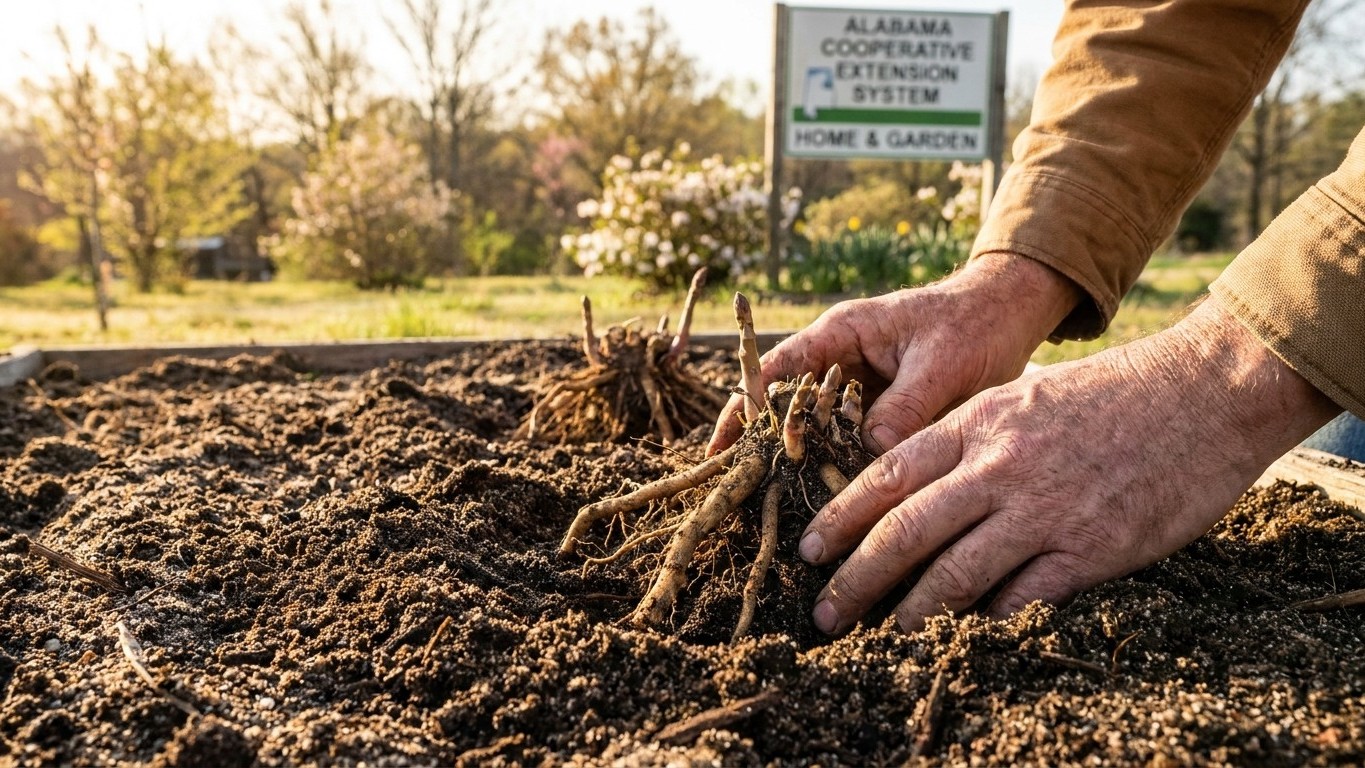

Plant Asparagus Crowns in Illinois in early spring, timed to the thaw rather than a fixed date, since the reference frost window for the region runs from April 11 to April 22. Get the timing right and you’re setting up a bed that will still be feeding you in over a decade. Get the site wrong, and no amount of good timing fixes it, because this crop asks for one thing above all: ground that drains.
The short answer
an Asparagus Bed is not a plant you swap out next season if it disappoints. Once the crowns go in, Utah State University Extension notes the planting will produce for 10 to 15 years, with the first real harvest not arriving until year three. That’s a decade-plus commitment tied to one patch of ground, which makes the choice of spot the single most consequential decision in the whole process, more so than variety, more so than exact planting week.
The source’s soil requirement is short and specific: most soils will work, provided they are well drained. That single word, drained, is where Illinois gardeners need to slow down. The soil recognized as the state’s official soil, the Drummer series, is a Mollisol, the deep, dark prairie soil that built the Corn Belt and made this region some of the most productive farmland on the planet. It’s rich: organic matter runs around 5.5 percent, and the texture is clayey, with roughly 8 percent sand, 31 percent clay, and 61 percent silt. Surface pH sits near neutral, about 6.7. But the same USDA data that records all that richness also records its drawback for this particular crop: the Drummer series is classified as poorly drained.
That’s not a judgment on any one backyard. The Drummer series is a state-level representative soil, mapped from over a hundred sampled components, and it describes a tendency across the region, not a diagnosis of a specific garden. Plenty of Illinois yards sit on sandier terrace soils, hillside ground, or fill dirt from a builder’s grading job, all of which drain very differently than the flat, dark prairie ground the state soil represents. The only way to know what’s actually under a given lawn is a soil test or a simple observation: dig a hole a foot deep, fill it with water, and see how long it takes to disappear. If it’s still standing after several hours, that ground behaves like heavy, poorly drained clay, and a permanent 10-to-15-year bed is the wrong crop to gamble on it.
The fix, where drainage is doubtful, is not to abandon asparagus. It’s to build up rather than dig down: a raised bed or mounded row lifts the crowns above the water table that heavier soils tend to hold. Given how long this planting stays put, an afternoon spent building a raised bed is a small price against the alternative, which is crowns that rot in their second wet spring.
Will the summer here water it for you?
Once the bed is established, Utah State University Extension’s watering guidance is specific: one to two inches every other week for the first two years, then one to two inches every three weeks after that. That’s the target. Whether the sky delivers it is a separate question, and the answer, for this region, is partial.
- What the reference station records: summer rainfall across June, July, and August averages about 12.1 inches, out of roughly 37.9 inches for the year. Spread evenly, that’s close to an inch a week, which sounds like it lines up with the every-other-week target.
- But rain doesn’t arrive evenly: July, the driest of the three summer months, averages just 3.71 inches, against 4.1 in June and 4.25 in August. A month can run short even when the seasonal average looks fine, and a bed doesn’t care about the average, it cares about the weeks it actually goes without water.
- Rain also often arrives as thunderstorms: a single heavy downpour tends to run off rather than soak into the ground, especially on the compacted clay surfaces common across the region, so a wet week on paper doesn’t always mean a wet root zone.
- The practical move is a rain gauge, not a calendar: track what actually falls on the bed itself, and top it up with a hose whenever a two-week stretch (in years one and two) or a three-week stretch (after that) comes in under an inch or two.
- Heavier soils change the math slightly: ground closer to the clay-rich Drummer profile holds moisture longer between rains, so a raised or amended bed built on that kind of ground may need slightly less supplemental watering than a sandy one, even under identical rainfall.
None of this replaces watching the bed. A summer normal is built from 1991-2020 averages at one reference station; a given July can run well below 3.71 inches, and a given yard, depending on slope, tree cover, or how close it sits to a downspout, can run drier or wetter than the regional number regardless of what falls from the sky.
When to put the crowns in
Crowns go into the ground in early spring, and for this region that means working around a last spring frost window that falls, on average, between April 11 and April 22. That’s a mean date from 1991-2020 records at one reference station, not a promise, and it should be read as a rough marker rather than a fixed line on a calendar. Rural and suburban gardens well outside that reference area often see their own last frost run later, sometimes by a week or two, so a gardener a couple of counties away should treat the window as a starting estimate and adjust to what their own ground has done in past years.
The planting method itself is straightforward: crowns are set into furrows about 8 inches deep, then the furrow is filled in gradually rather than all at once, adding roughly two inches of soil back every other month over the course of the season as the new shoots grow. That gradual backfill protects the emerging growth while still letting the crown settle at proper depth by the time the bed matures.
Crowns are dormant when planted, which is why early spring works even when the ground is still cool and the last frost date hasn’t technically passed. That said, gardeners who miss the crown-planting window, or who’d rather start from a smaller upfront investment, have a second route: starting asparagus from seed instead. Seed asks for more patience, since it adds a growing season before crown-sized plants are even ready for their permanent bed, but it’s a legitimate alternative documented by the same Extension source and worth considering for anyone planting later than the early spring window allows.
Whichever way it starts, the clock on harvest doesn’t move. No spears come out in year one or two regardless of planting method; year three is when picking begins, and even then it’s limited, a short four-week harvest window that extends to six weeks and then eight weeks in the following years as the crowns mature. The harvest doesn’t end on a set date either. The rule is a physical one: stop cutting once most of the spears coming up are thinner than a pencil, a sign the crown needs to put its energy into growing fern rather than spears.
Common questions
Does the state soil tell me what’s in my own yard?
No. The Drummer series is a representative soil mapped across the state, built from over a hundred sampled components, and it describes what the region’s ground tends to do, not what any single garden contains. River bottoms, hillsides, and any lot a builder has graded or filled can differ completely. A simple drainage test, or a soil test through a local Extension office, is the only way to know what’s actually under a specific bed.
Can I harvest anything the first or second year?
No. Utah State University Extension is clear that harvest doesn’t begin until year three, and even then it’s a short four-week window. Cutting spears earlier weakens the crown before it’s had a chance to establish, which undermines the whole point of a bed meant to produce for a decade or more.
Do I need to worry about winter cold when choosing a planting time?
The source used for this article doesn’t address winter chilling requirements or soil pH for asparagus, so no figure for either is given here. Planting timing in this guidance is anchored strictly to the spring frost window and soil drainage, not to a chilling threshold.
What varieties are available, and does it matter which one I choose?
Utah State University Extension names four: Jersey Giant and Jersey Knight, both all-male varieties, and UC 157 F1 and Purple Passion, which include both male and female plants. The source identifies them only by that trait and doesn’t publish comparisons of flavor, yield, or a recommendation for one over another, so no such claim is made here.