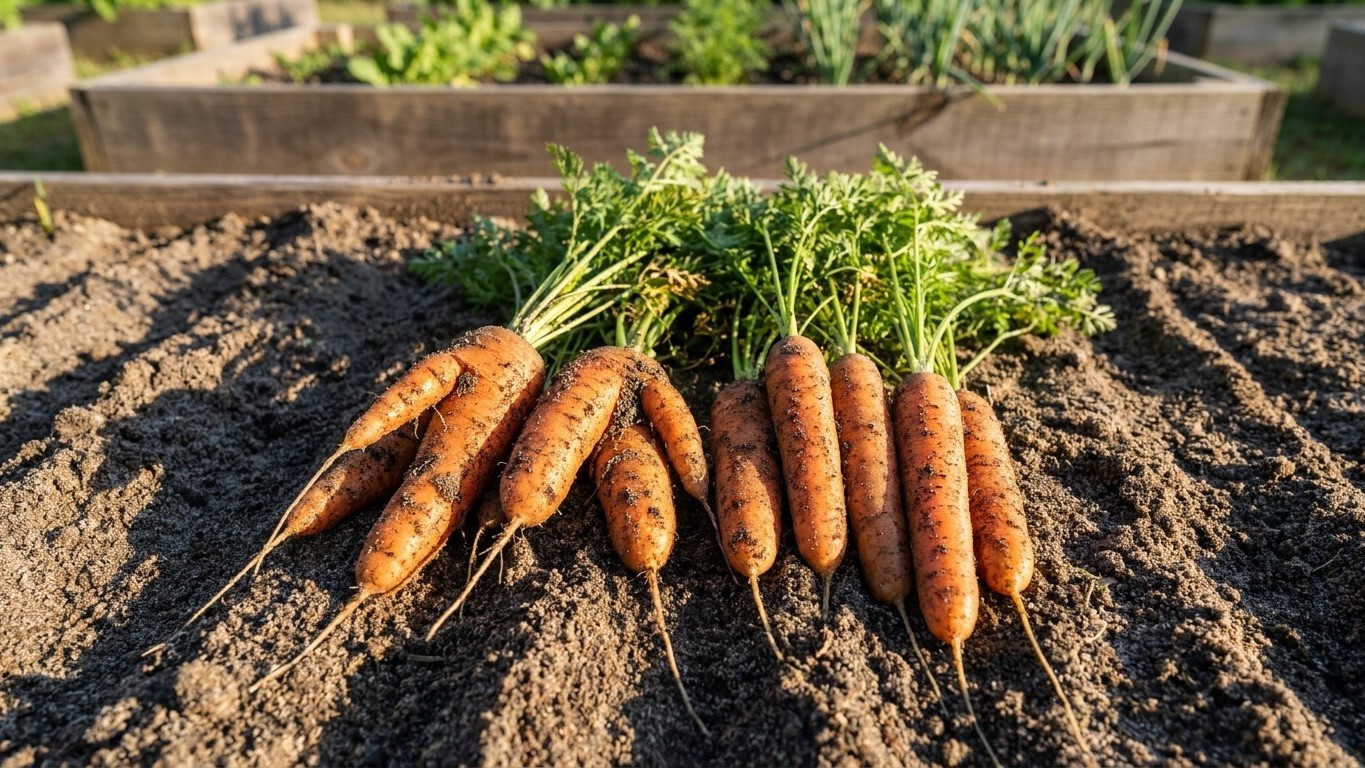

The facts gathered for this page include no documented list of carrot pests for Quebec from a named service, and inventing one would do more harm than leaving the gap. What this page can give you is the clock (carrots run 70 to 100 days from seeding, never from a transplant), a way to sort insect damage from look-alikes, and the barriers that suit a short season. The species list itself has to come from Quebec’s own advisory service. This page belongs to a wider guide on Growing Carrots in Quebec.
Which pests attack carrot in Quebec
A pest list worth trusting names its source: a public extension or agricultural advisory service that documents which insects turn up in the province’s vegetable crops. For Quebec, the verified facts behind this page hold no such list and name no such service, so no species are named here. Pulling names from memory or from a US state’s list would put insects on the page that may not be documented for your garden at all.
Once you have the real list, you will need to sort it, because a provincial list is never written for carrots alone. Anything filed under orchard trees, conifers, stored grain or greenhouse crops can be set aside. A carrot bed is attacked at ground level and in the tops, and a pest that lives in tree trunks has no business in a row of carrots.
What should stay on your shortlist are the species listed against carrot, or against its close relatives in the vegetable garden. Ask the service two things about each one: what part of the plant it feeds on, and at what stage of the crop it shows up. Those two answers matter more than the name. A pest that eats seedlings calls for a different move than one that tunnels in a nearly full-size root.
Treat any list as a set of candidates, not a verdict on your beds. Meanwhile, sow in place, keep a written record from the day of seeding, and learn what damage looks like at each stage.
When each one shows up, and what it does first
Carrots are sown directly in the bed. There is no transplant date to count from, so the 70 to 100 days run from the day the seed goes in. A bed seeded early and a bed seeded late will meet the same pests at different dates on the wall calendar but at similar points in their own 70 to 100 days. To place your seeding inside the frost-free season, count back from your last frost with When to Sow Carrots in Quebec: Counting Back From the Last Frost. No frost dates are published on this page, so I won’t guess them.
Which species arrives when is exactly what the missing list would have supplied, so I won’t assign dates to insects I can’t name. What I can do is tell you what you will see first at each stage, since you arrive with a symptom, not a Latin name.
Right after seeding, the sign is a thin or gappy row. Either seedlings never emerged, or they emerged and then disappeared. Those are different problems. Stems cut off at the soil line or vanished plants point toward something feeding. A row that never came up at all points toward dry seed, crusted soil or washed-out seed, which no insect explains.
In the leafy stage, the first sign is on the tops: chewed edges, holes, curled or discolored foliage, or plants that droop on hot afternoons. The roots are still small and hidden, so foliage is your only early warning. Pull one plant from a doubtful spot rather than guessing.
Near harvest, the first sign is often on the root itself: scars, tunnels or a rough surface at the shoulder. By then the feeding happened weeks earlier, which is why a spray applied when you spot the damage almost never helps. Clemson Extension puts harvest at about 65 to 75 days after planting, which sits inside the 70 to 100 day span, so pull a test carrot instead of trusting the packet.
Log each symptom as “day 12” or “day 40”, counting from seeding. Days since seeding tell an advisor far more than a month name, because they can match your stage against what each documented pest does and when.
Telling the damage apart from everything else
Half the carrot problems that get blamed on insects turn out to be soil, water or handling. The table sorts the common symptoms by what separates them. It gives you a sign to look for, not a diagnosis.
| What you see | Possible cause | What helps you tell |
|---|---|---|
| Forked, twisted or stubby roots, skin unbroken | Heavy or rocky soil | Dig around a forked root. If it bent around a stone or split at a hard clod, that is soil, not a pest. Utah State University Extension says heavy or rocky soil makes the root fork. |
| Tops wilt in the afternoon and recover by evening | Water shortage | Check the soil below the surface. If it is dry down there, water is the first suspect. |
| Whole bed pale or off-color, evenly | Nutrient or pH problem | Even color across the bed points to soil. Patchy damage points elsewhere. A soil test settles it. |
| Seedlings gone, no stems left | Seed never emerged | Scratch the row. Seed that is still there, dry and unsprouted, means no seedlings ever existed to be eaten. |
| Seedlings gone, cut stems left | Something fed on them | Cut stems at the soil line are a clue worth photographing. |
| Tunnels or scars on the root | Insect, disease or a tool | Clean, dry-edged cuts often come from a trowel or fork. Take the root, and a healthy one for comparison, to your advisor. |
Soil deserves a closer look, because forking is the symptom most often mistaken for a pest. The dominant profile in Quebec’s mapped agricultural soils is a Podzol, the acid, leached soil that forms under conifers. It covers 36 percent of the mapped surface, with Gleysolic soils next. The median surface reading is a pH of about 5.5, with 51 percent sand, 15 percent clay and 34 percent silt, organic matter near 6.2 percent, and good drainage (Agriculture and Agri-Food Canada, Canadian Soil Information Service, 248 mapped components). That is a starting point only: the survey covers agricultural regions, not the far north, and river bottoms, wet ground and anywhere a builder scraped or filled will differ completely.
The home test is simple. Fill a straight-sided jar about a third full of soil, top it up with water, shake, and let it settle. Sand drops first, silt next, clay last, so the layers show your texture. For pH, use a soil test through your provincial advisory service. If forking persists on heavy ground, see Will Carrots Fork in Quebec Soil?
What actually works here, and what is a waste of time
On a short season, the calendar does more than any product. The most reliable move is a physical barrier in place on the day of sowing, since a cover laid after damage appears only shuts the door behind the pest. Lay lightweight row cover over the bed the day you seed, seal the edges with soil so nothing crawls in under it, and leave it on through the vulnerable stages your advisor identifies. A pest that can’t reach the crop needs no name.
Bed preparation carries more weight than people expect. Utah State University Extension describes ideal carrot ground as deep, sandy, well-drained soil rich in organic matter, and says heavy soil needs plenty of compost and double digging. If your ground leans heavy, a raised bed or double digging is the answer, not a different variety. Unforked roots also make damage easier to read.
Several common reflexes waste your time. Spraying without an identification is the biggest: a treatment aimed at the wrong insect does nothing to the right one, and it can harm insects you want. Spraying after you see root damage is nearly as bad, since the feeding is already over. Treating forked roots as pest damage sends you after the wrong problem, and overwatering to cure wilting can worsen things if the soil is already wet.
This site names no product and no active ingredient, and gives no dose. Which treatments are registered for home use in Quebec is a question for the provincial advisory service. Bring your sample and your log.
Where to check this for your own county
The verified facts behind this page name no Quebec pest-monitoring service, so I won’t name one from memory and risk sending you to the wrong door. Quebec also isn’t organized around American-style county extension offices. Your best route is the provincial agriculture ministry’s advisory network, a local agronomist, or the nearest regional office that handles horticulture questions. Ask them for the documented carrot pest list for your area and the growth stage each one attacks.
Bring three things: a whole affected plant with the root attached (not just a leaf), a photo of the row showing whether the damage is patchy or even, and your log counted in days from seeding. Add a soil test result if you have one.
Your next step is small: seed the next bed with a written date, lay the row cover that day, and start the log at day one.
Common questions
Can I tell which pest it is from the damage alone?
Not reliably. Insect tunnels, tool cuts and rot can look alike, and no species list is published on this page to match against. Take an affected plant with its root, plus a healthy one, to the provincial advisory service.
How long do carrots take from seeding?
Count 70 to 100 days from seeding, since carrots are sown in place and never transplanted. Clemson Extension gives about 65 to 75 days after planting for harvest, so pull a test root before you commit to a date.
How should I store carrots after harvest?
Cut the tops off first. The leaves keep drawing moisture out of the root, which is why bunched carrots with tops on keep only about 10 to 14 days, while trimmed ones keep far longer. Clemson Extension recommends 33 °F and high humidity to prevent wilting. Carrots held at 50 °F sprout and soften much faster.
Does Quebec soil make carrots fork?
It can, but the province’s median profile (well drained, 51 percent sand, 34 percent silt, 15 percent clay) is not your garden. Utah State University Extension says heavy or rocky soil forks roots. Run the jar test, get a soil test, and use a raised bed or double digging if your ground is heavy.