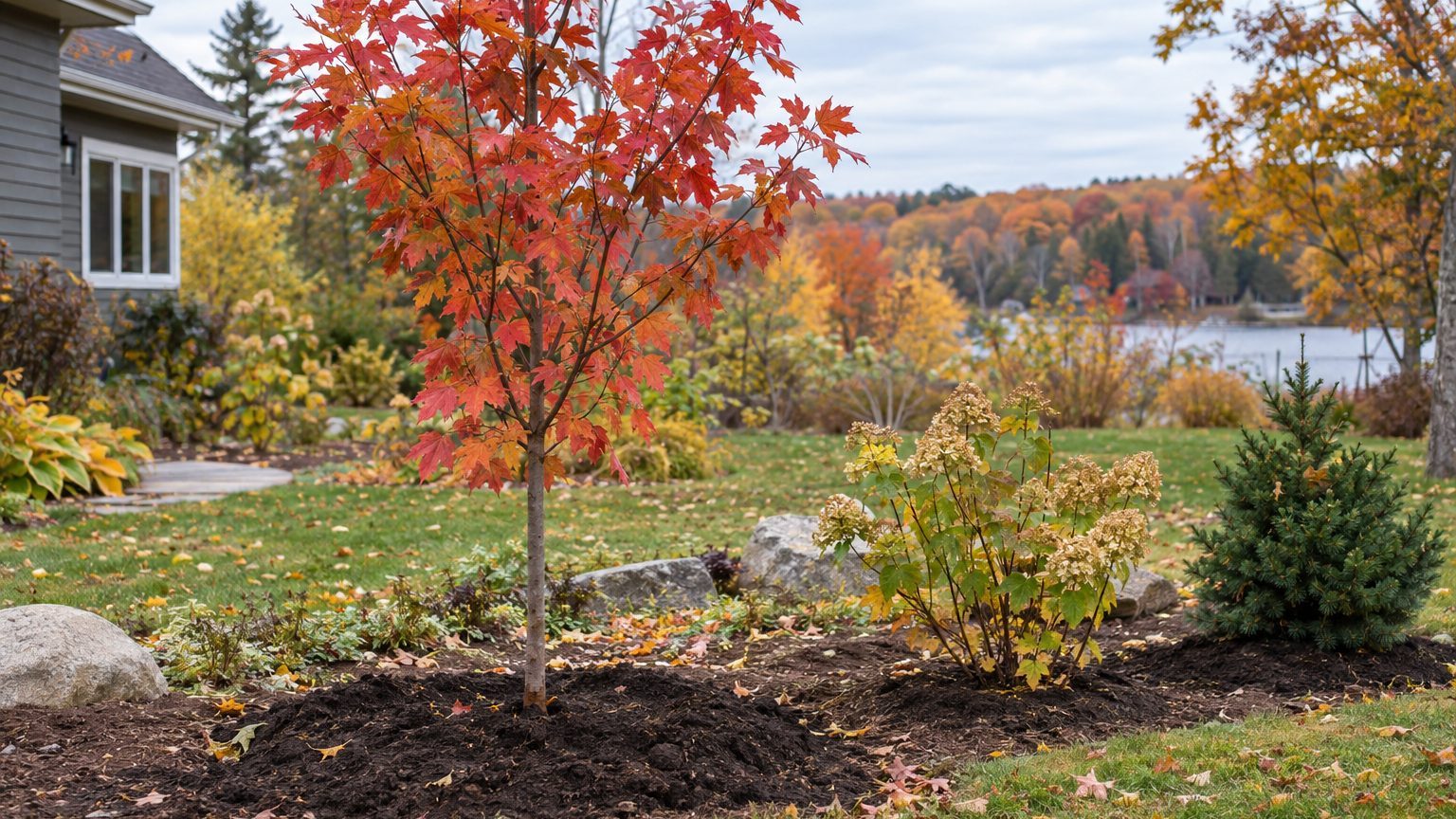

In Portland, the safe target for planting trees and shrubs in fall is August 28 to September 9, which is six weeks before the first fall frost (October 9 to October 21). Roots keep working after that, so a late September or October planting of hardy stock isn’t doomed. It just carries more risk with every passing week, and more still in inland and northern Maine, where frost arrives earlier. Here is how the timing works and what to do with it.
The deadline in Maine
Roots don’t follow the air temperature. A tree keeps pushing out new roots as long as the soil is workable and above freezing, and that can be weeks after the first cold nights and the last of the leaf color. So the true deadline is set by the ground, not by the calendar on the kitchen wall. The practical cutoff sits several weeks before the soil locks up.
Cornell Cooperative Extension puts the rule this way: “Fall is an excellent time for transplanting, provided you get them to their new home at least 6 weeks before the ground freezes, allowing them time to establish roots before winter dormancy.” (Cornell Cooperative Extension, Orleans County.) Good advice, but almost nobody knows in September what day the ground will freeze. The date of the first frost is far easier to look up.
For Portland, the NOAA NCEI 1991-2020 Climate Normals put the first 32°F freeze between October 9 and October 21. That is the band where the probability of a freeze runs from 30 to 70 percent (NOAA NCEI data). Count six weeks back from that range and you land on August 28 to September 9. Write that range down as the conservative target for coastal southern Maine.
Why the real limit falls later
Cornell counts from frozen ground, and soil freezes well after the air does. It holds summer heat like a stone in a fire pit. Counting from the first frost therefore builds in a cushion, and the August 28 to September 9 window is the safe date, not a hard stop. A healthy container-grown shrub planted a couple of weeks past it is often fine. A bare-rooted gamble in a cold pocket is another story.
Maine is not a place where the deadline can be ignored. Portland’s coldest-month mean daily minimum is 15.6°F (NOAA NCEI Climate Normals 1991-2020), well under 32°F, so the ground does freeze and the six-week logic applies. That figure is the average overnight low in the coldest month, not a record low, and it is the number that decides which plants survive the winter at all.
Portland also sits at the mild end of the state. Inland and northern Maine run later in spring and earlier in fall, which means the first frost arrives sooner and the ground locks up sooner. Move your planting deadline earlier as you go north or uphill. The USDA Plant Hardiness Zone Map (2023 edition, based on 1991-2020 normals) runs from 3b to 6a across the state, so your zone may differ a lot from the coast. Look up your own town in First and Last Frost Dates in Maine, then count back six weeks from the start of that range. Other Maine guides cover the regional differences in more detail.
What to plant late, and what to wait on
Fully hardy plants forgive a late start. Container-grown trees and shrubs come with an intact root system, so they go into the ground almost without interruption, and balled-and-burlapped stock does nearly as well if the ball is handled gently. Sugar maples, for example, are native and tough, and they settle in fine when the calendar gets tight.
The risk shifts to plants that are marginal for the zone. A shrub rated for a climate barely colder than yours has no reserves. It needs a full season of root growth before it meets a Maine January, and Portland’s coldest-month average low of 15.6°F is unforgiving to plants that haven’t settled in. The same goes for evergreens. Their needles and leaves keep losing water all winter, and frozen soil means the roots can’t replace it.
| Plant type | Late-fall verdict | Reason |
|---|---|---|
| Fully hardy deciduous trees and shrubs, in containers | Good, even past the safe window | Intact roots and no leaves to feed |
| Fully hardy balled-and-burlapped trees | Good if planted before the ground freezes | Roots are trimmed but protected in the ball |
| Borderline-hardy shrubs and trees | Wait until spring | No cold tolerance to spare, no time to root |
| Evergreens, needled and broadleaf | Plant early or wait | Foliage loses water all winter |
The decision to write down
Plant only fully hardy container and balled stock in the window, and leave borderline plants and broadleaf evergreens for spring. Nurseries put marked-down stock out in fall, and it is tempting to pick up a bargain that is a zone too tender. Check the plant tag against your own USDA zone, and if the tag lists the same zone as your yard, or one colder, you are fine. If it lists one warmer, wait.
Needled evergreens such as spruce, fir, and pine sit in between. They are perfectly hardy but hold their needles through the winter, so they need their planting done earliest, with the most watering afterward. If the date has slipped, a hardy evergreen planted late will do better with wind protection on its exposed side than one left bare. For step-by-step technique on hole size and root flare, see Planting and Caring for Trees, Shrubs and Perennials.
Watering and mulch until the ground freezes
The first winter is about roots, not growth. A newly planted tree may put on no visible top growth at all, and that is fine. What matters is that roots are spreading into the surrounding soil before dormancy, which is exactly the point of Cornell’s quote above. A tree that reaches winter with a small root system and dry soil around it starts spring at a disadvantage. That is why late-planted trees sometimes leaf out weakly, or leaf out, then fade in July.
Keep watering until the ground freezes. Fall in Maine is often dry, and a root ball in a container-sized hole can dry out even when the lawn looks green. Water slowly and deeply, so moisture reaches below the root ball rather than running off the surface. Push a trowel or screwdriver into the soil beside the tree to check. If it goes in easily and comes out damp, wait a few days. If the soil is hard and dry, water. Continue after the leaves drop, because the roots don’t stop drinking when the crown goes bare.
Mulch in a ring, not a volcano
Mulch does two jobs here, and NC State Extension’s Extension Gardener Handbook gives the depth for each. For weeds: “A 2-inch to 3-inch layer of mulch suppresses most annual weed seeds and makes it easy to hand-pull any that do germinate.” For trees: “Provide a 3-inch layer of mulch to reduce water loss and maintain uniform soil moisture and temperature around roots.” (NC State Extension Gardener Handbook, chapter 11.) It’s a North Carolina publication, but the physics of a mulch layer on soil hold in Maine. Both sentences point to the same depth, and more is not better.
Spread it in a wide ring around the tree, the shape of a doughnut, with the mulch pulled back from the trunk so the bark stays dry and the root flare stays visible. A mulch volcano piled against the trunk holds moisture on the bark and invites rot and rodents. For a fuller walk-through, see Mulching Without Killing the Plant.
What goes wrong
The most common failure is planting too late for the local climate. Portland’s window is the mild-end window. In colder inland and northern Maine, the same calendar dates can already be too late, because frost comes sooner and the ground follows. A homeowner who copies a coastal date into a colder town has effectively shortened the six weeks. If you miss the window, hold the plant until spring, keeping a container plant watered in a sheltered spot, rather than betting on a late planting that has no time to root.
Winter burn is the next problem, and it hits evergreens. Sun and wind pull moisture out of needles and leaves while frozen soil keeps the roots from replacing it, so foliage turns brown by late winter. Newly planted evergreens have the least root to draw on. Plant them on the early side, water them through fall, and site them out of the harshest wind.
Heaving catches shallow, freshly set root balls. Freeze-thaw cycles lift the soil, and a plant with no anchoring roots can pop partly out of the ground. Mulch helps by keeping the soil temperature steadier, and a spring check will tell you whether a tree has shifted. Gently press it back and firm the soil.
A dry fall does its own damage. Roots don’t grow in dry soil, so a planting made on time can still fall behind if the rain doesn’t come. Water is the fix, and it costs almost nothing compared with replacing a tree.
Common questions
Can I still plant a tree in Maine in October?
In Portland, October is past the conservative window of August 28 to September 9, but the ground is still workable and the first frost is only starting, so fully hardy container or balled stock can still be planted with careful watering and mulch. Inland and northern Maine run out of time sooner, so the answer there is more often no.
Is spring planting better than fall in Maine?
For borderline-hardy plants and for evergreens, yes. They get a full growing season to root before their first winter. For hardy deciduous trees and shrubs planted inside the window, fall is as good as spring, and Cornell Cooperative Extension calls it “an excellent time.”
Do I need to keep watering after the leaves drop?
Yes. Bare branches don’t mean the roots are done. Keep watering deeply whenever the soil is dry and not frozen, right up until the ground freezes.
Does the deadline change in northern Maine?
It moves earlier. Colder parts of the state reach the first fall frost sooner and freeze up sooner, so count six weeks back from your local frost range rather than Portland’s. For a look at how another cold-winter state handles the same calculation, see How Late Can You Plant Trees and Shrubs in Fall in South Dakota?