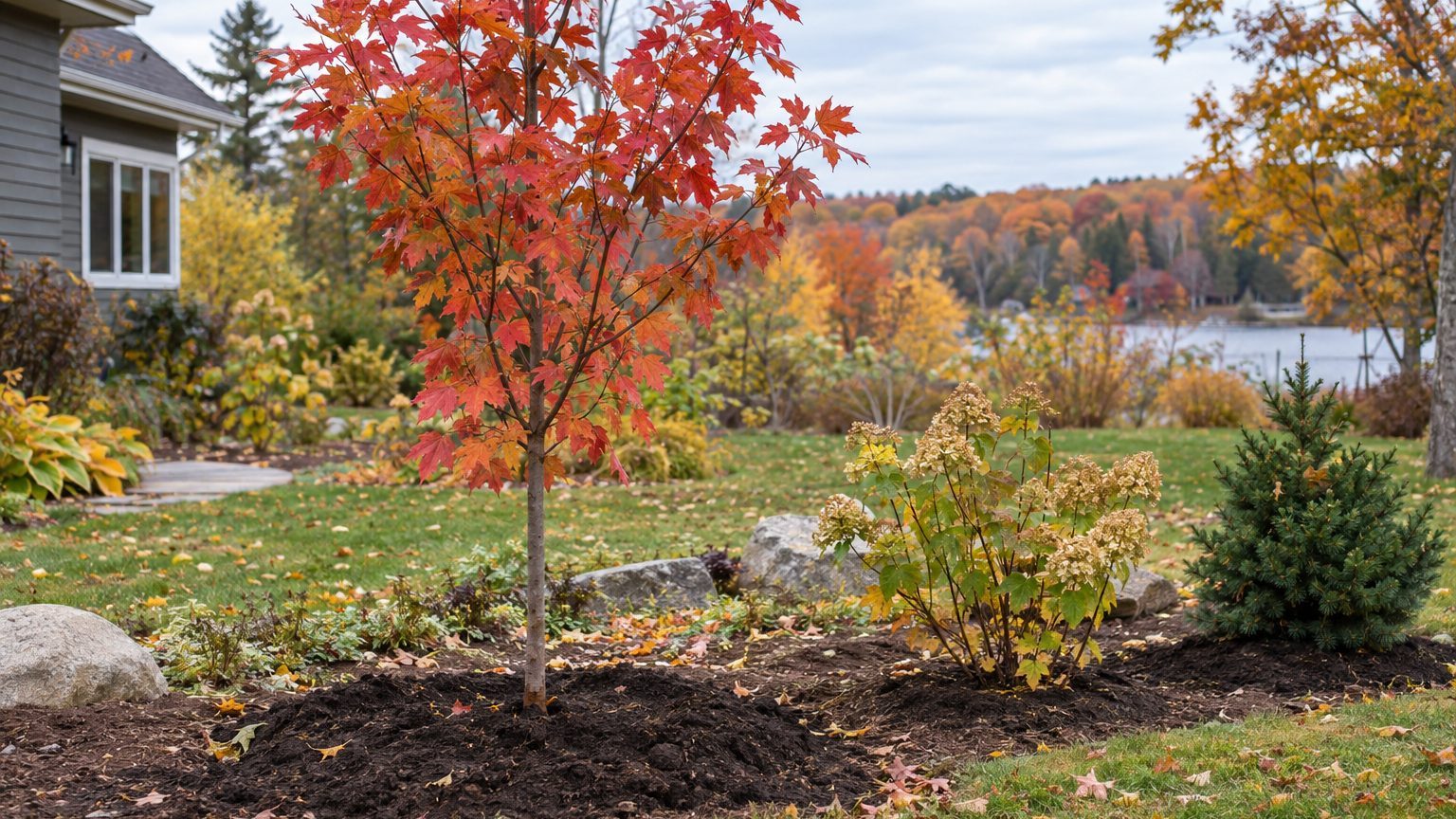

In New Hampshire, the safe target for fall planting is September 1 to September 14, which is six weeks before the first fall frost at the reference station (October 13 to October 26). Trees and shrubs can go in after that, and many survive, because the soil stays workable well past the first frost. Every week beyond the safe window, though, shortens the time a plant has to grow roots before winter. Colder northern towns and higher elevations run out of that time first.
The deadline in New Hampshire
Leaves answer to the air. Roots answer to the soil. A maple can drop its foliage after a frost and keep pushing out new root tips underground for weeks, as long as the soil is workable and above freezing. That gap between cold air and cold ground is what makes fall such a good planting season, and it is also what makes the deadline fuzzy.
Why the ground sets the clock
Cornell Cooperative Extension puts the rule this way: “Fall is an excellent time for transplanting, provided you get them to their new home at least 6 weeks before the ground freezes, allowing them time to establish roots before winter dormancy.” (Cornell Cooperative Extension, Orleans County.) Note what it counts from. Not the first frost, which is an air temperature, but the day the ground freezes, which arrives later.
Nobody can predict the exact day the ground locks up in a given year, so the practical move is to count back from something you can look up. NOAA’s 1991-2020 U.S. Climate Normals, using 32°F freeze probabilities, put the first fall frost at the reference station between October 13 and October 26. Six weeks before that lands on September 1 to September 14. Write that range on the calendar as the safe target.
It is a conservative target. Because the ground freezes after the first frost, the true limit usually falls later than that range, and a shrub planted in the following weeks still has real root-growing time. The safe range simply builds in margin for a cold snap, a wet October, or a shovel that sits in the garage too long.
Reading the range for your own yard
Those frost dates come from an airport weather station, and airports are open, paved and a bit warmer than most backyards. Suburban and rural gardens typically see the first fall frost one to two weeks earlier than the airport does, and more than that at elevation. So if your yard sits on a hillside in the northern part of the state, treat September 1 to September 14 as a ceiling, not a target, and aim earlier. Colder ground means fall tasks move earlier, never later. Your county Extension office can tell you how far your area departs from the reference numbers, and the First and Last Frost Dates in New Hampshire page lays out the frost side of the calendar in more detail.
The deadline applies everywhere in the state, since this is not a place where the ground stays thawed. At the reference city, Manchester, the mean daily minimum of the coldest month is 17.1°F (NOAA NCEI Climate Normals 1991-2020), far below freezing, so the ground does lock up every winter. The USDA Plant Hardiness Zone Map (2023 edition, built on 1991-2020 normals) lists New Hampshire as 3b to 6a. That is a range across the whole state, not one zone, so your own number may differ from Manchester’s.
What to plant late, and what to wait on
Plants that are fully hardy where you live are the ones to put in after the safe range has passed. A container-grown or balled-and-burlapped maple, oak, serviceberry, viburnum or spirea that is rated for your area has the best odds, because it arrives with its root system largely intact and sheds its leaves before winter, so it has little to defend against the cold. Late fall is also the season when nurseries and garden centers mark down stock, which makes that group tempting to buy.
Plants that settle in well
The deciding question is hardiness against the coldest weather you actually get. The coldest-month mean daily minimum of 17.1°F at Manchester is a reasonable baseline for central and southern parts of the state, but some winter nights in the north and in the hills run colder, which is why the USDA zone range runs as low as 3b. Check the plant tag against your own zone and give a plant a wide margin, not a narrow one. A shrub that merely tolerates your zone in a mild winter is not going to be forgiving in its first year, when its roots are still shallow.
Dormant, leafless deciduous plants are the easiest to move late. Loosen any circling roots on a container plant before it goes in the hole, set it at the same depth it grew at the nursery, and backfill with the soil you dug out. For bigger shrubs and trees in the colder part of the state, the decision to write down is to hold borderline plants until spring. A plant at the edge of its hardiness can handle one chilly night in October. What it cannot do is cope with a hard winter while its roots are still working to anchor.
Plants to hold until spring
Evergreens are the riskiest group to plant late. Hemlock, spruce, pine, arborvitae, boxwood and rhododendron keep their foliage all winter, and that foliage keeps losing water to wind and sun while the roots, sitting in cold or frozen soil, cannot replace it. A late-planted evergreen with a small root system is working a deficit by February. If you want evergreens, the early part of the window, close to September 1 to September 14 or ahead of it, gives them the best chance. After that, spring is the safer option.
Bare-root stock is a spring job in cold climates too, since its roots have no soil around them to protect them. The general principles for choosing and setting plants, whatever the season, are covered in Planting and Caring for Trees, Shrubs and Perennials.
Watering and mulch until the ground freezes
The first winter is about roots, not growth. A newly planted tree or shrub has only a fraction of the root system it needs, and everything it does in its first months goes toward building that system. That is why a plant that looks static in October can still be working underground, and why the job in fall is to keep the soil in the root zone in good shape, not to push the plant to grow more.
Water deeply, until the ground freezes
Water slowly and deeply right after planting, so the water reaches the root ball and the soil just beyond it, not just the surface. Then keep watching. Fall can be dry in New Hampshire, and a plant with no leaves still needs moisture in the soil. A trowel or a finger pushed into the soil beside the root ball tells you more than the weather forecast: if it is dry below the surface, water again. Keep that up until the ground actually freezes. For evergreens especially, a well-watered root zone going into winter helps cover the water they lose through their needles and leaves.
Skip the fertilizer and any heavy pruning. Both nudge a plant to put out new top growth that has no time to harden before winter, and both pull energy from the roots that the plant needs.
Mulch in a ring, not a volcano
Mulch evens out soil moisture and temperature, which is what a young root system needs most. NC State Extension gives the depth in plain terms: “A 2-inch to 3-inch layer of mulch suppresses most annual weed seeds and makes it easy to hand-pull any that do germinate.” On trees, the same handbook says: “Provide a 3-inch layer of mulch to reduce water loss and maintain uniform soil moisture and temperature around roots.” (NC State Extension Gardener Handbook, chapter 11.) So a 2-inch to 3-inch layer is the range to use, spread in a wide ring around the plant.
More is not better. Mulch piled against the trunk in a cone holds moisture against the bark, invites rot and gives voles a sheltered spot to chew through the winter. Pull it back so the trunk flare stays visible, and make the ring a doughnut with the plant in the hole. The full reasoning is in Mulching Without Killing the Plant.
What goes wrong
Most late-planting failures trace back to a short list of causes, and they are mostly predictable. Knowing them helps you decide whether a particular plant is worth the gamble.
Cold and wind damage
Planting too late for the climate is the first one. If your yard gets its first frost at the early end of the range, or earlier, and the plant goes in only a few weeks before the ground freezes, the roots may barely have started. The plant does not necessarily die in fall. It shows the damage in spring, with weak or late leaf-out, dieback on branch tips, or no growth at all.
Winter burn is the second. On evergreens, brown, scorched needles or leaves in late winter mean the foliage lost more water than the roots could supply. A burlap screen set on the windward side, plus a deep watering before the ground freezes, reduces the risk. Neither fully cancels it for a plant that went in late.
Heaving is the third. Shallow root balls get pushed upward when the soil freezes, thaws and freezes again, and a plant lifted partway out of the ground dries out quickly. Mulch moderates the swings, and a plant that has been pushed up in a thaw can be pressed back into place and re-mulched.
Moisture and timing mistakes
Drying out in a dry fall is the fourth, and it is the easiest to avoid. A plant can come through a mild stretch looking fine and still enter winter with the root zone dust-dry. Check the soil, not the sky.
When the safe window has passed and the plant is borderline or evergreen, wait for spring and keep the plant in its container in a protected spot, or heel it into a trench with mulch over the roots, so it does not sit in an exposed pot all winter. Colder-winter states face the same arithmetic, and How Late Can You Plant Trees and Shrubs in Fall in Wisconsin? shows how the same six-week rule plays out against a different frost range.
Common questions
Can I still plant trees in October in New Hampshire?
Often yes, with caveats. The safe target is September 1 to September 14, but the ground is usually workable well into October and sometimes beyond. A fully hardy, container-grown or balled deciduous tree has decent odds if you water it until the ground freezes and mulch it properly. Evergreens and borderline plants are the ones to hold until spring, and the farther north or higher up you are, the less margin you have.
Do I count six weeks from the first frost or from when the ground freezes?
Cornell’s rule counts from when the ground freezes. Because that date is hard to know in advance, the safe range here counts back from the first fall frost instead, which comes earlier. The result, September 1 to September 14, is deliberately cautious. The real limit, the day the soil locks up, usually comes later, so planting a little after that range is a calculated risk, not a mistake.
Is it still worth planting if the fall turns dry?
Yes, if you are willing to water. A dry fall does not change the planting window, but it raises the stakes on watering, since a plant with new roots cannot reach moisture deeper in the soil. Water slowly and deeply whenever the soil beside the root ball is dry below the surface, and keep it up until the ground freezes.
How do I know whether the airport frost dates fit my yard?
Treat them as the reference-city figure, not a statewide guarantee. Gardens outside town centers typically see the first fall frost one to two weeks earlier than the airport, and more at elevation, so shift your target earlier if you are in a cold hollow or on higher ground. Your county Extension office knows the local pattern, and the New Hampshire guides collect the state-specific timing for other jobs through the year.