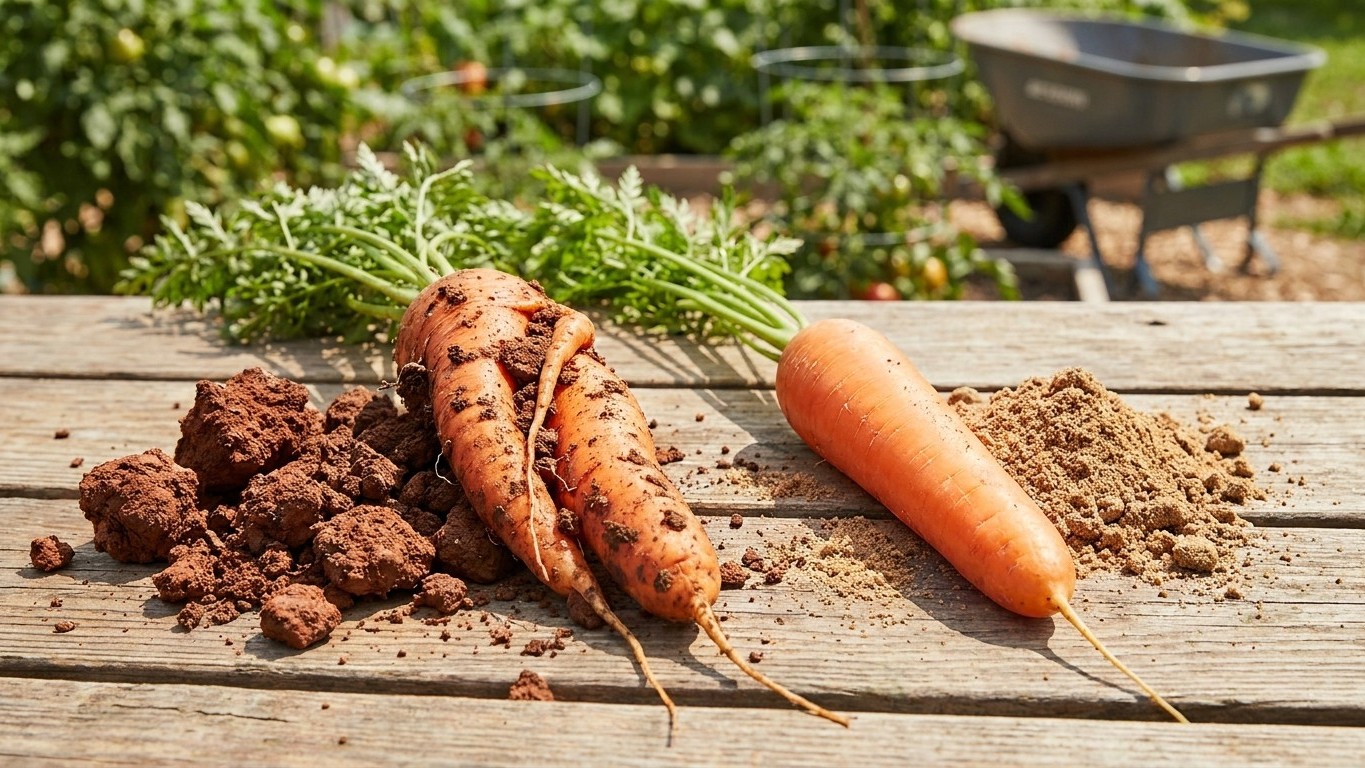

Start checking carrots about 65 to 75 days after planting, the window Clemson Cooperative Extension gives, and keep counting toward 70 to 100 days from seeding if the roots are still slim. Carrots are sown in place, so the clock starts the day the seed goes in. Once they’re out, cut the tops off right away and hold the roots at 33 °F with high humidity. Montana’s ground adds a wrinkle: it can make roots fork long before harvest day.
The short answer
What the state soil says
Montana’s official state soil is the Scobey series, a Mollisol, the deep, dark prairie type of ground that built the Corn Belt. USDA NRCS records its surface horizon as clayey: 35 percent sand, 31 percent clay and 34 percent silt. Organic matter sits at about 2.0 percent, surface pH at about 7.0 (near neutral), and the drainage class is well drained. Those are representative values for the major components of the series as mapped (36 of them in the query), not a reading from a worked garden bed.
Put that next to what carrots want. Utah State University Extension describes the ideal as deep, sandy, well-drained soil rich in organic matter, and it warns that heavy or rocky soil makes the root fork. Scobey gets one thing right, since it drains well. But sand is the smallest-but-one share of the mix, clay is close to a third, and 2.0 percent organic matter is modest. Left as it is, ground like this tends to set firm around a taproot, and a taproot that meets resistance splits into two or three legs.
So yes, a carrot is likely to fork in Scobey-type ground if you simply scratch a row and sow. Fertility isn’t the issue (Mollisols are famously productive). Texture and compaction are. For a closer look at that, see Will Carrots Fork in Montana Soil?
What fixes it
Utah State University Extension’s answer for heavy soil is plenty of compost and double digging. Double digging means loosening the bed in two layers, working compost into the top and breaking up the layer beneath without burying the topsoil, so the root has loose ground to travel through. Where the ground is very heavy, rocky or scraped by a builder, a raised bed filled with loose, compost-rich mix sidesteps the problem. A different variety won’t solve a texture problem.
One caution matters more than any percentage above. A state spans hundreds of soil series, and Scobey is a starting point, not a diagnosis. River bottoms, hill country and any lot a builder has graded or filled can look nothing like it. Your own garden may be sandier, stonier or heavier. The next section shows how to find out.
The test that settles it in your own garden
Nothing on this page can tell you what is under your rows. An hour with a spade can, and it costs nothing. Do these steps in order, on a day when the soil is damp but not soggy.
- Dig a hole deeper than the longest carrot you hope to grow. Go slowly and keep the soil you remove on a tarp so you can see how it layers.
- Look at the wall of the hole. Note where the dark topsoil ends and paler ground begins, since a thin topsoil over hardpan gives roots only a short run. Count the stones and look for a packed layer where the spade struggled. Stones and compaction are what bend a taproot.
- Feel the texture. Take a pinch of damp soil from the depth where the root will grow and rub it between finger and thumb. Gritty means sand. Smooth and floury means silt. Sticky, and able to be rolled into a shiny ribbon, means clay. A ribbon that holds together and shines points toward the heavy end.
- Watch the drainage. Fill the hole with water, let it empty, then fill it again and watch how long the second filling takes to disappear. Water that lingers means the bed needs raising or loosening. Water that vanishes quickly is the well-drained behavior carrots like.
- Send a sample for a soil test. Your county Extension office can tell you where. The test gives your own pH and organic matter numbers, which no state profile can supply.
If the hole shows loose, deep, crumbly ground, sow with confidence. If it shows stones, a hard layer or a sticky ribbon, amend first. Compost and double digging will do more for straight roots than any seed packet.
For the full picture on sowing, spacing and care before harvest, see Growing Carrots in Montana.
What goes wrong here
Montana’s heavy ground, hot spells and uneven moisture cause a short, predictable list of failures. Most are preventable before the seed goes in.
- Forked or stubby roots in heavy ground. Clay-leaning soil, stones or a compacted layer make the taproot split. Remedy: work in plenty of compost, double dig, pick out stones, or grow in a raised bed filled with loose mix. Fresh manure worked in just before sowing can also cause forking, so use finished compost.
- Patchy germination in a hot spell. Carrot seed is slow, and a crust forming on clay-rich soil or a dried-out seedbed can leave gaps in the row. This page holds no published temperature cutoff for germination, so watch the surface instead. Remedy: keep the seedbed evenly damp until seedlings show, water lightly and often, and lay a board or burlap over the row for the first days, lifting it as soon as green appears.
- Splitting from uneven water. A dry stretch followed by a soaking makes roots swell faster than their skins can stretch. Remedy: water on a steady schedule rather than in floods, mulch to even out moisture swings, and pull roots at the right time rather than leaving them to overgrow in a wet spell.
- Chewed or tunneled roots. Not a soil failure, but it looks like one at harvest. The timing of the damage tells you which pest is at work, and What Eats Carrot in Montana, and When walks through it.
- Soft, sprouting or wilted roots in storage. The tops are the catch. Leaves keep drawing moisture out of the root, which is why bunched carrots with tops on keep about 10 to 14 days, while trimmed ones keep for months. Remedy: cut the tops off right after pulling. Clemson Cooperative Extension says to store carrots at 33 °F with high humidity to prevent wilting. That is just above freezing, not cellar temperature, and a cellar near 50 °F costs you the crop to sprouting and softening in a fraction of the time.
Straight, sound roots at harvest come mostly from what you did months earlier, in the bed, before a single seed went in.
Common questions
How many days until I can pull carrots?
Clemson Cooperative Extension says to harvest about 65 to 75 days after planting. Carrots generally run 70 to 100 days, counted from seeding. Start checking at the early end and pull a test root to see whether it has reached a size you like.
Do I count from transplanting?
No. Carrots are sown in place and never transplanted, so there is no transplant date. Count from the day you seeded the row.
How should I store carrots after pulling them?
Cut the tops off first, because leaves keep pulling moisture out of the root. Then hold the carrots at 33 °F with high humidity, per Clemson Cooperative Extension. Bunched carrots with tops on keep about 10 to 14 days. Trimmed ones last far longer, in the range of months.
Will my carrots fork in Montana soil?
Montana’s state soil, the Scobey series, is 31 percent clay and well drained, so it leans heavy. Forking is likely without amendment, but your garden may differ. Do the digging test above, and if the ground is heavy or stony, add compost and double dig or build a raised bed. The state soil data comes from USDA NRCS, and the forking warning comes from Utah State University Extension. A pH of about 7.0 is what USDA records for the mapped series, not a number for your bed. A soil test gives yours.