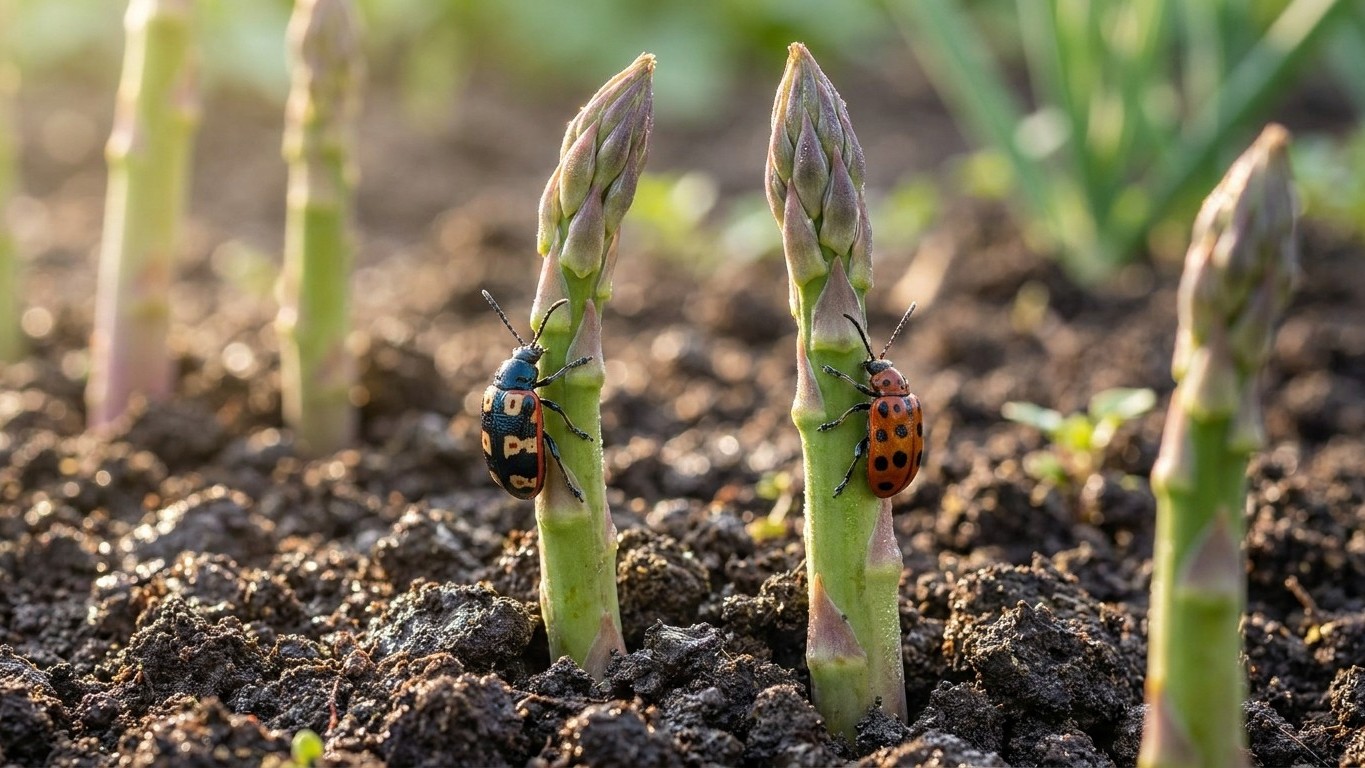

No pest calendar sits behind this page, and inventing one would be worse than skipping it. What the sources do cover is what an Indiana bed has to get through over 10 to 15 years: ground that drains, summer rain that may or may not keep up, and a last spring frost. Indiana’s representative soil drains moderately well, June through August brings about 12.6 inches of rain, and crowns go in around mid-April. For insect names and dates, your county extension office is the right call. The wider picture is in Growing Asparagus in Indiana.
The short answer
Start with the ground, because this is the one crop where you pick a spot and live with it. Asparagus goes in as crowns, is not harvested until year 3, and then produces for 10 to 15 years. The only soil requirement in the Utah State University Extension guidance is that the bed drains: most soils will do, provided they are well drained. A tomato bed in bad soil costs you one season. An asparagus bed in bad soil costs you the better part of two decades.
The soil USDA lists as representative of Indiana is the Miami series, an Alfisol. That is a forest soil of moderate fertility that holds nutrients reasonably well. The surface layer is loam to silt, at 30 percent sand, 20 percent clay and 49 percent silt, with organic matter around 2.0 percent. USDA’s records put the surface pH at about 6.5, slightly acid. That number describes the mapped series, not your yard, and the asparagus source says nothing about pH, so there is no target to chase here. The drainage class is the line that matters: moderately well drained.
Is that good enough? Mostly, with a caveat. “Moderately well” sits one notch below the “well drained” the source asks for. A silt loam with only 20 percent clay will usually shed extra water at a workable pace, and it will not dry out the way sand does. But it can stay wet in a low corner or after a run of rain. The furrow planting makes this sharper. A trench dug in slow soil can act like a shallow bathtub around the crowns. That is my reading of the method, not something the source states, but it is a good reason to be picky about where the trench goes.
Treat all of this as a starting point. A state spans hundreds of soil series. River bottoms, hill country, and any lot a builder has scraped or filled can behave nothing like the Miami series. If your plot holds water long after the rain has stopped, you have three sensible moves: pick higher ground, build the bed up above the surrounding grade, or plant something else. A soil test through your county extension office gives you your own numbers. For a closer look at the fifteen-year question, read Will Indiana Soil Hold an Asparagus Bed for Fifteen Years?
Will the summer here water it for you?
Mostly, on paper. The bed wants 1 to 2 inches every other week for the first two years, then every three weeks after that. June, July and August add up to roughly 13 weeks, so that is six or seven waterings, or about 6 to 13 inches. The reference station for Indiana (Indianapolis, NOAA’s normals for the most recent 30-year period) records about 12.6 inches across those three months, out of 43.6 inches for the whole year. Here is how it plays out month by month.
- June, 4.95 inches. That is about four and a half weeks, or two waterings of 1 to 2 inches each (2 to 4 inches in all). Average rainfall covers it with room to spare.
- July, 4.42 inches. The need is the same two waterings, and the normal rain again covers it.
- August, 3.2 inches. This is the driest of the three, and it lands in the middle of a 2 to 4 inch need. If your gauge shows less than an inch over a two-week stretch, that is your cue to water.
- Year three onward. Watering drops to every three weeks, about four soakings across the summer. The normals cover that comfortably, but dry spells still call for a hose.
By the averages, then, the gardener adds little in a typical summer and a good deal in a dry one. Averages hide two things, though. One is delivery: a single thunderstorm mostly runs off rather than soaking in, so 2 inches in an hour is not the same as 1 inch a week apart. The other is heat. Hot spells evaporate moisture from the surface quickly, and a bed that looked fine on paper can be dry an inch or two down.
Soil works in your favor here. The Miami series is silt loam, which holds water far longer than sand does. A sandy yard in the same wet summer could need watering every couple of days, while a silty one coasts between storms. These figures are normals for one station over three decades. They are not a forecast, and a slope, a windbreak or a city block changes them. A cheap rain gauge on your own plot settles it better than any table can.
When to put the crowns in
Early spring is the window, and in Indiana that points to around the second and third weeks of April. NOAA’s normals for the Indianapolis station put the last 32°F freeze between about April 9 and April 21, using the 30 to 70 percent probability band. Mean dates are averages, so some years will break either way. Southern Indiana usually runs earlier than the north by a fortnight or more, so a garden near the Ohio River can reasonably start ahead of one near Lake Michigan.
Purdue adds a caution worth keeping in mind: there is still roughly a 10 percent chance of a 32°F night after the published spring date. If you plant on the early edge of the range, keep something handy to cover the bed. The asparagus source does not give a cold tolerance for crowns, so I will not guess at one. For a fuller look at timing decisions, see When to Plant Asparagus Crowns in Indiana.
The furrow, the backfill and the wait
Crowns go into furrows about 8 inches deep. The furrow is not filled in at once. Instead, you backfill gradually through the year, about 2 inches every other month. After that comes the long wait: no harvest until year 3. Then the picking season runs 4 weeks, then 6 weeks, then 8 weeks in successive years. The end-of-season rule is a thing you look at, not a date: stop when most spears are thinner than a pencil. Nothing in the source permits “just a few spears” earlier than that.
Crowns or seed
Seed is the alternative route to crowns. The source used here gives no sowing dates and no seed timetable, so check the packet and ask your county extension office rather than relying on a number from me. On varieties, four are named, and only by sex: Jersey Giant and Jersey Knight are all-male, while UC 157 F1 and Purple Passion are male and female. The source says nothing about flavor, yield or why you would prefer one over another, so pick on availability.
Common questions
What actually eats asparagus in Indiana?
The sources behind this page do not list pests, so there are no insect names or timing windows here. Your county extension office can tell you what is active locally and when to scout.
How long until I can harvest?
Not until year 3. The first harvest runs 4 weeks, the next year 6 weeks, then 8 weeks. Stop when most spears are thinner than a pencil, and the bed can then produce for 10 to 15 years.
Can I plant in heavy, slow-draining soil?
The source’s one soil requirement is good drainage, and it calls for well-drained ground. If water lingers in your spot, move to higher ground or build the bed up. A soil test from your extension office will show what you are working with.
How should I store fresh spears?
Aim for 32 to 35°F with near-saturated air, about 95 to 100 percent humidity, according to UC Davis Postharvest. Above 50°F the spears toughen within hours, and at about 31°F or lower they freeze and go mushy when thawed. In a home kitchen, stand the cut ends in water or wrap them damp, since spears lose moisture fastest through the cut end.