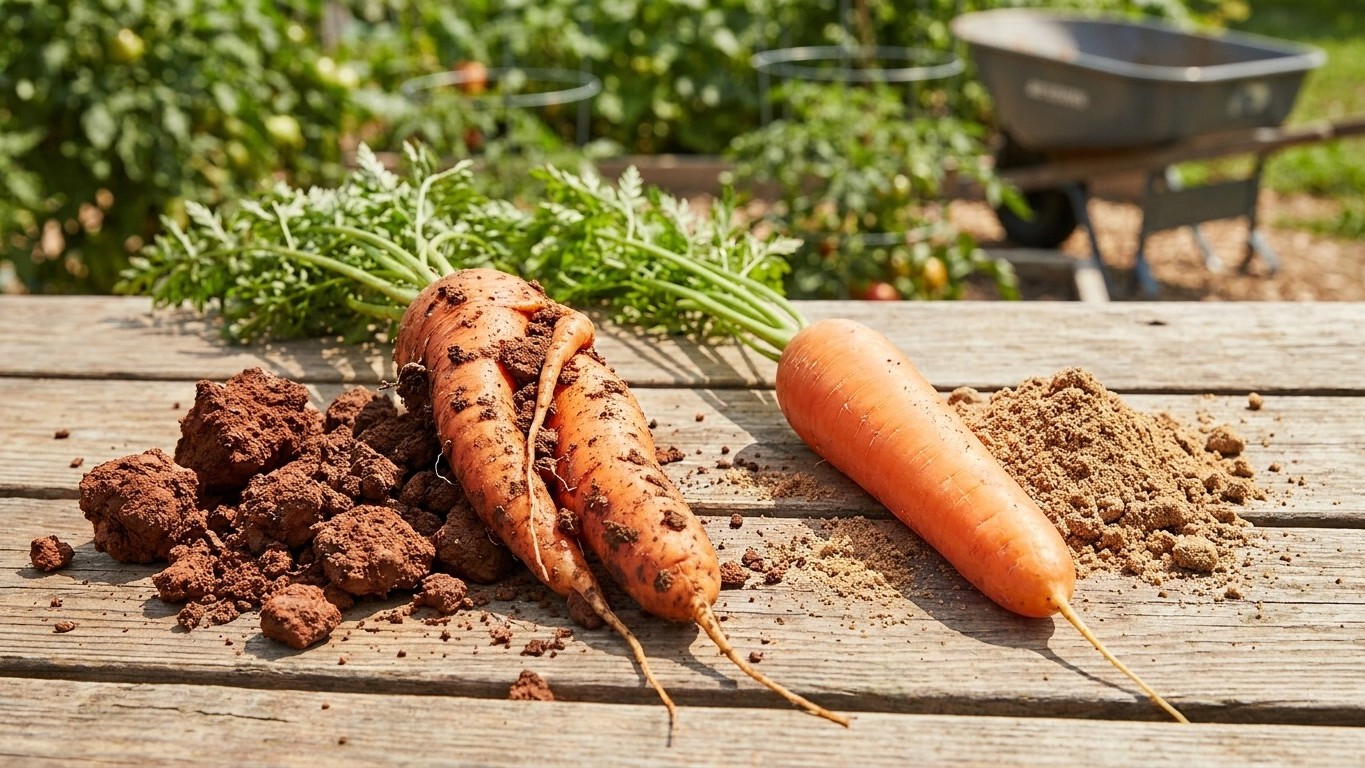

Pull carrots about 65 to 75 days after planting, according to Clemson Cooperative Extension. Since carrots are sown in place and never transplanted, count those days from the day the seed goes in. Seed-to-harvest times for the crop run 70 to 100 days. To keep them, cut the tops off first, then hold the roots near 33 °F with high humidity. The details below are tuned to Newfoundland and Labrador ground. The wider picture is in Growing Carrots in Newfoundland and Labrador.
The short answer
What the province’s ground tends to be
Across the mapped agricultural surface of Newfoundland and Labrador, the most common soil is a Podzol, the acid, leached soil that forms under conifers, where rain has washed the bases out of the top layer. It covers 59 percent of the mapped surface, with Organic soils next in line. The median surface layer is a loam to silt: 56 percent sand, 9 percent clay and 35 percent silt. Organic matter sits around 3.3 percent. The median surface pH is about 4.3, which is strongly acid. Drainage is imperfectly drained.
Those numbers come from Agriculture and Agri-Food Canada’s Canadian Soil Information Service, from 459 mapped soil components. Canada has no official provincial soil the way an American state has a state soil, so there is no single named series to point to. This is the dominant profile, the commonest order with the median of its measurements. The survey also covers farmland regions only, so the far north of Labrador is not represented. Organic matter was estimated from measured organic carbon using the conventional 1.724 factor.
Will a carrot fork in it?
Utah State University Extension describes the ideal carrot ground as deep, sandy, well-drained soil rich in organic matter. It also says heavy or rocky soil makes the root fork. Hold the provincial profile up against that. Only 9 percent clay is low, and more than half the mineral fraction is sand, so the texture leans toward what carrots like rather than away from it. The weak spot is the drainage. Imperfectly drained ground stays wet longer than a carrot bed should, and a root that meets a soggy pocket or a buried stone tends to split into legs.
So on the median profile, forking is not a foregone conclusion, but it is a real risk wherever water lingers or stones lurk. The fix follows the Extension advice: work in plenty of compost and double dig, or build a raised bed where the ground stays wet. A different variety does not solve it, and the source names none.
Now the caveat, and it matters. A province spans hundreds of soil series, and this median is a starting point, not a diagnosis. River bottoms, muskeg, and any lot a builder has scraped or filled can be nothing like it. The pH of 4.3 is the province’s median, not yours. The source gives no pH target for carrots, and no liming figure is published here, so get your own number from a soil test. The Will Carrots Fork in Newfoundland and Labrador Soil? page goes deeper on the forking question.
The test that settles it in your own garden
Your backyard is not the provincial median, and an hour with a spade tells you more than any survey. Do this in the spot where you plan to sow, and ideally after a stretch of normal weather rather than right after a downpour or a dry spell.
- Dig a hole with a spade, straight down and wide enough to see the walls. Work in the exact bed you intend to use, not the nicest corner of the yard.
- Look at the depth of loose, dark topsoil, and note where it gives way to something harder, paler, or stonier. A carrot root wants a clear run downward. A hard layer or a pocket of rocks near the surface is where forking begins.
- Pull out the stones and count them by eye. A few are a nuisance. A hole that keeps yielding rocks tells you the bed needs sifting or a raised frame.
- Squeeze a moist handful. Sandy soil feels gritty and falls apart. Silt feels smooth and floury. Clay feels sticky, holds a shape, and polishes to a shine under your thumb. A loam to silt sits somewhere in between, and heavy clay announces itself quickly.
- Fill the hole with water and let it drain, then fill it again. Watch how the second filling behaves. If the water is still sitting there long after the rest of the garden has dried, you have poor drainage, and that points to a raised bed or heavy compost.
- Send a sample to a soil lab for pH and nutrients. Your hand and your eyes cannot read acidity, and the lab result is the only number that belongs to your garden.
No figure here is a pass mark, because the facts behind this page carry none for depth, stones, or drainage time. The test is comparative: you are looking for loose, deep, stone-free ground that sheds water. If the bed fails one of those checks, amend it with compost and double dig, or build up. If it fails all of them, go straight to the raised bed.
What goes wrong here
Some failures come from the ground, others from the weather, and a few from what happens after the harvest. These are the ones to plan around, each with its remedy.
- Forked, stubby, or twisted roots: Heavy or rocky ground is the cause. In imperfectly drained soil, water pockets and stones push the root sideways. Work in plenty of compost, double dig to loosen the layer below, pull out the stones, or move up to a raised bed. Changing the variety is not the answer.
- Poor germination in a hot spell: Carrots are sown in place, so there is no second chance from a tray of seedlings. If a warm, dry stretch follows sowing, the surface dries out and the seed stalls. Keep the seedbed evenly moist until the rows show, and re-sow gaps early rather than waiting. The days to harvest then run from the day of the successful seeding.
- Splitting from uneven water: A long dry stretch followed by a soaking rain makes the root swell faster than its skin can stretch. Water steadily through dry spells so the moisture level stays even, and mulch to hold it.
- Wilting in storage: Carrots lose moisture fast. Clemson recommends storing them at 33 °F with high humidity to prevent wilting.
- Sprouting and softening: 33 °F is just above freezing, not a typical cellar temperature. A reader who stores carrots at 50 °F loses them to sprouting and softening in a fraction of the time.
- Leaving the tops on: The leaves keep drawing moisture out of the root. Bunched carrots, with the tops still on, keep about 10 to 14 days, while trimmed ones keep for months. So cut the tops first, right after the harvest.
Pests are a separate problem with their own calendar. What Eats Carrot in Newfoundland and Labrador, and When covers what to watch for through the season.
Common questions
How do I know it’s time to pull a carrot?
Count from seeding. Clemson Cooperative Extension says to harvest about 65 to 75 days after planting, and the broader range for the crop is 70 to 100 days. You can brush the soil from the top of one root to check its thickness. A carrot is never transplanted, so there is no transplant date to count from.
Is there a frost date that tells me when to pull?
No frost date for Newfoundland and Labrador is published here, so none is given. Count the days from seeding, then check your own garden and local conditions.
How long will harvested carrots keep?
Clemson says bunched carrots, with the tops still on, keep about 10 to 14 days. Trimmed ones keep for months. Cut the tops right away and store them at 33 °F with high humidity.
Do I need a special variety to avoid forking?
No. The source names no variety. The answer to forking is the ground itself: plenty of compost and double digging, or a raised bed.
One last point on storage. Clemson’s 33 °F sits only a degree above the freezing point of water, so a thermometer is worth having wherever you keep the roots. A fridge drawer set too cold can freeze them.