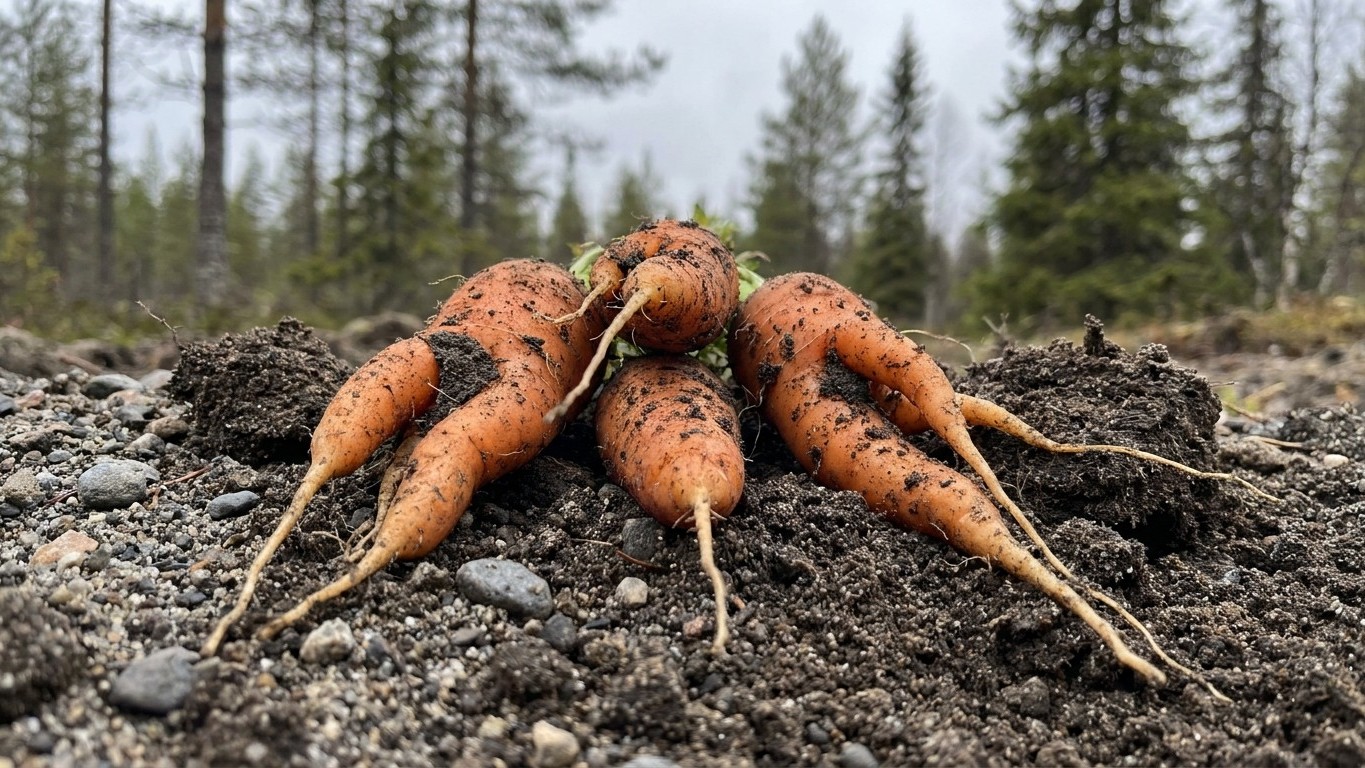

Newfoundland and Labrador’s ground runs acid and sandy, and it drains slower than it looks. On paper, that’s not the recipe for forked carrots the way heavy clay is. But the province’s short, cool season and its patchy drainage change the sowing math more than the soil texture does. Here’s what actually decides whether your carrots come out straight.
The short answer
The most common soil across Newfoundland and Labrador’s mapped agricultural ground is a Podzol, the acid, leached soil type that forms under conifer cover, where centuries of rain have washed the bases out of the topsoil. It covers 59 percent of the mapped surface, with Organic soils as the next most common type behind it. The median surface pH comes in around 4.3, which is strongly acid, well below what most root crops prefer. Texture-wise, the median reading is 56 percent sand, 9 percent clay and 35 percent silt, a loam to silt loam that leans sandy rather than heavy. Organic matter sits around 3.3 percent. Drainage is classed as imperfectly drained.
That combination is a mixed bag for carrots. The clay share is low, only 9 percent, so this isn’t the dense, sticky ground that typically splits a taproot in two. But imperfect drainage means water sits longer than it should after rain or snowmelt, and Podzols under conifer cover often carry stones and root debris close to the surface, both of which can deflect a growing root just as effectively as clay does. Utah State University Extension is blunt about this: carrots want deep, sandy, well-drained soil rich in organic matter, and heavy or rocky ground makes the root fork. Here, it’s less about clay content and more about stones, compaction and standing water.
The fix follows the same logic either way. Heavy or obstructed soil needs plenty of compost worked in and double digging to open up a foot or more of loose ground, or a raised bed filled with a looser mix if the native soil is too shallow, too stony or too wet to fix in place. Compost also does double duty here, since it lifts organic matter and buffers some of that acidity, though a soil test is still the only way to know how much lime, if any, your particular patch needs. Getting the timing right matters just as much as the soil prep, so see When to Sow Carrots in Newfoundland and Labrador for guidance on when to put seed in the ground.
None of this is a diagnosis of your yard. Newfoundland and Labrador’s agricultural land spans hundreds of individual soil series, and the median figures above describe the province’s mapped surface horizons as a group, not any one garden. A bottomland near a river, a patch of muskeg, or ground a builder scraped and refilled decades ago can sit nowhere near that median. For a closer look at Will Carrots Fork in Newfoundland and Labrador Soil?, treat this as the region’s general tendency, sandy loam, acid, slow to drain, and confirm your own dirt before you commit a season to it.
The test that settles it in your own garden
The provincial figures tell you what the ground tends to do across the mapped agricultural region. Only your own soil tells you what it will do under your carrots. None of the steps below need a lab, just a spade, a bucket and some patience.
- Dig a test hole a foot deep. Carrots need loose ground to at least that depth for a straight root; if your spade hits a hardpan, a rock layer or standing water before then, that’s your limiting factor, not the soil chemistry.
- Look at what comes out. Count the stones and root fragments in the spoil. A handful per shovelful in the top foot is enough to fork a carrot as it pushes down.
- Feel the texture between your fingers. Rub a moist handful of soil. Gritty and loose suggests a sandy profile like the provincial median; sticky and cohesive when wet, then brick-hard when dry, points to more clay than the regional average.
- Watch how water drains. Fill the same hole with water and time how long it takes to disappear. Water still sitting there after several hours is a strong sign of the imperfect drainage the provincial data already flags as common, and it argues for raised beds or drainage work before you sow.
When to sow here
Carrots are sown as seed directly in the ground, never started indoors and transplanted, so every date below counts from the seeding day itself. The window is built backward from the average last spring frost.
- Start from the frost date. At the St. John’s climate station, the average last spring frost falls on May 30, based on Environment and Climate Change Canada’s Canadian Climate Normals data. That’s a mean, not a guarantee: in roughly one year out of two, the last frost lands later than that date, so treat it as the middle of a window rather than a safe deadline.
- Check the soil, not the calendar. Carrot seed needs soil at a minimum of 40 degrees Fahrenheit to sprout at all. A thermometer pushed a couple of inches into the bed beats guessing from the date on the wall, especially on ground that drains as slowly as much of this province’s soil does.
- Sow two to three weeks ahead of that average frost date. Counting back from May 30 puts direct sowing somewhere in the second half of May for most of the region, once the soil itself has cleared that 40 degree floor.
- Expect the fastest, most even germination between 55 and 65 degrees Fahrenheit. Soil that’s merely thawed but still cold will sprout slowly and unevenly; soil in that range gets seedlings up together, which matters later for thinning and for even root size at harvest.
- Remember the location bias. May 30 comes from a single coastal station. Inland, upland or more northerly parts of the province typically run behind it, sometimes by a good margin, so gardeners outside the immediate St. John’s area should lean toward the later end of that sowing window rather than the earlier one.
What goes wrong here
- Forking roots in stony, imperfectly drained ground. This is the province’s signature problem given the soil profile above: not heavy clay, but stones, compacted subsoil and slow drainage deflecting the taproot. The fix is the same one Utah State University Extension gives for any obstructed soil, work in generous compost and double dig the bed, or switch to a raised bed filled with a loose, stone-free mix.
- Weak or patchy germination from cold soil. Sowing before the ground reaches that 40 degree floor, or during a stretch that stays below the 55 to 65 degree sweet spot, leaves gaps in the row and uneven seedling emergence. Wait for the soil thermometer, not the calendar page.
- Splitting from uneven moisture. Roots that dry out, then get soaked by a heavy rain on this slow-draining ground, can split along their length as they swell unevenly. Consistent watering, and a raised bed or amended row that drains between rains rather than holding water, keeps growth steady instead of stop-start.
- Acidic soil limiting root development. A median surface pH near 4.3 is strongly acid, and while the source data doesn’t give a target pH or a lime rate for carrots, chronically sour soil is worth ruling out with a proper soil test rather than guessing at correction.
Checking this against your own county
The provincial figures above describe the mapped agricultural region as a whole, and your own yard, whether it sits on a coastal terrace, a river flat or filled ground near a newer subdivision, can differ from that median by a wide margin. Newfoundland and Labrador’s Department of Fisheries, Forestry and Agriculture is the place to ask about local soil conditions, frost patterns specific to your district and any recommendations tailored to your part of the province rather than to a single climate station or a provincewide average.
Common questions
Does Newfoundland and Labrador’s acidic soil actually hurt carrots?
Strongly acid soil, and the median here sits around pH 4.3, can limit root development, though the source data behind this page doesn’t give a target pH or a correction rate for carrots specifically. A soil test is the only reliable way to know whether, and how much, your particular bed needs adjusting.
Is Newfoundland and Labrador’s soil too sandy or too heavy for carrots?
Neither, on the median figures. At 56 percent sand and only 9 percent clay, the province’s typical agricultural soil leans sandy loam, which suits carrots well. The bigger obstacles are the stones and organic debris common in Podzols and the imperfect drainage that leaves ground wetter than carrots prefer.
Can I sow carrots before the last frost date in this province?
Yes, and it’s the standard approach: sow two to three weeks before the average last frost, provided the soil itself has reached at least 40 degrees Fahrenheit. Carrot seed and young seedlings tolerate cool soil far better than most vegetables, but the soil temperature threshold still has to be met first.
Why did my carrots fork even though my soil isn’t clay-heavy?
Clay isn’t the only cause. In this province’s typical Podzol, stones, root fragments and a compacted or waterlogged subsoil layer can deflect a taproot just as easily as dense clay does elsewhere. The remedy is the same either way, generous compost worked into a deeply dug bed, or a raised bed with a loose, stone-free fill.