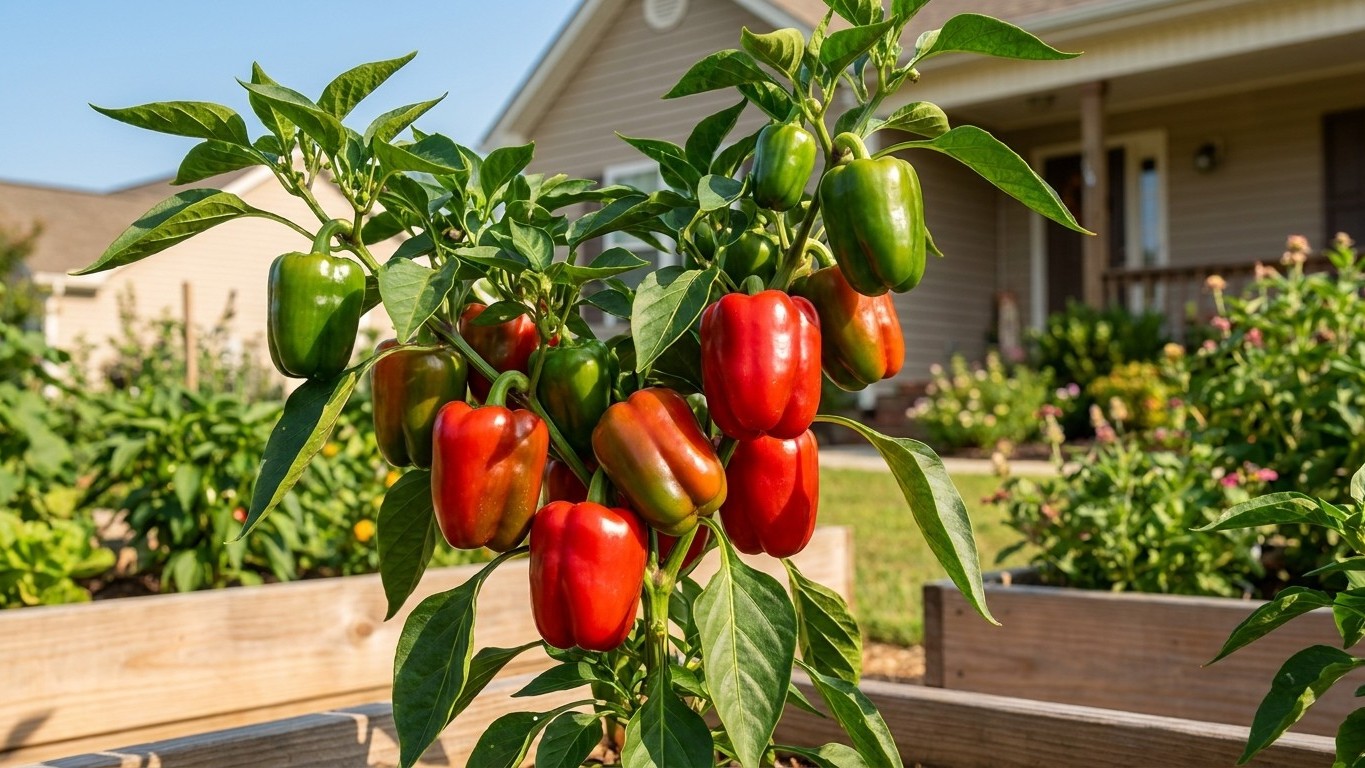

In South Carolina, the thing that eats most into a pepper crop is weather, not a bug. Charleston, this site’s reference station, logs 55.1 days a year at 90 F or more, and pepper flowers stop setting fruit in that heat, just as they do on nights under 55 F. Insect pest calendars aren’t published here, so this page covers what the climate does to the plants and how to time around it.
The short answer
The hot end
Fifty-five point one days. That is how many days a year reach 90 F or more at Charleston, per NOAA’s most recent 30-year climate normals, and it adds up to nearly eight weeks of the calendar. The number measures heat load, not average summer temperature, so a summer can feel ordinary and still stack up dozens of days over the line.
Utah State University Extension states the rule for peppers plainly: fruit set fails when days climb above 90 F. Blossoms open, then drop, and nothing forms behind them. Set that beside 55.1 and a South Carolina pepper plant clearly spends a real slice of its life in weather that stalls fruiting. The plant itself usually survives. It just stops turning flowers into peppers until the heat breaks.
One caution on the count: it comes from a single reference station on the coast. Gardens farther inland may run differently, and this site doesn’t carry a separate figure for them.
The cool end
The same Utah State source names the other failure. Nights below 55 F also stop fruit set. This is where pepper growing gets tricky, because peppers fail at both ends and most advice only warns about the hot one.
This site does not carry summer night minima, and nights can’t be guessed from latitude or from how cold the winter gets. So the job falls to you. A cheap min-max thermometer on a stake near the plants will tell you each morning what the night actually did. Check it through late spring, when transplants are just starting to flower, and again in early fall, when the season is winding down. A few lows under 55 F while blossoms are open is your cue that drop is coming, and a light row cover on those evenings can take the edge off.
The productive window sits between those two limits. Timing the crop so flowering lands inside it is most of the game, and the next section shows how to work backward to a seed-starting date. For the mechanics of what happens inside the flower, see Why Peppers Fail to Set Fruit in South Carolina. The broader picture lives in Growing Peppers in South Carolina.
When to start seed here
No single date works statewide, because the coast and the Upstate sit weeks apart. What works everywhere is the arithmetic. Start from the day you’ll transplant and count backward.
- Find your frost window. For the Charleston area, NOAA’s 30-year normals put the 30 to 70 percent band for the last 32 F freeze between February 28 and March 17 (station USW00013880). That station is the airport, and peninsular Charleston runs milder. Upstate South Carolina runs several weeks tighter at both ends of the season, so expect a later spring date there.
- Wait for 60 F soil. Passing the last frost is not enough. Utah State Extension says to transplant when the soil reaches 60 F, after frost. Push a soil thermometer a few inches down in the morning. In a cool spring the soil can lag well behind the calendar, and this site doesn’t publish a soil-temperature date for your county.
- Pick the later of the two. Your transplant date is whichever comes last: the end of your frost window or the day the soil hits 60 F.
- Subtract 8 to 10 weeks. That is how long transplants need indoors. Eight weeks is 56 days and ten weeks is 70 days, so count back that far from your transplant date. The result is your sowing window.
- Check the far end. Clemson Extension says peppers should be ready for harvest in about 70 to 85 days after transplanting. Add that to your transplant date and see where first harvest lands compared with your hottest stretch. Varieties that ripen sooner give you more room, which is the subject of Pepper Varieties That Ripen in a South Carolina Season.
A worked example
Say your soil thermometer reads 60 F on April 10. That date is invented for the exercise, not a forecast for any county. Counting back 56 days lands on February 13, and counting back 70 days lands on January 30. Sow somewhere between those two dates.
Now run it forward. April 10 plus 70 days is June 19, and plus 85 days is July 4. That is the first-harvest window, and it means the plants will be flowering well before the worst of the heat arrives. Redo the same sums with your own soil date and you have a plan specific to your yard.
Starting earlier than ten weeks buys nothing if the soil isn’t ready. Plants just sit in pots outgrowing their space while you wait on the ground.
What goes wrong here
South Carolina’s heat, sun and rain patterns produce a predictable set of pepper problems. Three of them account for most of the lost fruit in home gardens.
- Blossom drop. Flowers fall off with no fruit behind them. The trigger is a hot spell with days above 90 F or a cool night under 55 F, and with 55.1 hot days a year on the coast, the heat version is common. Remedy: on hot afternoons, give plants some shade cloth and keep the soil evenly moist. On cool nights, cover them with row cover. Go easy on nitrogen, since a leafy plant with few flowers is a different problem from drop. Log your own nights with a thermometer, because this site can’t supply them.
- Sunscald. Pale, papery, sunken patches show up on the side of the fruit facing the sun. The sun here is strong enough to cook exposed peppers, and it happens most when leaves have been lost to disease, heavy pruning or a rough storm. Remedy: keep the leaf canopy intact, never strip foliage to “help” fruit ripen, and use cages or stakes so branches don’t splay open. Shade cloth over the worst afternoon stretch helps too. Scalded spots invite rot, so pick affected fruit promptly.
- Blossom-end rot. A dark, leathery patch spreads across the bottom of the fruit. It is tied to uneven watering more often than to a shortage of calcium in the soil. Remedy: water deeply and on a steady schedule, mulch to hold moisture through dry spells, and get a soil test before adding lime or calcium. Piling on amendments without a test can make things worse.
Reading the pattern
These three problems overlap. A plant stressed by a heat spell drops blossoms, and the same plant swinging between drought and downpour is a candidate for end rot. Watering evenly and protecting the canopy addresses all three at once.
Common questions
How many 90 F days does South Carolina get?
At Charleston, this site’s reference station, the mean is 55.1 days a year at 90 F or more, based on NOAA’s most recent 30-year normals. It is a single-station figure, so inland gardens may see something different, and this site doesn’t publish separate counts for them.
Can I transplant as soon as the last frost passes?
Not necessarily. Utah State Extension says to transplant when soil reaches 60 F, after frost. In the Charleston area the last 32 F freeze falls between February 28 and March 17 in the 30 to 70 percent probability band, but soil can stay cooler than that date implies. Use a thermometer rather than the calendar.
Do cool nights really matter in a hot state?
Yes. Fruit set fails when nights fall below 55 F as well as when days pass 90 F. This site does not carry summer night minima, so you can’t read your own lows off a table here. Put a min-max thermometer near the plants and watch it, especially in late spring and early fall.
Where should I store harvested peppers?
Not in the refrigerator, which is the mistake nearly everyone makes. Clemson Extension gives the optimal storage conditions as 45 to 50 °F with 80 to 90 percent relative humidity. A home fridge runs colder than that, and below about 45 °F peppers pit and soften from chilling injury. Clemson’s “two to three weeks” is a ceiling under ideal conditions, not a guarantee, so a cool pantry or basement shelf will keep peppers only as long as those conditions hold. Read the full Clemson pepper factsheet for details.