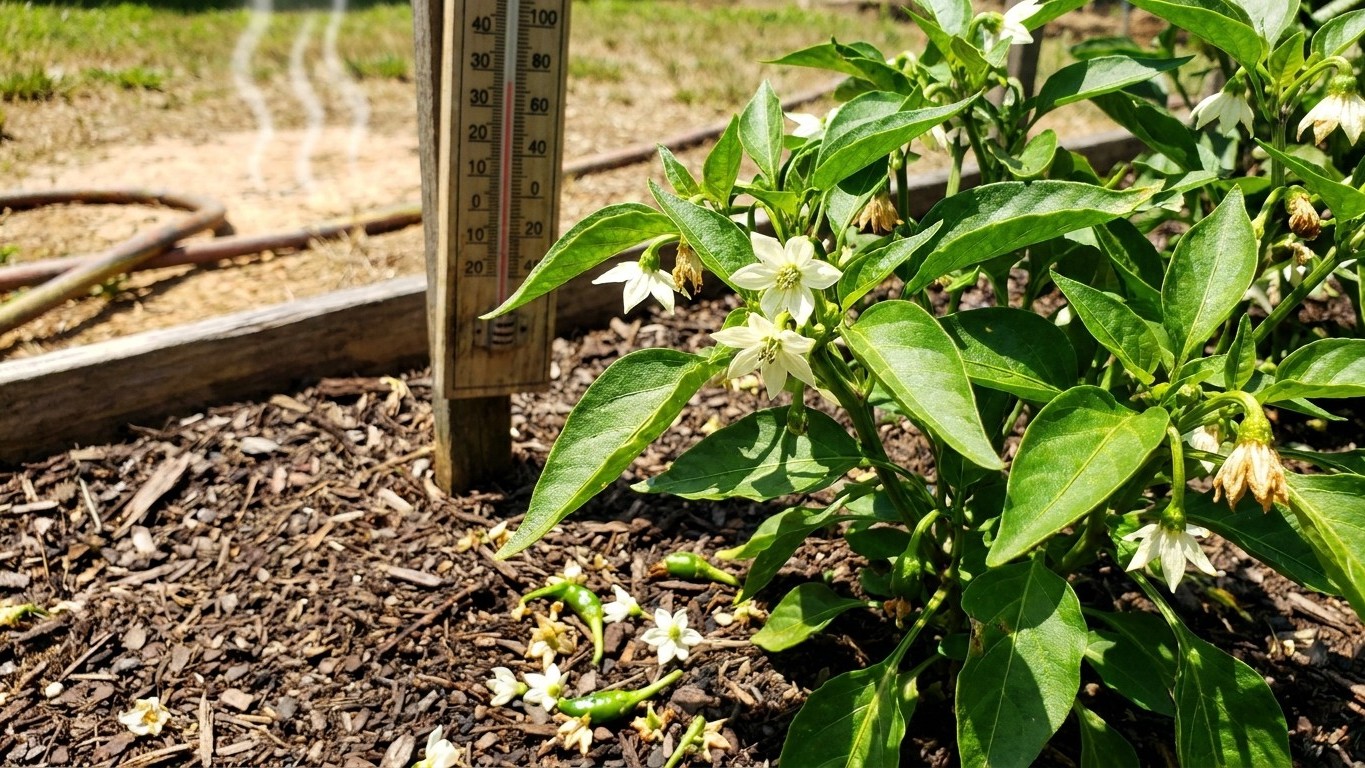

Pepper plants stop setting fruit in South Carolina mostly because of heat, and the numbers back that up: Charleston’s climate record shows 55.1 days a year at or above 90 F, which is more than enough time to shut down pollen viability for weeks at a stretch. The cooler failure point, nights under 55 F, matters too, but this site doesn’t track summer night lows for South Carolina, so that end of the range is on the grower to watch.
The short answer
Charleston’s climate normal of 55.1 days a year at or above 90 F isn’t spread evenly across the calendar. It bunches up in June, July, and August, which means a pepper plant flowering during a normal South Carolina summer can face two, three, sometimes four weeks running where daytime highs never drop below that mark. Pepper pollen gets sticky and non-viable once temperatures climb into the low 90s, especially when humidity is high, which it usually is across the Lowcountry and Midlands. The flower opens, nothing pollinates it, and it falls off the plant within a day or two. No blight, no pest, no disease. Just heat.
That 55.1-day figure comes from the Charleston reference station, and it’s a statewide benchmark, not a county-by-county guarantee. Inland areas of South Carolina, particularly the Sandhills and parts of the Midlands, tend to run hotter in midsummer than the coast, where sea breezes take some of the edge off afternoon highs. A grower in Aiken or Orangeburg should expect at least as many 90-degree-plus days as Charleston logs, possibly more, while someone gardening right on the coast may catch a slight break from onshore air. The practical move is to track your own local run of hot days rather than assume the state average applies exactly where you garden.
The other end of the failure window is cooler nights, and it works the same way in reverse. When nighttime temperatures drop below 55 F, pepper pollen becomes non-viable again, just from cold instead of heat. This shows up most often in early spring, right after transplanting, before nights have reliably warmed, and again in fall as the season winds down. This site doesn’t carry summer night minima for South Carolina, so there’s no published figure here to lean on for that threshold. The only reliable approach is watching your own overnight lows during the weeks your plants are flowering, especially in the first few weeks after you set transplants out, when a late cold snap can wipe out an entire flush of blooms before you even notice the flowers are gone.
When to start seed here
Working out a seed-starting date for peppers in South Carolina is a matter of counting backward from two conditions that both have to be met before transplants go in the ground: the last frost has passed, and the soil has warmed to 60 F. Here’s how the arithmetic works, step by step, so it can be redone for any county in the state.
- Find your local last spring frost window. For the Charleston airport reference station, NOAA’s 1991-2020 climate normals put the 30 to 70 percent probability band for a 32 F freeze between February 28 and March 17. Peninsular Charleston itself tends to run milder than that airport reading, while Upstate South Carolina runs several weeks tighter on both ends of the frost season, so an Upstate gardener should push this whole calculation later.
- Wait for soil, not just air, to hit 60 F. Air temperature can feel warm on a sunny March afternoon while the soil a few inches down is still cold from winter. Peppers don’t care how the air feels; they care about root-zone temperature, and Utah State University Extension is clear that transplanting should wait until the soil itself reaches 60 F, not just the calendar date past frost.
- Set your transplant date at whichever condition lands later. If your frost-free date falls in early March but soil hasn’t caught up to 60 F until three or four weeks later, plant by the soil temperature, not the frost date. In much of South Carolina, that gap between “frost is over” and “soil is warm enough” can run several weeks, particularly in a cool, wet spring.
- Count back 8 to 10 weeks from that transplant date for indoor seed starting. Utah State University Extension recommends starting pepper seed indoors 8 to 10 weeks before transplanting. If your working transplant date lands in mid-April, for example, seed should go into trays roughly between early and mid-February.
- Adjust the whole sequence for your region of the state. Coastal and Lowcountry gardeners working from a late-February to mid-March frost window can start seed as early as late December through January. Upstate gardeners, working from a later and tighter frost window, should shift their entire seed-starting calendar back by two to three weeks to match their local conditions.
What goes wrong here
- Blossom drop during a heat spell. Once daytime highs push into the low 90s and above, which happens on 55.1 days a year on the Charleston climate record alone, pollen loses viability and flowers drop without setting fruit. The remedy is timing: get plants flowering before the hottest run of summer sets in, and expect a lull in fruit set during the peak of a heat spell even on healthy plants. Shade cloth over the row during the worst afternoons can take a few degrees off the air around the flowers.
- Blossom drop after a cool night. On the other end, a night that drops below 55 F, whether from an early spring cold snap or a fall cool front, damages pollen the same way heat does. Since summer night lows for South Carolina aren’t published on this site, the only real defense is watching your own overnight forecast closely during flowering weeks and using row cover to buffer transplants set out early in the season.
- Sunscald on exposed fruit. South Carolina’s strong summer sun can scorch pepper fruit that loses its leaf cover, leaving a pale, papery patch on the side facing the sun. This tends to follow aggressive pruning or foliage loss from wind or disease. Keeping the plant’s natural leaf canopy intact, rather than stripping leaves to “let light in,” is the simplest fix, since the leaves are what shade the fruit in the first place.
- Blossom-end rot. A dark, sunken patch at the blossom end of the fruit is a calcium delivery problem, usually triggered by uneven watering rather than a true calcium shortage in the soil. South Carolina’s mix of heavy summer downpours and dry spells between them creates exactly the kind of inconsistent soil moisture that brings this on. Even, regular watering, along with a layer of mulch to hold soil moisture steady, addresses most cases without any need for a calcium supplement.
Common questions
Can peppers recover after a hot spell drops their flowers?
Yes. Blossom drop from heat doesn’t damage the plant itself, only the flowers that were open during the hot stretch. Once temperatures cool back down below the mid-90s, healthy plants typically resume flowering and setting fruit within one to two weeks.
Does South Carolina’s humidity make heat-related fruit drop worse?
Humidity isn’t part of the published figures here, but high humidity is generally understood to compound heat stress on pollen, since it slows evaporative cooling for the plant overall. In practice, South Carolina’s combination of high heat and high humidity during summer is a tougher combination for fruit set than dry heat alone.
Should Upstate South Carolina gardeners use a different transplant date than the Coast?
Yes. The frost data for the Charleston airport station doesn’t apply directly to the Upstate, where the frost season runs several weeks tighter on both ends. Upstate gardeners should build their entire seed-starting and transplant schedule around their own local frost window rather than the coastal dates.
What pepper varieties handle South Carolina’s climate best?
Utah State University Extension names several pepper varieties suited to home gardens but doesn’t publish heat tolerance ratings, days-to-maturity figures, or fruit size for any of them. Without that data attached to specific names, the more reliable strategy for South Carolina is managing planting timing and watering consistency rather than relying on variety choice alone.