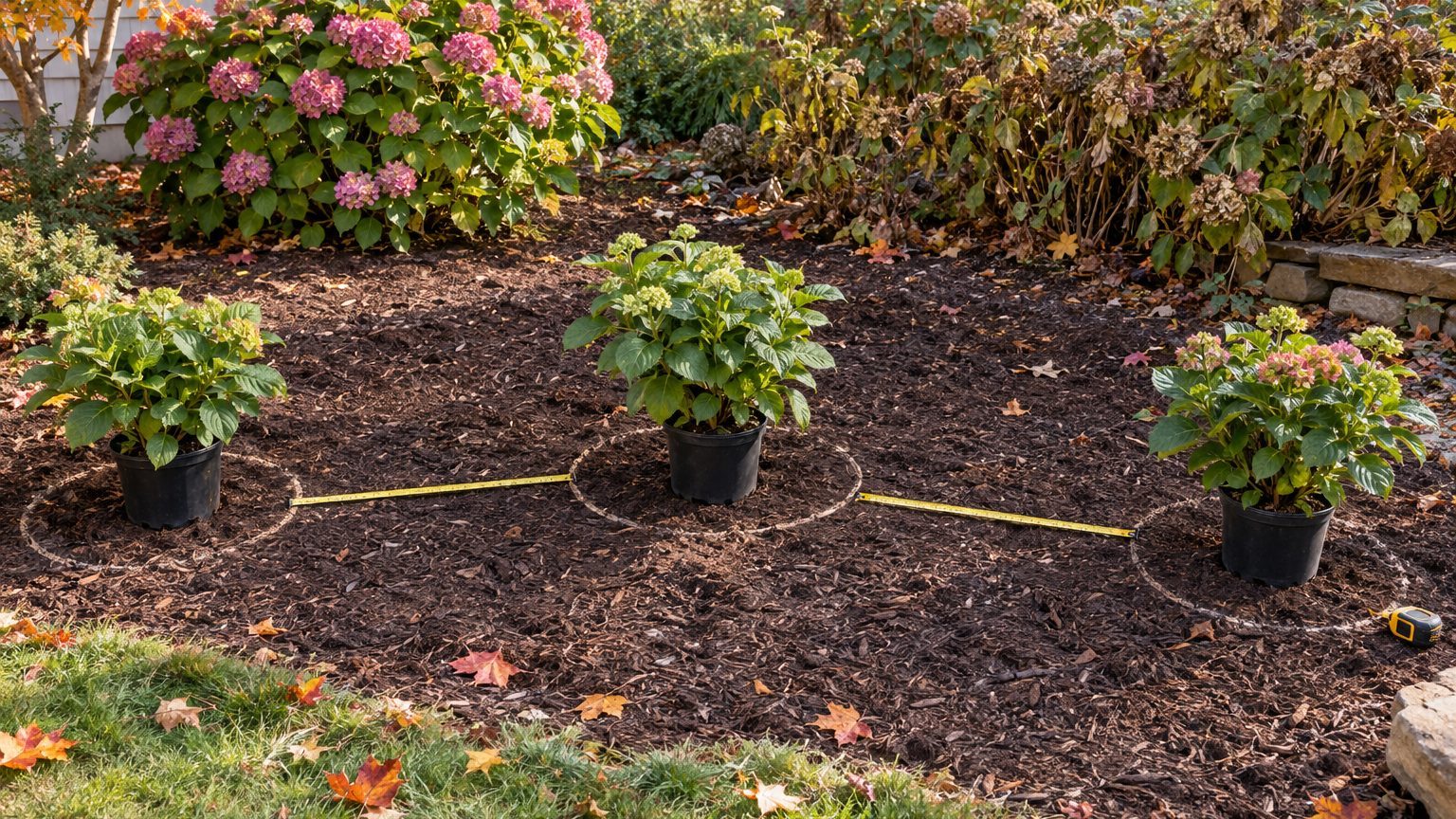

Space each hydrangea by the mature width of its type, not by the size of the pot it came in. A bigleaf (mop-head or lacecap, H. macrophylla) reaches 3 to 6 feet tall and wide, so centers go roughly 3 to 6 feet apart. A panicle hydrangea is listed at 8 to 25 feet and needs far more room. Your zone and type shape the final number.
Why this matters
Hydrangeas are shallow-rooted, and that is the whole reason spacing matters. Bigleaf and panicle types, per the NC State Extension Gardener Plant Toolbox, both keep their roots near the surface, where they compete with a neighbor’s roots for the same thin layer of moisture. Plant them too close and both plants draw from one pool. The first sign is wilting on warm afternoons, even in soil you watered the day before. (More on that in Watering Hydrangeas: Why They Wilt and When to Worry.)
Crowding also affects the leaves. Branches that overlap stay damp longer, and the source names leaf spot and powdery mildew among the genus’s diseases (see Hydrangea Diseases: Reading the Leaf). Tight plantings are also hard to prune and mulch, and a shrub squeezed against a wall or walkway ends up cut to fit, which costs flowers on the types that bloom on last year’s wood. Planting too far apart costs very little. Planting too close costs you for the life of the shrub.
When to do it
The spacing decision comes before the hole, so the right moment is when the plants are still in their pots and you can set them out on the ground without digging. Do it when you are ready to plant, not after. Moving a crowded hydrangea later is possible, but it sets the plant back, and on types that bloom on old wood (bigleaf, oakleaf, mountain, climbing) the buds were already formed the previous summer. Disturbing the roots just before they open can mean fewer flowers that year.
If you are fixing a planting that is already too tight, wait for a stage when the shrub is not under strain. That means dormant, with the leaves down, or at the very start of growth before leaves expand. Avoid moving a plant while it is in full flower or while it is wilting in warm weather. Watch the plant, not the calendar. Swelling buds and firm, unfolding leaves tell you the plant is waking up. Limp leaves and a loose, dry root ball tell you to wait.
Your local planting window depends on your zone and type. The state pages in this guide cover that. This page covers only distance.
How to do it

Find the mature width of your type
Start with the plant tag, then check it against the type. Nursery tags are often generic, and a hydrangea labeled by color tells you little about size. The facts below come from the NC State Extension Gardener Plant Toolbox.
| Type | Blooms on | Mature size | Light |
|---|---|---|---|
| Bigleaf / mop-head / lacecap (H. macrophylla) | Last year’s wood | 3 to 6 feet tall and wide | Dappled sun, partial or deep shade; protect from afternoon sun |
| Panicle / peegee (H. paniculata) | Current season’s growth | 8 to 25 feet | The only hydrangea that takes full sun well |
| Oakleaf (H. quercifolia) | Old wood | To about 5 feet | Check your cultivar tag |
| Climbing (H. petiolaris) | Old wood | 15 feet and more | Clings by aerial rootlets |
Smooth hydrangeas (H. arborescens, such as Annabelle) bloom on new wood and are the hardiest of the genus. Mountain hydrangeas (H. serrata) bloom on old wood. This page holds no verified size figure for either one, so use the tag on your specific plant.
Lay it out before you dig
Set the potted plants where you intend to plant them. Use a tape measure to check the distance between centers, and mark each spot with a stake, a flag, or a line of flour or marking paint. A garden hose laid in a circle at the mature radius shows you how much ground each shrub will eventually claim. Then stand back and look at it. If the circles overlap more than you want, either remove a plant or accept more pruning later.
A simple rule works for most borders: center-to-center distance equals the mature width. For a bigleaf variety listed at 5 feet wide, that means 5 feet between plants. Keep the center of the plant about half the mature width from a wall, fence or walkway edge. For that same 5-foot shrub, that is roughly 2.5 feet, so branches can spread without scraping siding or rubbing a fence.
Plant and mulch the whole footprint
Dig each hole and set the plant so the top of the root ball is level with the surrounding soil. Backfill, water in, and then mulch. Both bigleaf and panicle hydrangeas benefit from mulch, according to the source, and since their roots are shallow, a mulched footprint keeps the surface cool and moist. Spread it out to the mature width instead of ringing the stem, because the roots will eventually grow out there anyway. Keep the mulch itself off the stems.
Done right, a new planting looks sparse for the first season or two. That is the point. The gaps fill as the shrubs grow, and the neighbors just touch at maturity without crowding into each other. For first-season routines after planting, see First-Year Hydrangea Care: What to Do and What to Leave.
What goes wrong

Spacing by the pot. A small hydrangea in a 1-gallon pot looks like it needs 18 inches. It does not. Read the type, not the container. You will recognize this mistake two or three years later, when branches interlace and the shrubs in the middle of the row look thin and leggy.
Treating a panicle like a bigleaf. Both are called hydrangeas, but a panicle is listed at 8 to 25 feet. Setting it at bigleaf distances will produce a thicket. The hard-cutting habit of panicles (they bloom on new growth) can hide the problem for a while, then the shrub outgrows its slot anyway.
Crowding on purpose for instant fullness. This one passes for good design. A tight row looks lush by the first summer, but you then have a dense canopy, shallow roots in competition, and more leaf-spot and powdery-mildew risk. Sometimes you see it as a lower half that is bare while the tops reach for light.
The mistake that looks like extra care. Heavy fertilizing and extra watering to make crowded plants perform. It feels diligent, but it feeds growth in a space that is already full, and it does not fix the root competition. High-phosphorus fertilizer also locks aluminum up in the soil, which pushes blue bigleaf flowers toward pink, so one feeding decision can create a second problem. The cure for crowding is distance, or removing a plant, not more input.
Ignoring the light mismatch. Setting a panicle in the shade of a bigleaf, or the reverse, because the spacing looked even. Mixed plantings need the right sun for each type, not just the right gap.
Doing it differently
Containers. A pot sets its own limit, and bigleaf is the type usually grown this way. Roots are confined, so you manage size with the pot and pruning instead of distance. Keep pots far enough apart that leaves dry between rains or waterings. One real advantage: soil in a pot is easy to control, and for bigleaf and mountain hydrangeas, which are the only types whose flower color responds to soil chemistry, that matters. Flowers run blue below about pH 5.5, pink above about pH 6.5, and purple in between.
Hedges and mass plantings. If you want a continuous screen, you can set plants closer than mature width, and the shrubs will knit together sooner. The trade-off is less air movement and more pruning. This works better with a panicle type, which can be cut back hard in late winter, than with an old-wood bloomer, where heavy pruning removes flower buds.
Raised beds. Roots have less lateral room and the soil dries faster, so give hydrangeas at least the full mature width and mulch the surface.
Climbing hydrangea. This one is spaced along a wall or structure by its spread, not its footprint. At 15 feet and more, and slow to start flowering, it needs patience and a solid support.
Common questions
Can I plant hydrangeas closer than the tag says?
You can, but you accept the costs: more root competition, more pruning, and damper foliage. If you do, choose a type that tolerates hard cutting, such as panicle, and plan to thin the planting if the shrubs begin to crowd each other.
How far from the house should a hydrangea go?
About half the mature width, measured from the center of the plant. A bigleaf listed at up to 6 feet wide would sit roughly 3 feet from the wall. Check your type’s actual mature size first, since a panicle needs much more.
Does spacing change how well they bloom?
Indirectly. Crowded shrubs compete for light and water, and shaded stems flower less. Panicle hydrangeas are the only type that takes full sun well, so a panicle crowded into shade is a particular loss.
Do I need to space differently for blue flowers?
Not for the distance itself. Color applies to bigleaf and mountain hydrangeas only, and it depends on soil pH and available aluminum. Aluminum sulfate acidifies soil and lime makes it more alkaline. Coffee grounds and citrus peel are widely repeated as remedies, but they shift pH very little, and the plant needs available aluminum, which acidity releases. So keep a blue-managed bigleaf separate from plants that want sweeter soil, so your amendments do not drift to them.