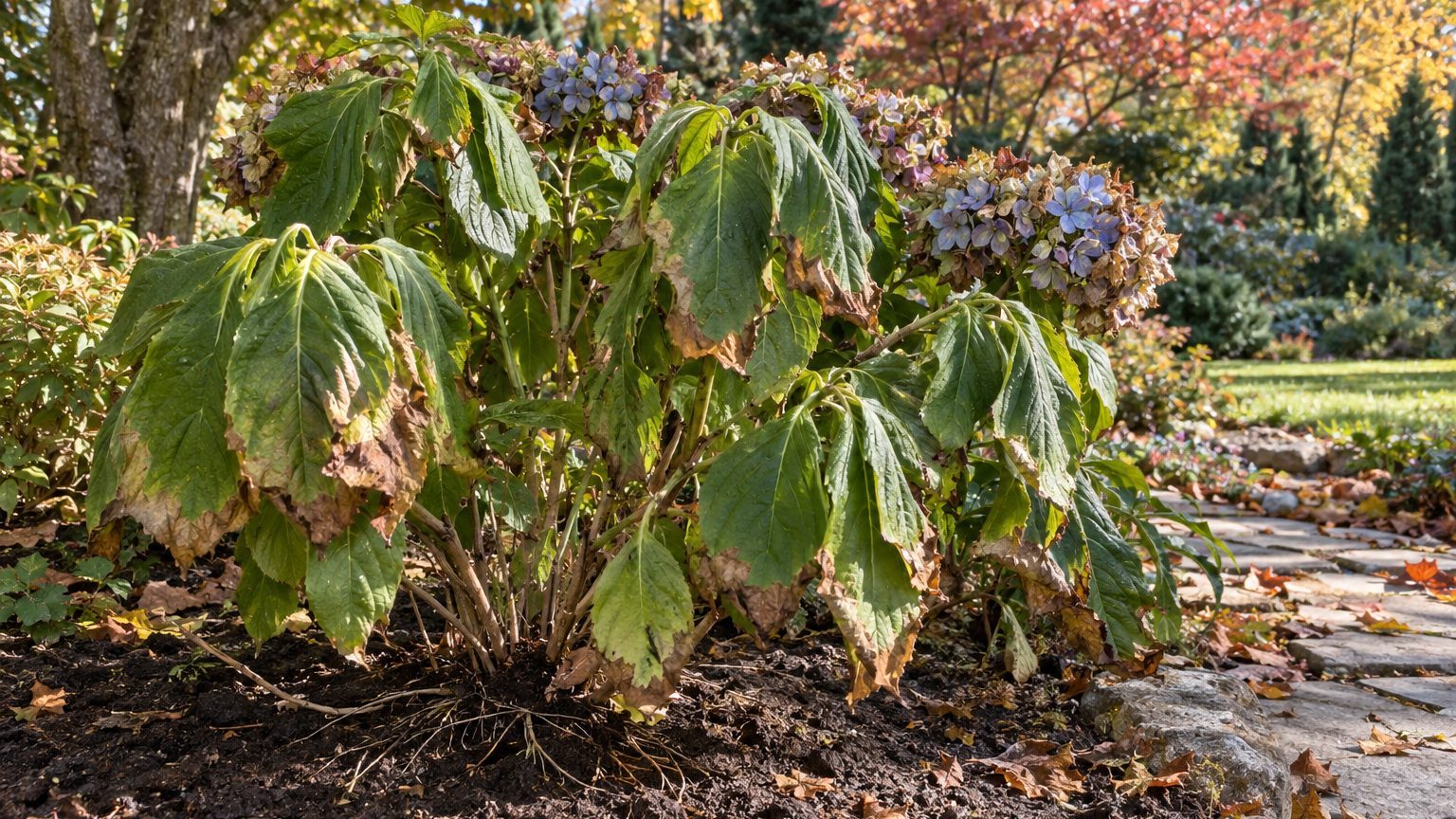

Afternoon wilting on a hot day is usually a supply problem, not a death sentence. Hydrangea leaves are big and lose water fast, while the roots sit shallow. If the leaves stand back up by evening, the plant is coping. If they are still limp the next morning, or the edges are turning crisp, something needs fixing, and it may be too much water rather than too little.
Why this matters
Bigleaf (H. macrophylla) and panicle (H. paniculata) hydrangeas are both shallow-rooted, according to NC State Extension’s Plant Toolbox. Most of their roots sit in the top layer of soil, exactly the layer that dries out first. A plant with broad leaves pulling water upward all day and roots that can’t reach deeper reserves will droop whenever the soil runs low. Sun makes it worse. Bigleaf types need protection from afternoon sun, and only panicle hydrangeas take full sun well, so a bigleaf in a hot spot is working harder than its roots can support.
Skipping water has a cost that outlasts the droop. Bigleaf hydrangeas form their flower buds the summer before they bloom, on last year’s wood. A plant stressed through summer is building next year’s flowers with less to work with. The opposite error does just as much harm. The source says good drainage is needed and that occasionally wet soil is acceptable, which is not the same as permanently wet. Roots sitting in saturated soil can’t breathe, and the plant wilts for the very reason a dry one does. Same symptom, opposite cure.
When to do it
Timing follows the plant, not the calendar. The most vulnerable stage is the first season after planting, when roots haven’t spread beyond the original planting hole. A newly planted hydrangea depends entirely on you until it establishes. Watch it more closely than the shrubs around it, and expect it to need water more often than a neighbor planted years ago.
Demand also jumps when leaves are fully out and flowers are swelling, because the plant is moving the most water at exactly that moment. Hot spells push it further. And don’t stop once the blooms finish. Bigleaf types are setting next year’s buds that summer, so late-season dryness still matters.
The plant tells you when. Check in the morning, before heat has had a chance to fool you. A droop at 3 p.m. that recovers by dusk means the plant is outpacing its roots for a few hours. A droop that is still there at breakfast means the soil is truly dry or truly waterlogged. Push a finger into the soil near the base, down to your second knuckle. Dry and crumbly means water. Cool and damp means leave it alone and look for another cause.
How to do it

Check the soil before reaching for the hose
The finger test beats any schedule. Soil type changes everything here: sand drains fast and needs more frequent watering, while clay holds moisture and stays wet longer. The same shrub in two yards can need very different routines. Your own soil is the better gauge.
Water slowly, at the base
Set a hose to a trickle at the foot of the plant, or use a watering can poured gently around the root zone. A young shrub typically takes a couple of full cans, applied slowly so the water sinks in instead of running off. You want the soil wet as deep as a trowel blade is long, not just darkened on top. Dig a small test hole an hour later if you’re unsure. Done right, the soil is evenly damp below the surface and the plant never stands in a puddle.
Aim at soil, not leaves. Overhead sprinklers waste water on foliage and bloom heads, and leaf spot is one of the diseases the source lists for hydrangeas. Watering at the base puts the water where the roots are.
A deep soak every so often does more than a daily sprinkle. Shallow, frequent watering wets only the top of the soil and teaches roots to stay near the surface, which is the habit that makes these shrubs droop in the first place.
Mulch to hold what you give
The source notes that both bigleaf and panicle hydrangeas benefit from mulch, and watering is where it pays off. A layer of shredded bark or similar material over the root zone slows evaporation and keeps the top soil from baking. Keep it pulled back slightly from the stems so it doesn’t sit against the bark. If your soil is poor to begin with, Soil for Hydrangeas: pH, Drainage and What to Dig In explains how drainage and texture decide how often you’ll be out there with the hose.
One note on feeding. Fertilizer doesn’t replace water, and dry soil makes the plant less able to use it. If you’re adjusting both, Feeding Hydrangeas: What to Use and What It Changes covers what each product does once the moisture side is sorted.
What goes wrong

The mistake that looks like extra care is watering a wilted plant every time it droops. Midday droop on a hot day is often the plant’s own way of cutting water loss, and soaking it again and again, day after day, can leave the soil soggy while the roots suffocate. Afterward you’ll see leaves that stay limp even though the soil is wet, yellowing, and a plant that never fully recovers overnight. Always check the soil before adding water.
The shallow sprinkle is a close second. Ten minutes with the hose wand every day feels diligent, but only the top layer gets wet. You’ll recognize it by a plant that wilts quickly whenever you skip a day, because nothing deeper has been wetted. Switching to a slow, deep soak and mulching usually fixes it within a few weeks.
Poor drainage is the third. A hydrangea planted in a low spot or heavy clay can wilt while surrounded by water. Dig down and check. If the soil is wet and smells sour, the problem is the site, not your routine.
Crisp brown leaf edges, especially after a hot, dry stretch, point to underwatering or too much sun for that type. Moving a bigleaf out of strong afternoon light may help more than extra water.
Finally, wilting that persists with moist soil and good drainage may not be a watering issue at all. The source names bacterial wilt among the diseases that affect hydrangeas, along with leaf spot and powdery mildew. Aphids, scales, nematodes and mites are listed as rarely a problem, and the source also lists deer as a source of damage (browsing is observed). If the plant keeps declining despite correct watering, take a sample to your county extension office for a diagnosis.
Doing it differently
Containers are the clearest case for changing the routine. A pot holds a small volume of soil, so it dries much faster than ground soil, and a potted bigleaf on a sunny patio can need water far more often than one in a bed. Make sure the pot drains freely, and check the soil daily in warm weather instead of trusting the date of your last watering.
Raised beds and sandy soils behave similarly: they drain quickly, so mulch matters even more and the finger test should be your guide. Heavy clay is the opposite, where the risk is waterlogging, so water less often and more deeply.
Type matters too. Panicle hydrangeas, the only ones that handle full sun well, will use more water in a bright location than a bigleaf in dappled shade, even though both are shallow-rooted. Panicle and smooth hydrangeas (H. arborescens, such as Annabelle) bloom on new wood, while bigleaf, oakleaf and mountain types bloom on old wood. That makes late-season water more important for the old-wood types, since their buds are already forming. Climbing hydrangeas (H. petiolaris) are slow to start flowering, so don’t read a lack of blooms in a young one as a watering failure. Your zone and type shape the exact routine, and the state-by-state pages in this guide cover local specifics. For the full growing picture, see How to Grow Hydrangeas.
Common questions
Should I water a hydrangea that wilts in the afternoon?
Check the soil first. If it’s dry a couple of inches down, water slowly at the base. If it’s moist and the plant recovers by evening, leave it alone. Repeated midday watering of damp soil causes more trouble than it solves.
Do all hydrangea types need the same amount of water?
No. Bigleaf hydrangeas in shade need less than the same plant in hot sun, and panicle hydrangeas in full sun use more. Soil type changes it again, with sand needing water more often than clay.
Does watering affect flower color?
Not directly. Color in bigleaf and mountain hydrangeas depends on soil pH and available aluminum: blue below about pH 5.5, pink above about pH 6.5, purple in between. Panicle, smooth, oakleaf and climbing types don’t change color with pH at all. Coffee grounds and citrus peel are widely believed to turn flowers blue, but the pH shift they produce is very small, and what the plant needs is available aluminum, which acidity releases. Aluminum sulfate acidifies soil; lime raises pH.
Why do my cut hydrangeas wilt so quickly in a vase?
Large flower heads lose water fast and the stems struggle to replace it, so the problem is related but not identical to garden wilting. Cutting Hydrangeas for the Vase Without Them Collapsing covers how to cut and condition stems so they hold up.