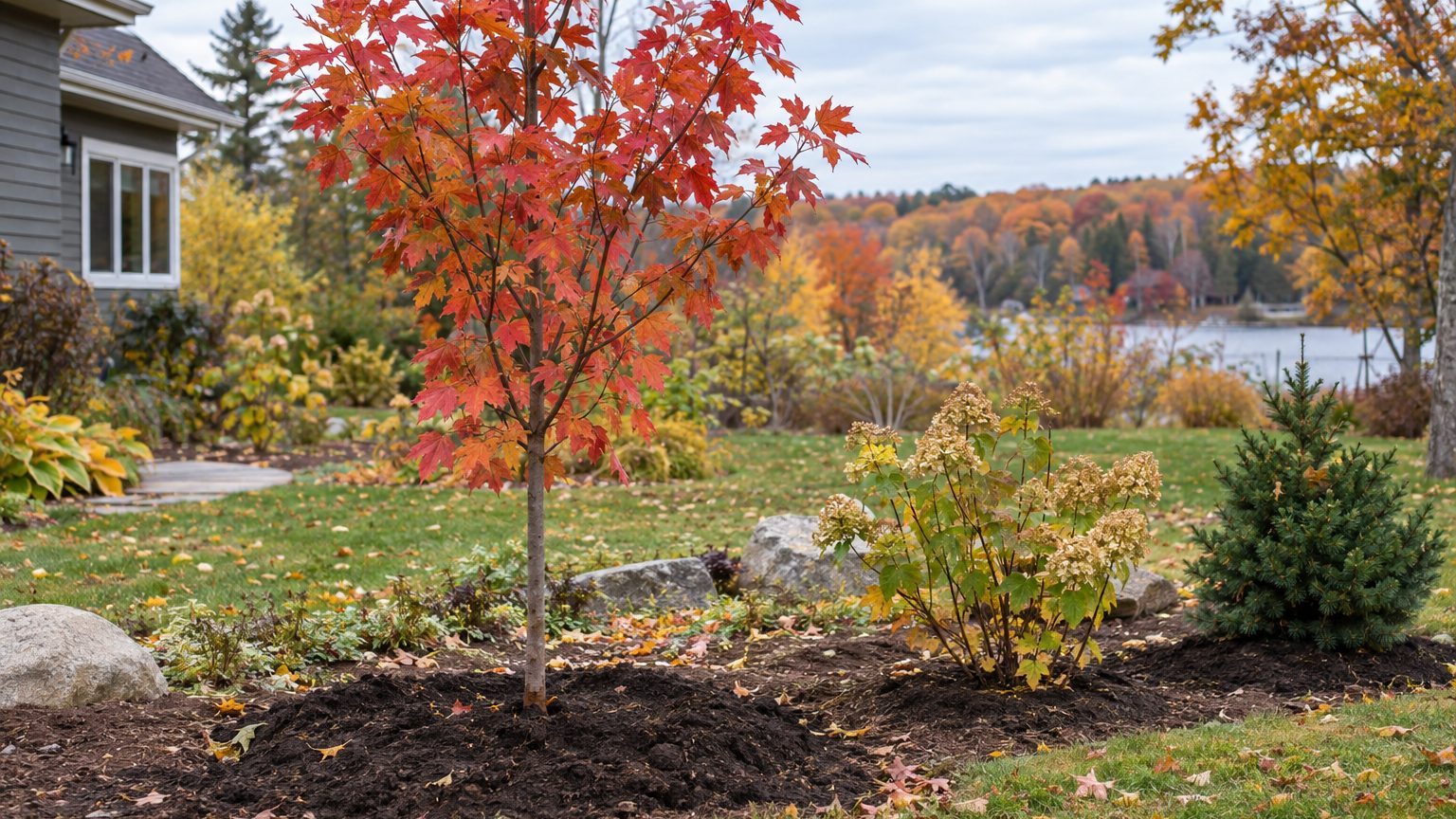

Plan to have trees and shrubs in the ground by early August in the Northwest Territories, about six weeks before the first fall frost, which averages September 18 at the Yellowknife A station. That is the conservative target. The real limit is the day the ground freezes, and that comes later than the first frost, so a hardy container plant set in after early August is a calculated risk, not a lost cause. Farther north, expect every one of these dates to arrive earlier.
The deadline in Northwest Territories
Roots don’t keep the calendar the way leaves do. They grow as long as the soil is workable and above freezing, even while the top of the plant looks finished for the year. Soil also holds heat longer than air, so a frosty September night doesn’t shut down what is happening underground. What ends root growth is cold soil, and then frozen soil.
Working back from the first fall frost
Cornell Cooperative Extension states the rule plainly: “Fall is an excellent time for transplanting, provided you get them to their new home at least 6 weeks before the ground freezes, allowing them time to establish roots before winter dormancy.” Ground freezing is hard to predict months ahead, so the practical move is to count back from something you can look up. Environment and Climate Change Canada’s 1981-2010 normals for the Yellowknife A station put the first fall frost on average at September 18. Six weeks earlier lands in the first week of August, which gives a conservative target of August 7.
Finish planting in early August, with August 7 as the conservative target. That date sits well inside the safe zone because the ground freezes after the air does. Counting from the frost instead of the freeze builds in a cushion.
Treat September 18 as the middle of a window, not as a safe date. It is a mean, which means that in about one year out of two the first frost arrives later, and in the other years it arrives earlier. A planting schedule built on the average date will get caught short in some years.
Where the limit falls later, and where it falls earlier
Because the ground freezes after the first frost, a plant set in the ground a bit past early August still has some time to root. It just has less margin with each passing week, and a smaller root system going into winter. That is a gamble you can sometimes win with hardy stock, not a plan to build a landscape around.
One more caution on the numbers. Yellowknife A is a single station in a very large territory, and northern or higher-elevation districts have an earlier first frost, so the deadline moves earlier there, not later. The normals also cover 1981-2010, while the US figures elsewhere on this site cover 1991-2020, so the two sets of dates are not directly comparable.
There is no mild-winter exception here. The mean daily minimum of the coldest month at Yellowknife is -29.5 °C (-21.1 °F), according to the same Canadian normals, and the ground freezes solid. The deadline applies in full. Natural Resources Canada places Yellowknife in Canadian hardiness zone 1b, based on 1991-2020 normals. That is the Canadian system, built on seven climate variables, and it does not convert to a USDA zone. For a closer read on your own community, see the First and Last Frost Dates in Northwest Territories.
What to plant late, and what to wait on
Container-grown and balled plants that are fully hardy for the territory are the ones that establish well when planted late. They arrive with an intact root mass, so they lose less time recovering from the move. Check the tag against the Canadian zone rating (zone 1b for Yellowknife, per Natural Resources Canada), because a US zone number on a nursery tag is not a match for it. If a plant is borderline for the cold here, a late planting only takes away its chance to settle in before the hardest test.
Evergreens are the other risky group. A spruce or a juniper keeps its needles all winter and keeps losing water through them, while frozen roots can’t send any back up. A late-planted evergreen has the smallest root system relative to the foliage it has to support. If one has to go in late, plant it early in the window and give it a windbreak on the exposed side.
| Type of stock | Late fall planting | Reason |
|---|---|---|
| Container-grown, fully hardy deciduous trees and shrubs | Good choice | Intact roots, quick recovery, and no leaves to feed |
| Balled plants, fully hardy | Good if the root ball stays moist | A dried root ball is the main failure, not the cold |
| Borderline-hardy plants of any kind | Wait for spring | No time to root before the winter test |
| Evergreens | Risky, best planted early or in spring | They lose water all winter through frozen roots |
| Bare-root stock | Wait for spring | Little root mass to carry it through freeze-up |
| Small perennials | Plant early, mulch well | Shallow roots are easily pushed up by frost |
Deciduous trees and shrubs have one advantage in fall. Once the leaves drop, the plant stops sending water into the canopy and puts what it has into roots. That is why a leafless hardy shrub can go in after the leaves color and still do well, as long as the ground is workable and the planting is not left for the last few days.
For anything borderline-hardy or evergreen that missed early August, wait until spring. The hole, the planting depth and the backfill are the same as at any other time of year, and they are covered in Planting and Caring for Trees, Shrubs and Perennials. A plant held in its container through winter on a sheltered spot is a better bet than one forced into a rushed planting.
Watering and mulch until the ground freezes
The first winter is about roots, not growth. A new tree or shrub has lost much of its root system in the move, and what it needs through freeze-up is to rebuild that system, not to push new top growth. Anything you do to encourage leaf and shoot growth late in the season works against that, which is a good reason to skip fertilizer in fall.
Water deeply until freeze-up
Water slowly and deeply, and keep doing it until the ground freezes. A light sprinkle wets the surface and the roots never feel it. A long, slow soak reaches the root ball and the soil around it. A dry fall is common enough that you shouldn’t count on rain to do this for you. Before the ground locks up, give a final deep soak, because plants go into winter better with moist soil around their roots than with dry soil.
Mulch in a ring, not a volcano
Mulch holds moisture and evens out soil temperature, which is what a new planting needs. NC State Extension’s Gardener Handbook says: “A 2-inch to 3-inch layer of mulch suppresses most annual weed seeds and makes it easy to hand-pull any that do germinate.” For trees specifically, it adds: “Provide a 3-inch layer of mulch to reduce water loss and maintain uniform soil moisture and temperature around roots.” The two sentences have different purposes, but they point to the same depth.
Spread a 2-inch to 3-inch layer in a flat ring, kept off the trunk. More is not better. Piled against the bark in a cone, mulch holds moisture against the trunk, invites rot, and gives mice and voles a sheltered place to nest and chew. A flat ring with a clear gap around the stem does the work without the problems. The longer version of the argument is in Mulching Without Killing the Plant.
Put the mulch down after the final deep watering, not before, so the water reaches the soil instead of sitting in the mulch layer.
What goes wrong
The most common mistake is planting too late for this climate. A tree set in the ground close to freeze-up has had no time to root, and it enters winter with a root ball that is, in effect, still sitting in its old container shape. Anything that goes in after the safe window should be hardy stock, watered well, and mulched, with the understanding that the odds are lower. Closer to the Arctic coast, the timing is tighter still, as the How Late Can You Plant Trees and Shrubs in Fall in Nunavut? article shows.
Winter burn is the second. Evergreens lose moisture to wind and sun through their needles while the roots sit in frozen ground and can’t replace it, and the foliage browns in late winter. A burlap screen on the windward side, set up before the ground freezes, cuts that loss. Deciduous plants dodge the problem by shedding their leaves.
Frost heave is the third. Freezing and thawing push shallow root balls and small perennials upward, leaving roots exposed to air. A planting set high, or one that never settled into the soil, is the most likely to move. Check new plantings in spring and press any lifted plant back into the ground while the soil is soft.
The last is drying out, which is easy to overlook because the weather is cool. A dry fall can leave soil short of moisture right when roots need it, and a root ball that goes into winter dry has very little to draw on. Keep watering until the ground freezes, as long as the soil is still workable.
Common questions
Is September 18 a safe planting cutoff?
No. September 18 is the average first fall frost at the Yellowknife A station, taken from Environment and Climate Change Canada’s 1981-2010 normals. It is a midpoint, and in about one year out of two the frost falls later. The conservative planting target is six weeks before that frost, which works out to August 7, so early August is the date to plan around.
Does the first frost stop roots from growing?
No. Roots keep growing while the soil is workable and above freezing, and soil stays warmer than air for some time. The first frost ends the growing season above ground, but the deadline that matters is when the ground freezes, which comes later.
What if my community is farther north than Yellowknife?
Move every fall date earlier. Northern and higher-elevation districts have an earlier first frost than the Yellowknife A station, and the ground there freezes sooner. The six-week rule still applies, but it counts back from a frost date that arrives sooner than September 18.
Can I use a USDA zone to pick plants for the Northwest Territories?
Not reliably. Natural Resources Canada rates Yellowknife as Canadian zone 1b, and its own comparison notes that there are no simple conversions between the Canadian and USDA systems. Canadian zone 4a, for example, overlaps nine USDA zones, from 3a to 7a. When you shop, look for the Canadian zone on the tag and browse more Northwest Territories guides for local conditions.