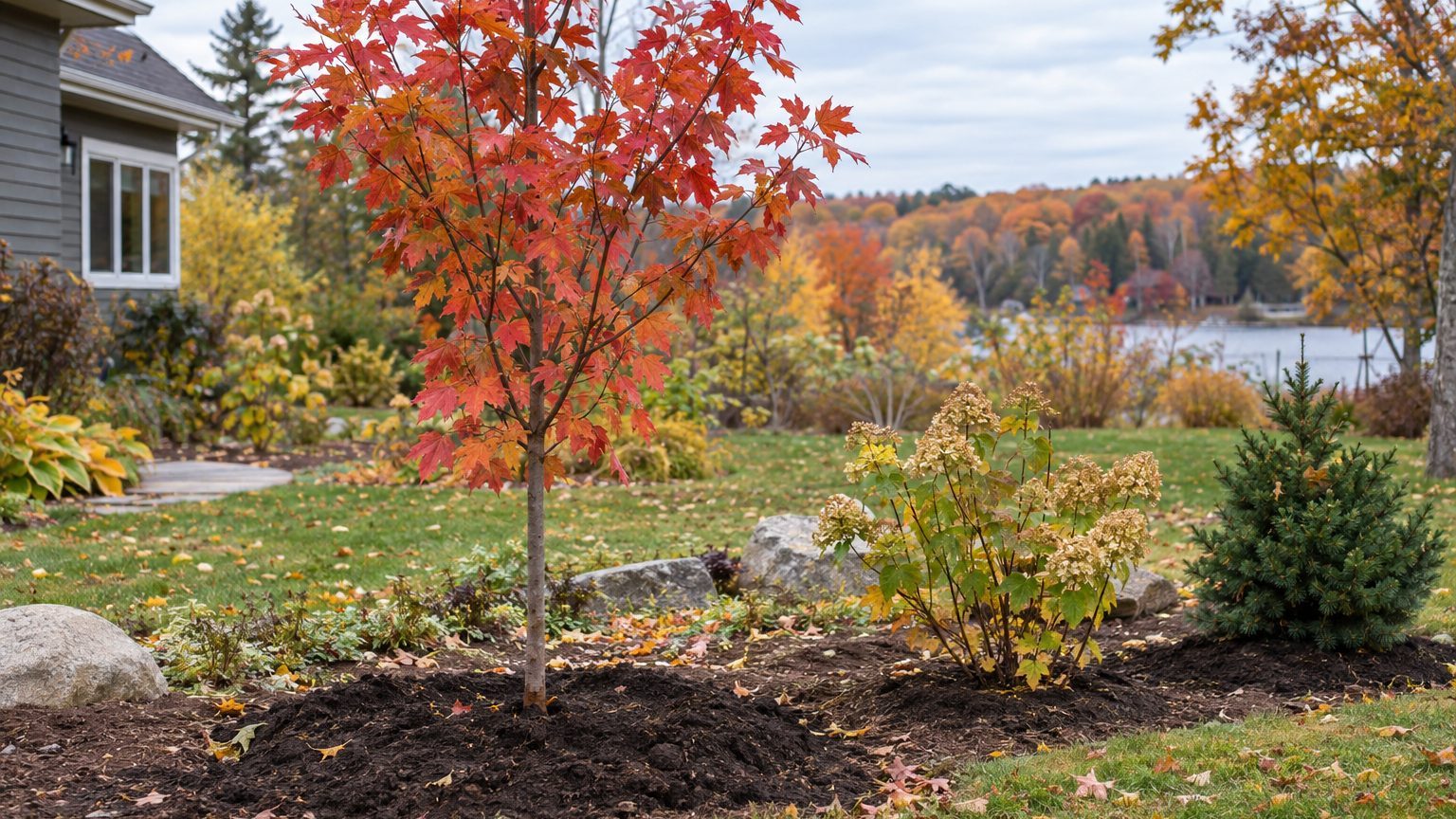

In Nunavut, the safe target for planting trees and shrubs is early August, six weeks before the first fall frost, which averages September 13 at Rankin Inlet. Plants in the ground by then have time to root before the soil locks up. Later planting isn’t automatically doomed, but every week past that date thins your margin. The figures below come from Environment and Climate Change Canada and a university extension rule, and the whole schedule slides earlier the farther north you garden. More local reading sits in the Nunavut guides.
The deadline in Nunavut
Roots don’t follow the thermometer on the porch. They keep growing while the soil is workable and above freezing, which can be weeks after the first frost has blackened the leaves. So the real deadline hangs on the ground, not the air. Cornell Cooperative Extension states the principle plainly: “Fall is an excellent time for transplanting, provided you get them to their new home at least 6 weeks before the ground freezes, allowing them time to establish roots before winter dormancy.” (Cornell Cooperative Extension, Orleans County)
Working back from the first frost
Nobody publishes a tidy ground-freeze date for every Nunavut community, so the practical move is to count back from something that is measured. Environment and Climate Change Canada’s 1981-2010 normals for the Rankin Inlet A station put the average first fall frost on September 13. Six weeks earlier lands on August 2. Plan to have every tree and shrub planted by early August, with August 2 as the conservative mark.
That September 13 figure is a mean, not a promise. In one year out of two the first frost arrives later, and in the other half it arrives earlier. Treat it as the midpoint of a window, never as a safe date. A cold, early fall is exactly what the six-week cushion is there to absorb.
Because the ground freezes later than the air first dips below freezing, the true biological limit usually falls after August 2. That extra time is a bonus you can’t count on, and it belongs in the “maybe” column, not in your plan.
Why the north runs earlier
Rankin Inlet is one station in a territory that stretches across a huge span of latitude. Farther north, or on higher ground, the first fall frost comes earlier, so the planting deadline moves earlier with it, sometimes by weeks. If your community sits well north of Rankin Inlet, treat early August as the outer edge, not the target. The First and Last Frost Dates in Nunavut page gives a better sense of how the frost window shifts by location.
A fall-planting question in this part of Canada has no warm-weather loophole. The mean daily minimum of the coldest month at Rankin Inlet is -34.3 °C (-29.8 °F), per the same Canadian normals, so the ground does freeze and the deadline applies. Natural Resources Canada places the reference city in Canadian hardiness zone 0a, a rating built on seven climate variables. It is not a USDA zone and it doesn’t convert to one. Also keep in mind that the Canadian normals cover 1981-2010, while US figures elsewhere cover 1991-2020, so don’t line the two up date for date.
Gardeners comparing notes with the territory next door can read How Late Can You Plant Trees and Shrubs in Fall in Northwest Territories?, though its dates won’t transfer to Nunavut.
What to plant late, and what to wait on
Not every plant handles a late start equally. The ones that do best are container-grown and balled plants that are fully hardy for your conditions. They arrive with a root mass intact, so the roots only have to reach out into new soil rather than rebuild from scratch. When that happens close to the early-August target, they have a real shot at settling in before the ground freezes.
Hardiness is where Nunavut gardeners get tripped up. A plant sold as “hardy” in a catalog is usually rated for milder conditions than Canadian zone 0a, and a plant that survives a normal winter in the south may be marginal here. A first winter in the ground, with roots that haven’t spread yet, is the worst possible time to test a borderline plant. Much of the territory is tundra, so low, tough shrubs suited to the region generally make better bets than anything reaching for the sky.
Evergreens deserve extra caution
Evergreens keep their needles or leaves all winter, and they keep losing moisture through them. When the ground is frozen, the roots can’t replace that water. A young evergreen with a thin root system is at the greatest disadvantage, and planting one late stacks the odds against it. Deciduous shrubs drop their leaves and stop the leak, which is why they forgive a late start more readily.
| Type of plant | Late planting outlook | Main reason |
|---|---|---|
| Container or balled, fully hardy deciduous shrub or tree | Reasonable, if close to the early-August target | Intact root ball, no leaf water loss in winter |
| Container or balled, fully hardy evergreen | Riskier, plant early or wait | Needles keep losing water while the ground is frozen |
| Borderline-hardy plant of any kind | Wait for spring | No established roots to carry it through the coldest month |
| Anything bought after the first frost window opens | Hold it, or plant with care | Little time left for roots to grow |
If a plant lands in your hands after the early-August window has closed, you have two options. You can plant it and accept the risk, or you can keep the pot somewhere sheltered and wait. For anything borderline hardy, and for evergreens that miss the early-August target, wait until spring. The plant isn’t going anywhere, and a spring planting gets a full season of root growth before its first winter.
To plan the sequence for the whole garden, Planting and Caring for Trees, Shrubs and Perennials covers the basics of getting a plant into the ground properly in the first place.
Watering and mulch until the ground freezes
A tree planted in August or early September has one job before winter: grow roots. Leaves, new shoots, and height can wait. Plants put their energy where they need it most, and a fresh transplant needs a root system that can find water in spring. Top growth in the first season is a sign of a healthy root system, not the goal itself.
Water deeply, and keep going
Fall can be dry, and a new root ball sits in a pocket of loose soil that dries out faster than the surrounding ground. Give the plant a deep soaking, enough that water reaches the full depth of the root ball and beyond, rather than a quick sprinkle that wets only the surface. Repeat as the soil dries, and keep this up until the ground freezes, which in an average year comes well after the mid-September first frost. Frozen soil can’t take up water, so the last soaking you give before freeze-up is the one the plant lives on through winter.
Checking is simple. Push a finger or a trowel into the soil beside the root ball. If it is dry a few inches down, water. If it is damp, wait a few days and check again.
Mulch in a ring, not a volcano
Mulch evens out the soil’s swings in moisture and temperature, and that matters in a place where a warm afternoon can follow a hard freeze. The depth is where people overdo it. NC State Extension’s handbook says: “A 2-inch to 3-inch layer of mulch suppresses most annual weed seeds and makes it easy to hand-pull any that do germinate.” On trees, it adds: “Provide a 3-inch layer of mulch to reduce water loss and maintain uniform soil moisture and temperature around roots.” (NC State Extension Gardener Handbook, chapter 11)
Spread mulch 2 to 3 inches deep, and pull it back from the trunk so it forms a flat ring rather than a mound. More is not better. A pile of mulch against the bark holds moisture where the trunk needs to stay dry, and it makes an inviting nest for rodents. The ring should extend outward over the root zone, with a few inches of bare soil right at the trunk. Mulching Without Killing the Plant walks through the details.
Timing counts, too. Put mulch down after the soil has had a chance to take up a good watering, because mulch laid over bone-dry ground can shed light rain instead of passing it through.
What goes wrong
The most common failure is simple: planting too late for this climate. The August 2 figure exists because six weeks of root growth takes six weeks. A shrub put in around the average first-frost date of September 13 may still do fine in a mild year, but it has the thinnest margin, and a cold snap that arrives early can leave it with almost no new roots. If the plant isn’t in the ground by early August, treat September planting as a gamble and consider holding it until spring.
Winter burn is the next problem, and evergreens take the worst of it. Cold wind and winter sun pull moisture out of needles while frozen ground blocks the roots from replacing it. The tips turn brown or tan by late winter. A well-watered plant going into freeze-up with healthy roots copes far better, which is another reason the watering schedule above isn’t optional. A windbreak on the exposed side can also take some of the strain off a young evergreen.
Heaving threatens shallow root balls. Where the soil freezes and thaws repeatedly, the ground can push a poorly anchored plant upward, exposing roots to air and drying wind. A plant that hasn’t had time to knit into the surrounding soil is the most vulnerable. Check new plantings after thaws, and if one has lifted, press it gently back into place and add soil over any exposed roots.
Last comes the quiet one: drying out in a dry fall. When rain is scarce, a new transplant can slip into winter thirsty, and nothing looks wrong until spring, when buds fail to open. A deep watering right before freeze-up is the cheapest insurance, and it takes only a hose and a few minutes per plant.
Common questions
Can I still plant after September 13?
Sometimes. September 13 is the average first frost at Rankin Inlet, so in about half of years the frost comes later, and the soil may stay workable for a while after that. Still, it’s past the conservative target of early August, so a plant set out then has less time to root. A fully hardy, container-grown deciduous shrub has the best odds, and it needs deep watering and mulch right away.
Does Cornell’s six-week rule apply in Nunavut?
Yes, with a caveat. Cornell’s rule counts back from when the ground freezes, and the ground does freeze at Rankin Inlet, where the coldest month’s mean daily minimum is -34.3 °C (-29.8 °F). Since a ground-freeze date isn’t published for most communities, counting six weeks back from the first fall frost gives a safer, earlier target. The true limit usually falls later, but colder northern communities reach it sooner.
How deep should mulch be on a new tree?
NC State Extension recommends “a 3-inch layer of mulch” around trees to reduce water loss and keep soil moisture and temperature even, and a 2-inch to 3-inch layer for general weed suppression. Keep it in a ring and clear of the trunk. Going deeper doesn’t add protection and can cause rot at the bark.
Is Canadian hardiness zone 0a the same as a USDA zone?
No. Natural Resources Canada builds its system on seven climate variables, while the USDA system uses one, and there are no simple conversions between them. NRCan’s own comparison shows Canadian zone 4a overlapping nine USDA zones, from 3a to 7a. When a nursery tag lists only a USDA number, treat it as a rough hint and look for the plant’s Canadian zone before you buy.