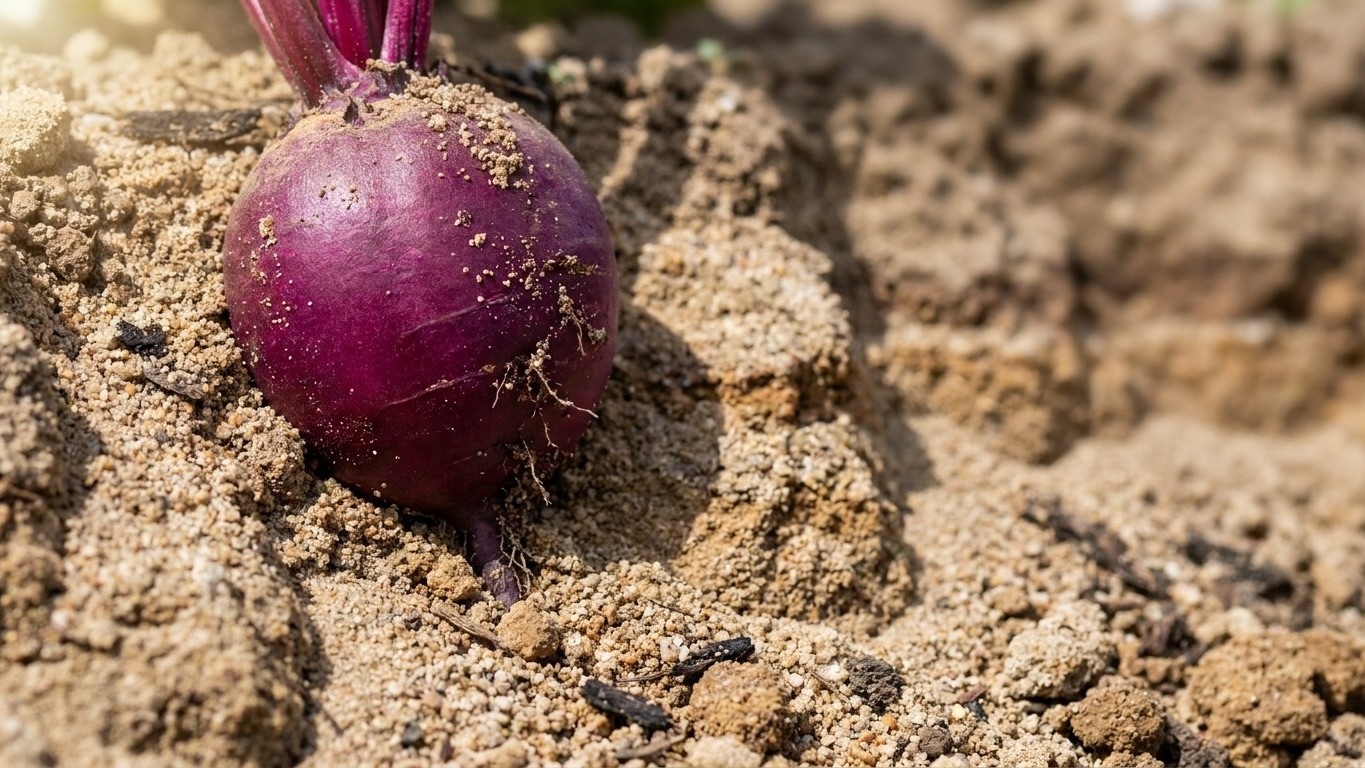

Weather and ground do most of the damage to a Minnesota beet crop, and they strike in a set order. Thirst in the first six weeks pushes plants toward flowers instead of roots. Heat above 85 F combined with dry soil makes the root woody later on. After harvest, a cellar that is too cold brings black spot and rot. This page follows those three failures in sequence, from seed to storage. Insect pests are not covered, because the verified data behind this page does not include them. For the full crop calendar, see Growing Beets in Minnesota.
The short answer
Start with the ground. Minnesota’s official state soil, named by state law, is the Lester series, an Alfisol: a forest soil of moderate fertility that holds nutrients reasonably well. USDA NRCS records representative values for its surface horizon across 251 mapped components. Those values are 39 percent sand, 24 percent clay and 37 percent silt, so a loam leaning toward silt. Organic matter is about 3.0 percent, surface pH about 6.6 (near neutral), and the drainage class is well drained.
Set that against what a beet asks for. Utah State University Extension describes the ideal as deep, sandy, well-drained soil rich in organic matter. Lester meets the drainage requirement. It falls short on sand, since silt and clay together make up 61 percent of the surface. A ground that heavy holds more water than a sandy one, which cushions a dry week. But a well-drained loam still dries at the top between rains, and a seedbed with that much clay and silt tends to firm up once it has been rained on and baked.
The organic matter figure deserves a caution of its own. The 3.0 percent describes the mapped surface of the series, not a worked garden bed. Utah State University Extension also puts a ceiling on how much you add: no more than 1 inch of composted organic matter per 100 sq ft. That is a limit, not a target.
Then there is heat. The reference city here is the Twin Cities, the mild south of the state. How many days a year it passes 90 F is not published in the figures behind this page, so there is no count to quote. The threshold that matters for beets is lower anyway. Utah State University Extension names heat above 85 F, and only when it arrives with water stress, as the cause of a woody root. A tally of 90 F days would understate the days at risk, and heat on its own, with the bed kept evenly moist, is not what the source blames.
One limit on all of this. A state spans hundreds of soil series, and Lester is the one chosen to represent Minnesota, not the one under every garden. River bottoms, hill country and any lot a builder has scraped or filled can behave completely differently. Treat the numbers above as a starting point for what the region’s ground tends to do, then get a soil test for your own bed. The Beet Soil in Minnesota: What the Root Will Meet page goes further into reading that result.
The six weeks that decide it here
NOAA NCEI climate normals put the Twin Cities’ last spring frost between April 17 and April 30. That range comes from the 32 F freeze probabilities in the 30 to 70 percent band. Sowing beets two to three weeks before the last frost means counting back from those dates. On paper, that gives a window running from about March 27 at the early end to about April 16 at the late end. Whether a bed is workable that early is a separate matter, and the When to Sow Beets in Minnesota page handles it.
Beets are sown in place. The 60 to 80 days to harvest run from seeding, and there is no transplant stage to reset the clock. So the first six weeks after seeding are a fixed stretch of the calendar. Add six weeks to the paper window and they end somewhere between early May and late May.
That stretch of a Minnesota spring tends to swing instead of settle. Freezing nights give way to warm afternoons, wet spells are followed by dry, breezy ones, and no two weeks look alike. For a beet, the swing matters less than the dry spells inside it. Utah State University Extension says water stress during the first six weeks causes premature flowering. On a well-drained loam like Lester, the top few inches can dry out within days of the last rain, and that is where the bolting risk sits here. It is a spring problem, in the gaps between rains, in a bed that looked fine the week before.
A seedling that gets through those six weeks is not safe for the season. Woodiness is a different failure with a different window. It shows up later, when summer heat above 85 F meets dry soil, and a plant that never bolted can still produce a woody root in July. Keep the two apart when you plan: early thirst sends the plant to seed, and later heat with thirst toughens the root.
Northern Minnesota runs two to three weeks tighter at both ends of the season than the Twin Cities. Shift every date accordingly. The six-week logic stays the same, but the whole sequence starts later and has less room before fall.
What goes wrong here
- Bolting in spring. Early water stress, in the first six weeks after seeding, causes premature flowering. The remedy is to check the bed by hand through every dry spell in that window, because a well-drained loam sheds water faster than the calendar suggests.
- Woody roots in summer. Heat above 85 F with water stress is the combination Utah State University Extension names. Keep the bed evenly moist through hot stretches, not just through the seedling weeks.
- Too much compost. More than 1 inch of composted organic matter per 100 sq ft goes past the limit Utah State University Extension sets. Measure it out, and stay under it.
- A firm, crusted surface. Lester’s 24 percent clay and 37 percent silt can pack down after rain, and beets want deep soil. Loosen the bed well before sowing, and if your own soil test shows a heavier or lighter ground than Lester, adjust from that number.
- Rot and black spot in storage. This is the failure that surprises people, because colder is not better for beets. USDA Handbook 66 reports more black spot and rot at 32 to 34 F than at slightly higher temperatures. Topped roots belong at 33 to 36 F and 98 percent relative humidity, and a pit or cellar should stay between 31 F and 41 F. Details are in the USDA handbook chapter on commercial storage.
- Leaves left on stored roots. Bunched beets, with their tops, keep only about 10 to 14 days at 32 F and above 98 percent humidity. Top the roots first if they are going into storage for longer.
- Shriveled small roots. Large roots keep much better because they lose water and shrivel more slowly. Save the big ones for storage and eat the small ones first.
Common questions
Is the Lester soil what I have in my garden?
Probably not exactly. It is the soil that represents the state, and Minnesota has hundreds of soil series. The pH of 6.6 and the 3.0 percent organic matter are mapped surface values for the series, not your numbers. A soil test on your own bed is the only way to know.
Can I start beets indoors and transplant them for a head start?
Beets are sown in place. The 60 to 80 days to harvest count from seeding, so there is no transplant clock to run ahead of the garden. The head start comes from sowing two to three weeks before the last frost, not from indoor trays.
Should beets go in the coldest part of the cellar?
No. USDA Handbook 66 reports more black spot and rot at 32 to 34 F than at slightly higher temperatures, and it sets the target for topped roots at 33 to 36 F with 98 percent humidity. Cellars and pits should not drop below 31 F or climb above 41 F.
Do the Twin Cities dates apply to northern Minnesota?
Not directly. The April 17 to April 30 last-frost range is for the Twin Cities, the mild south of the state. Northern Minnesota runs two to three weeks tighter at both ends of the season, so sowing dates and the six-week window both move later.