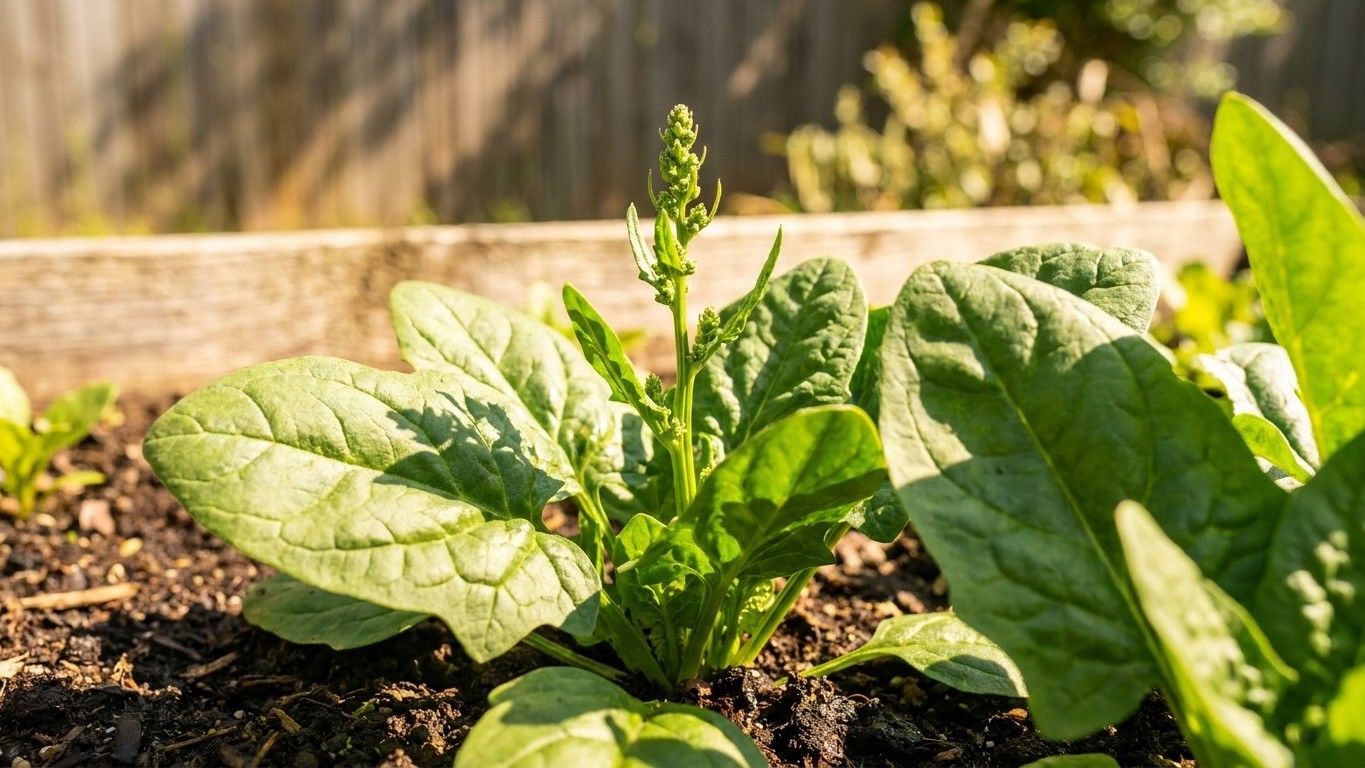

In New Brunswick, the thing that eats a spinach crop is usually the calendar, not an insect. Day length and heat cut the leafy season short from both ends, and you can plan around them once you know where the limits sit. Pest damage is not covered by the sourced data behind this page, so it stays out. The dates below use the Moncton reference station.
The short answer
At the latitude of Moncton, the longest day of the year holds 15 h 34 of daylight. That figure is calculated from the station’s latitude and counts the geometric horizon only. Atmospheric refraction adds roughly seven more minutes of real daylight.
That matters because spinach bolts, meaning it sends up a flower stalk and the leaves turn bitter and small, in response to long days as well as warm temperatures. Utah State University Extension is the source here. Long days alone are enough to start the process. A cool summer therefore does not buy extra weeks. A June evening in New Brunswick, still bright at a late supper hour, is already telling the plant to flower, whatever the thermometer says.
So is the limit the day length or the heat? Both. Day length sets a hard ceiling on the season no matter how mild the weather is. Heat then shaves more off the front and back of it. Spinach grows best where temperatures stay at or below 75 F (24 °C), and that number does two jobs at once: it marks where good growth stops, and it marks where bitterness begins. It is a temperature to watch, never a date on the calendar.
The heat side of the ledger looks gentle on paper. At the Moncton A station, Environment and Climate Change Canada counts 4.6 days a year at or above 30 °C, and 1.0 day a year at or above 32 °C. Those are counts of extreme days, though, and spinach does not wait for extremes. It slows well below them. A summer with five hot days can still spend weeks above 24 °C, so these figures say little about how much spinach weather you really get.
The honest summary is that New Brunswick offers two spinach seasons, one in spring and one in late summer into autumn, with a gap in the middle where long days and warmth both work against the crop. The detail on flowering lives in Will Spinach Bolt Early in New Brunswick?, and the general picture of the crop sits in Growing Spinach in New Brunswick.
One caution about geography. Moncton is a single station, and a province is not one climate. Northern and upland districts run weeks behind its frost dates, so shift every date below later if you garden there.
How long the spring window really is
The advice for spring is to sow 2 to 3 weeks before the last frost. Work the arithmetic through with the Moncton figures and the window turns out shorter than most gardeners expect.
- Find the sowing dates. The average last spring frost at Moncton is May 23. Two to three weeks earlier puts sowing at roughly May 2 to May 9, as soon as the soil can be worked.
- Treat May 23 as a midpoint. It is a mean date from Environment and Climate Change Canada, not a safe date. In one year out of two, the last frost falls later. An early sowing is a bet you win about half the time, which is fine for spinach because the seed is cheap.
- Count to the longest day. From May 2 to the solstice, around June 21, is about seven weeks. From May 9 it is about six. That is the outer edge of the window, because by then the day is at its longest and the plants are being pushed toward flowering.
- Subtract the heat. Growth stops being good above 75 F (24 °C). No date for when New Brunswick crosses that line is published here, so a warm spring can remove weeks from the end of the window, and a cool one removes none of the day-length pressure.
- Fit the harvest inside what is left. The source publishes no days-to-maturity for spinach, so there is no honest number to count forward with. Sow early, cut leaves young, and treat anything left standing at the solstice as borrowed time.
The result is roughly six to seven weeks on paper and often less in practice. Think of it as a sprint, not a season.
The source names four varieties: Bloomsdale, Melody, Teton and Olympia. It publishes no data about any of them, not on bolting, not on speed, not on heat tolerance, so this page will not rank them. If a seed packet claims one is slow to bolt, that claim did not come from the source behind this page.
The autumn crop, and when the soil lets you sow
Autumn spinach runs on the same two limits in reverse. Days are shortening, which removes the flowering trigger, but two obstacles stand in the way of a successful sowing.
Soil that is still too warm to germinate
Seed germination is reduced when the soil is above 80 F (27 °C). Note what that means: the autumn sowing is blocked by warm soil, not by cold. The days when you want to sow, in the heat of late summer, are the days when a seed bed in full sun can sit above that line and leave you with patchy rows.
The window opens when the soil falls below the threshold, not on a fixed date. A soil thermometer pushed an inch or two into the bed tells you more than the calendar does. Shade the bed, water it before sowing, and sow in the evening if the ground is borderline. No published figure says when New Brunswick soils cool below 80 F, so measure, don’t guess.
The frost that ends the season
The other end of the window is the first fall frost, an average of October 2 at the Moncton station. It is a midpoint, so in one year out of two the frost arrives later, and in the other half it arrives sooner. Northern and upland gardens should expect it weeks earlier than the coast.
The rule from the source is to plant 50 to 75 days before the date you want to harvest. Count back from October 2:
- 50 days before is about August 13.
- 75 days before is about July 19.
So sowing between roughly July 19 and August 13 lines up with a harvest by the average frost date. The earliest end of that range collides with the warm-soil problem above, which is why the later half of the range is usually the practical one. A gardener who wants a margin against an early frost should sow toward the earlier dates once the soil thermometer allows it. The full month-by-month approach is in When to Sow Autumn Spinach in New Brunswick.
Common questions
Does a cool summer in New Brunswick stop spinach from bolting?
No. Long days alone can trigger flowering, and the longest day at Moncton holds 15 h 34 of daylight. Cool weather helps with bitterness and growth, but it does not cancel the day-length signal.
Is 75 F a date or a temperature?
A temperature. Spinach grows best where it does not exceed 75 F (24 °C), and bitterness starts at the same number. No calendar date for crossing it is published here.
Which variety should I grow?
The source names Bloomsdale, Melody, Teton and Olympia, and publishes no data on any of them. Anything more specific than that would be invented, so compare the packet details against the limits above instead.
How long does harvested spinach keep?
UC Davis Postharvest says the best storage is 32°F (0 °C) at 95 to 98 percent relative humidity, and that spinach “will not maintain good quality for more than 2 weeks.” Treat two weeks as a ceiling, not a plan. In a home fridge that is the back of the bottom shelf, not the door. At 41 to 50°F (5 to 10 °C), spinach yellows and decays faster. The full fact sheet is on the UC Davis Postharvest Technology Center site.