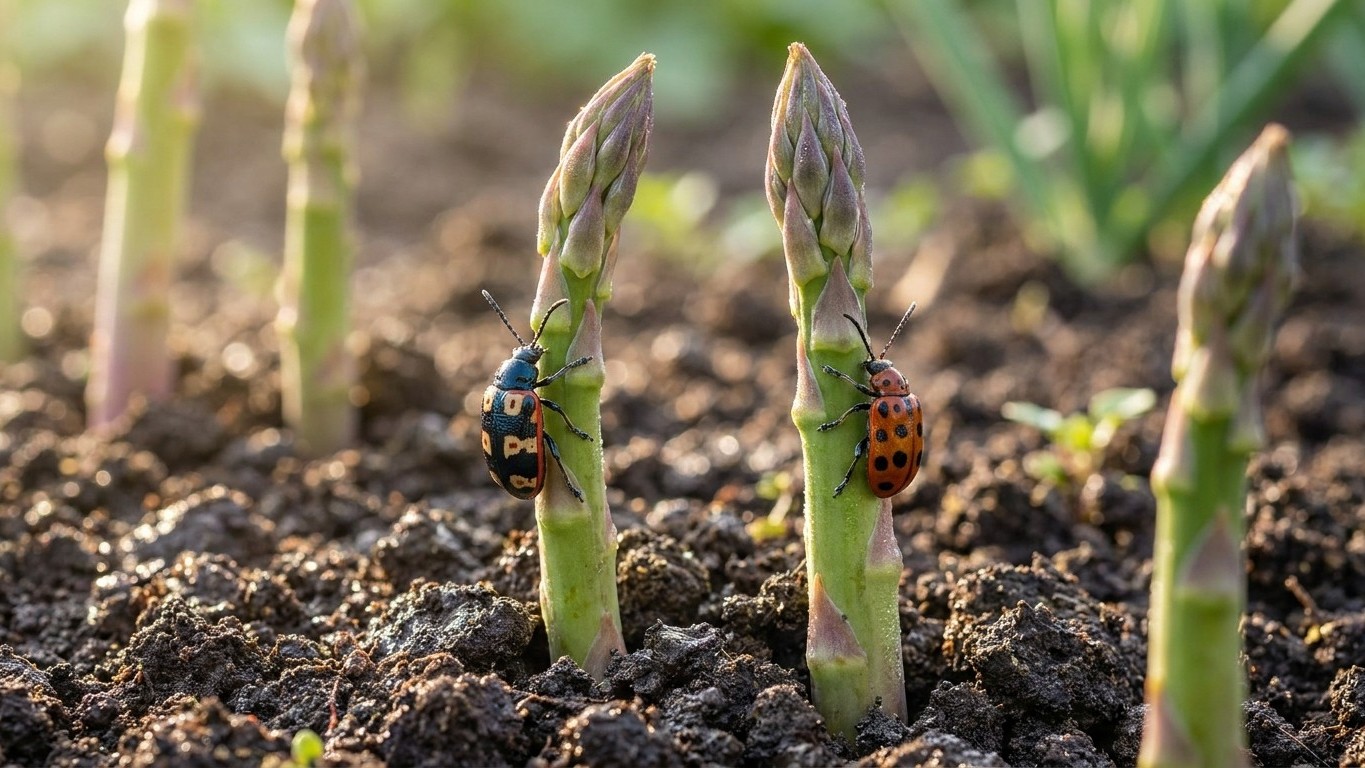

The sources behind this page publish no pest calendar for asparagus, so none appears here. What they do measure is what a bed takes from a Michigan garden: fifteen years of ground, a steady supply of water, and a planting window that sits around the last spring frost. Those three decide whether a bed lasts. For the full overview, start with Growing Asparagus in Michigan.
The short answer
An asparagus bed is a long commitment. Crowns go into the ground, nothing is harvested until year 3, and then the bed produces for 10 to 15 years. The only soil requirement in the source, Utah State University Extension, is that the ground drains: most soils will do provided they are well drained. Michigan’s dominant soil drains well enough. If yours does not, the fix is a different spot or a raised bed, not an annual battle with the ground.
What the state soil tends to do
Michigan’s official state soil, by state law, is the Kalkaska series, a Spodosol. That is a sandy, acid, strongly leached soil, typically formed under conifers. USDA records its surface horizon as 86 percent sand, 5 percent clay and 9 percent silt, and classes it as somewhat excessively drained. Water goes through it fast.
That matters for asparagus in an unexpected way. Most gardeners worry about wet feet. On this kind of ground the worry runs the other way: the crowns will not sit in a puddle, but the bed will dry out quickly (more on that in the next section).
Two more numbers need a caveat. The surface pH for the series is about 4.7, strongly acid, and organic matter is about 75.0 percent. Neither describes your garden. An organic-matter figure that high means the mapped surface is a natural layer of forest litter or peat, which a cultivated bed will not have. The asparagus source says nothing about soil pH, so this page won’t invent a target. A soil test gives you your own number.
When your own ground does not drain
The state soil is a starting point, not a diagnosis. A state has hundreds of soil series, and river bottoms, clay pockets and any lot a builder has scraped or filled will behave nothing like Kalkaska. A heavy clay bed that stays soggy is an annoyance with tomatoes, because you amend it next season. With asparagus you only get one shot, since the crowns stay put for a decade or more.
The practical check is simple. Dig a hole where the bed would go, fill it with water after a wet spell, and watch how long it takes to empty. If it sits for a long time, move the bed to higher ground or build it up above the surrounding grade. That is general gardening judgment, not a figure from the source. For a closer look at the question, see Will Michigan Soil Hold an Asparagus Bed for Fifteen Years?
Will the summer here water it for you?
Partly. The bed wants 1 to 2 inches of water every other week for its first two years, then every three weeks after that. Michigan’s summer rain comes close to that on paper, but sandy ground and thunderstorm-style rain can erase the benefit.
What the rain gauge says
NOAA NCEI’s most recent 30-year normals, for reference station USW00094847, show about 10.0 inches of rain across June, July and August, out of 34.3 inches for the whole year. By month: June 3.26 inches, July 3.51, August 3.26. August is listed as the driest summer month. My own arithmetic on those monthly totals gives roughly 1.5 inches in an average two-week stretch, which sits inside the 1 to 2 inch target.
Those are normals, not a forecast, and they come from one station. A slope, a city or a rain shadow changes the picture, so a rain gauge on your own plot settles it.
The watering routine
- Put a gauge in the bed. Count what actually falls, not what the forecast promised. A normal fortnight gives about 1.5 inches, but real fortnights swing well above and below that.
- Years one and two: every other week, make sure the bed has received 1 to 2 inches in total. Rain counts toward it. Add water only for the shortfall, and top up to the full 2 inches in a hot stretch.
- Year three onward: stretch the interval to every three weeks, using the same 1 to 2 inch target.
- On sandy ground, watch closely. A sandy surface lets rain through within the day, while clay holds it for a week. A summer that looks wet on paper can still leave a Kalkaska-type bed thirsty, and heat speeds the drying. Rain that arrives as a single storm mostly runs off rather than soaking in.
The gardener’s share, then, is the gap between the gauge and the target. In a normal fortnight that gap is small. In a dry one it could be the whole 1 to 2 inches, and on sand it may come around sooner than the calendar says.
When to put the crowns in
Crowns go in during early spring. In Michigan that lands around the last frost, which MSU Extension puts at around April 30 in the Detroit area and early to mid May across most of the Lower Peninsula. A mean frost date is an average, so some years it comes earlier and some later.
Anchoring the date
The source says early spring but does not state how many days before or after the last frost to plant, and I won’t make up a number. Treat the Detroit-area date as a marker and the early-to-mid May range as the wider guide for the Lower Peninsula. MSU’s frost-free dates for the Upper Peninsula are not published here, so check your local extension office there. Our companion piece, When to Plant Asparagus Crowns in Michigan, goes further into timing.
Crowns are planted in furrows 8 inches deep. Do not fill the furrow all at once. Backfill it gradually through the year, about 2 inches every other month, so the shoots always have something to push through.
Starting from seed instead
Seed is the alternative to buying crowns. It means growing your own plants first, and the three-year count in the source is written for crowns, so I wouldn’t promise the same timeline from seed. A sowing date for seed is not published in the facts behind this page.
Four varieties are named, with only their sex given. Jersey Giant and Jersey Knight are all-male. UC 157 F1 and Purple Passion are male/female. Nothing is published on flavor, yield or why to prefer one, so there is no basis here for recommending any of them. The only authority for this page is Utah State University Extension.
Common questions
Is there a pest calendar for Michigan asparagus?
Not here. The sources behind this page do not cover insects, deer or other animals, and a made-up schedule would be worse than none. Your county’s MSU Extension office is the place to ask.
Can I cut a few spears in the second spring?
No. Nothing is harvested until year 3. After that, the harvest runs 4 weeks, then 6 weeks, then 8 weeks in the following years. Cutting early is a trade of future years for one meal.
How do I know when to stop harvesting?
Stop when most spears are thinner than a pencil. That is an object to look at, not a date on the calendar, so it holds whatever the weather did that spring.
How should I keep cut spears?
Aim for 32 to 35°F with near-saturated air, 95 to 100 percent humidity, according to UC Davis Postharvest. Both edges bite: above 50°F spears toughen within hours, and at about 31°F or lower they freeze and go soft when thawed. In a home kitchen, standing the cut ends in water or wrapping them damp is the practical way to hold that humidity, since spears lose water through the cut end faster than anywhere else.