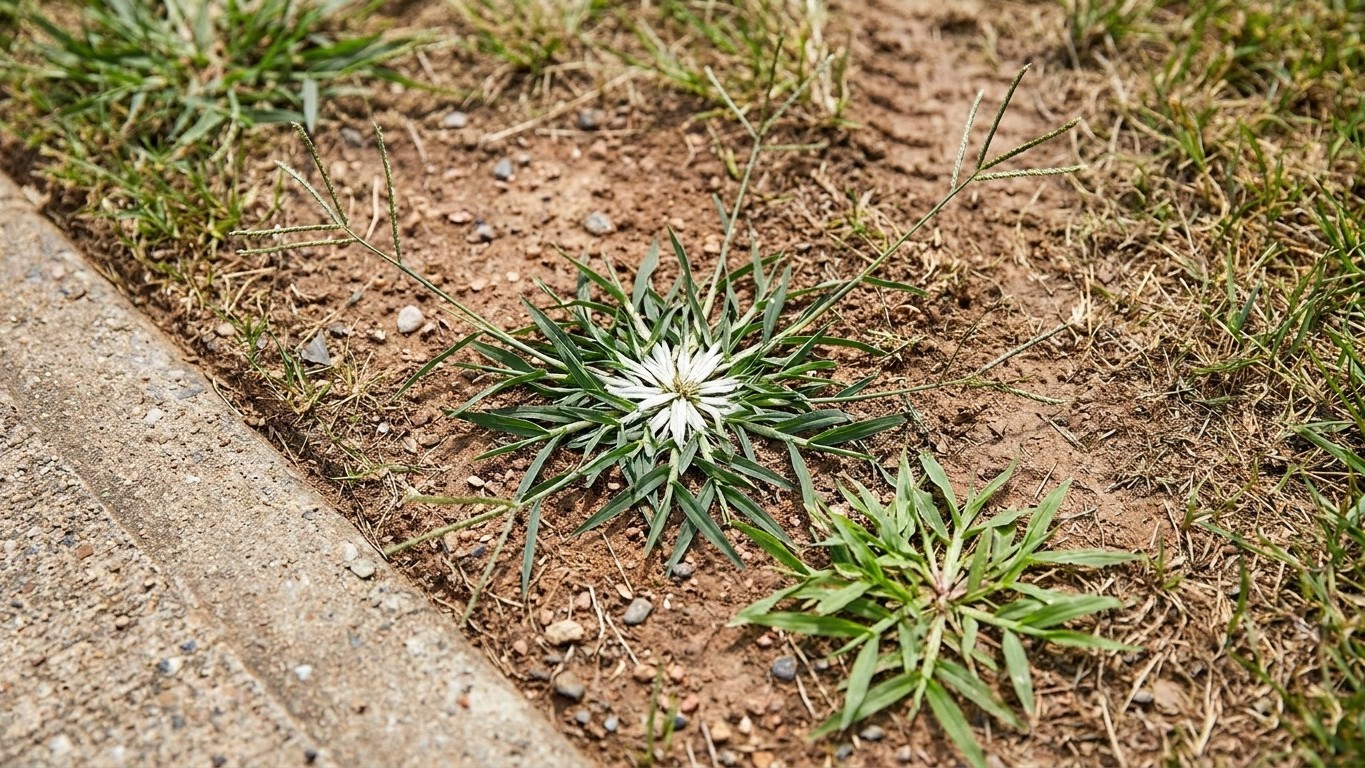

Most New Hampshire lawns do not need dethatching at all. If a spade-cut wedge shows more than 0.75 inch of thatch, the best window is late summer into early fall, while the soil is still warm and seed has time to establish before freezing weather. Spring, after the last frost passes, is the backup. Here is how to check yours, and how to choose between the tools.
Do you need to dethatch at all?
Thatch is the tan-brown, spongy layer of dead stems and roots that sits between the green blades and the soil. It builds up when the grass produces organic matter faster than soil microbes can break it down. Heavy nitrogen feeding, frequent shallow watering, and compacted or acidic soil all slow that breakdown. Grass clippings get blamed a lot, but they are mostly water and rot quickly. Letting them fall is rarely the cause.
The only reliable test takes two minutes. Cut a wedge out of the lawn with a spade, lift it out, and look at its side. Measure the brown, springy band between the green growth and the dirt. Extension turfgrass guidance, including material from Clemson Cooperative Extension and Penn State Extension, puts the line like this: under 0.5 inch is healthy, and action is warranted above 0.75 inch. Between those numbers, leave it alone and measure again next year. Take wedges from three or four spots, since thatch is rarely uniform across a yard.
A thin layer is actually useful. It cushions foot traffic and insulates the crown of the plant. Trouble starts when it gets thick enough that roots grow up into it instead of down into soil. Water runs off, fertilizer sits on the surface, and the roots stay shallow. A lawn like that browns fast in a July dry spell and winters poorly.
Why the grass type matters
New Hampshire lawns run on cool-season species: fine fescues, Kentucky bluegrass, perennial ryegrass, rough bluegrass, and tall fescue. Warm-season grasses such as bermuda or zoysia are not a fit here. They stop growing and go dormant when the weather cools, and the winters are too cold for them to reliably come back. A patch of one would turn straw-colored in September and might not return in spring.
Among the cool-season types, Kentucky bluegrass and the creeping fine fescues spread by underground stems, which makes them the likeliest to build thatch. A bunch-type lawn of tall fescue or perennial ryegrass usually stays under the threshold. If you have a lawn like that, a wedge measurement may save you a weekend. For the full process, see our guide to Dethatching a Lawn.
The season to do it in New Hampshire
Dethatching tears up the turf, so you want to do it when the grass is growing hard enough to fill the gaps within a few weeks. For cool-season lawns, that means early fall. Soil is still warm from summer, nights are cooler, rain tends to be more reliable, and weeds are fading instead of exploding. In most of the state, that points to late August through mid-September, shifting a bit earlier at higher elevations.
Work backward from frost. In NOAA NCEI’s 1991-2020 U.S. Climate Normals, one airport weather station used as the reference for this page puts the first fall frost between October 13 and October 26. These are the dates in the 30 to 70 percent probability band for a 32°F freeze, and you can see the underlying data in the NOAA NCEI normals file. Treat that as a reference-city figure, not a statewide guarantee. Suburban and rural yards typically get their first frost one to two weeks earlier than an airport station, and hill towns can see it sooner than that. If you want seed to be well established before the freeze, count your own calendar back from your own frost date.
Spring is workable but less forgiving. The same station’s last spring frost band runs April 16 to April 27, and again, yards outside the airport’s setting usually see it one to two weeks later. Wait for the lawn to green up and begin growing, and for the frost window to pass in your area. Then there is the crabgrass problem. If you apply a pre-emergent herbicide in spring, it blocks grass seed as well as weed seed, so you have to choose between overseeding and crabgrass prevention that year. In fall, that conflict mostly disappears.
Avoid dethatching in midsummer heat and drought. Stressed grass can’t recover from being ripped, and open soil invites weeds. Avoid late fall too, when seed has no time to germinate. For your county’s frost timing, University of New Hampshire Cooperative Extension is the local source to check. Cold-climate states run on different clocks, as you can see in When to Dethatch a Lawn in Wisconsin and When to Dethatch a Lawn in Alaska.
Rake, power rake, or core aeration
The tool should match the thatch, not the other way around. A thatch rake (the kind with curved, blade-like tines) suits small lawns where the layer is just over the 0.75 inch line. Pull it hard across the surface and you will bring up a surprising amount of brown debris. It is slow, sweaty work, and a few hundred square feet is about the practical limit before your shoulders object. But it is gentle, and cheap if you already own one.
A power rake, also sold as a vertical mower, is the right call for bigger yards or thicker thatch. Rental centers carry them. The spinning blades slice into the thatch and pull it to the surface. Set them shallow at first. Make one pass in one direction, and only a second pass crosswise if the debris is still coming up heavy. Expect the lawn to look rough afterward. Brown, ragged turf is normal for a few weeks, but if you can see large patches of bare soil, you went too deep.
Core aeration is a different tool for an overlapping problem. A machine pulls plugs of soil, and those plugs break down on the surface and mix with the thatch, which helps microbes break it down. It also relieves compaction, which is common on New Hampshire lots with heavy clay or glacial till and years of foot traffic. For a lawn measuring between 0.5 and 0.75 inch, or a lawn with compaction as well as thatch, aeration alone can be enough. It is also easier on the grass than power raking.
Whichever you choose, mow a little shorter than usual first, make sure the soil is slightly moist but not soggy, and rake up the debris afterward. Compost it. Do not leave it on the lawn, or you will have just moved the thatch around.
What the lawn needs afterwards
Overseed right away. Newly opened soil is the best seedbed you will get all year, and a lawn thinned by dethatching fills with weeds quickly if you leave it bare. Use seed matched to your existing grass or to the conditions: fine fescues in shade, tall fescue where it is hot and dry, Kentucky bluegrass in full sun.
Mind the rate. The figures below are pounds per 1,000 square feet for a new lawn, drawn from extension sources including Penn State Extension, the University of Maryland, NC State, Rutgers NJAES, and the University of Illinois. Where those sources differ, the range covers them. Overseeding an existing lawn takes half.
| Grass | New lawn (lb per 1,000 sq ft) | Overseeding (half rate) |
|---|---|---|
| Tall Fescue | 6 to 8 lb | 3 to 4 lb |
| Fine Fescues | 4 to 6 lb | 2 to 3 lb |
| Rough Bluegrass | 2 to 3 lb | 1 to 1.5 lb |
| Kentucky Bluegrass | 1 to 3 lb | 0.5 to 1.5 lb |
| Perennial Ryegrass | 4 to 10 lb | 2 to 5 lb |
More seed is not insurance. Crowded seedlings compete for light and water, and the weaker ones thin out anyway, leaving a patchy stand that is prone to disease.
Water lightly and often until the seed germinates, keeping the top inch of soil damp, then taper off to deeper, less frequent watering. Hold off on heavy nitrogen until the new grass has been mowed a few times, since too much feeds weeds and piles up thatch again. A soil test through UNH Extension will tell you whether your pH is part of the reason the thatch built up in the first place.
Common questions
Can I dethatch in the spring instead?
Yes, once the lawn is actively growing and your local last frost has passed. The reference-city window is April 16 to April 27, and many yards will be later. Just remember that pre-emergent crabgrass products will also stop the new seed.
How often should I dethatch?
Only when a spade-cut wedge shows more than 0.75 inch of thatch. Many lawns never reach that. Check once a year in late summer, and skip the job if the layer is under 0.5 inch.
Is dethatching the same as aerating?
No. Dethatching removes the layer of dead material on top of the soil, while core aeration pulls plugs out of the soil to relieve compaction and speed up thatch breakdown. A lawn with a moderate layer plus compacted soil may only need aeration.
Do I need to dethatch a brand-new lawn?
No. Thatch takes years to accumulate. A new lawn needs steady watering and proper seeding rates for the species you chose, and a wedge check after a few seasons.