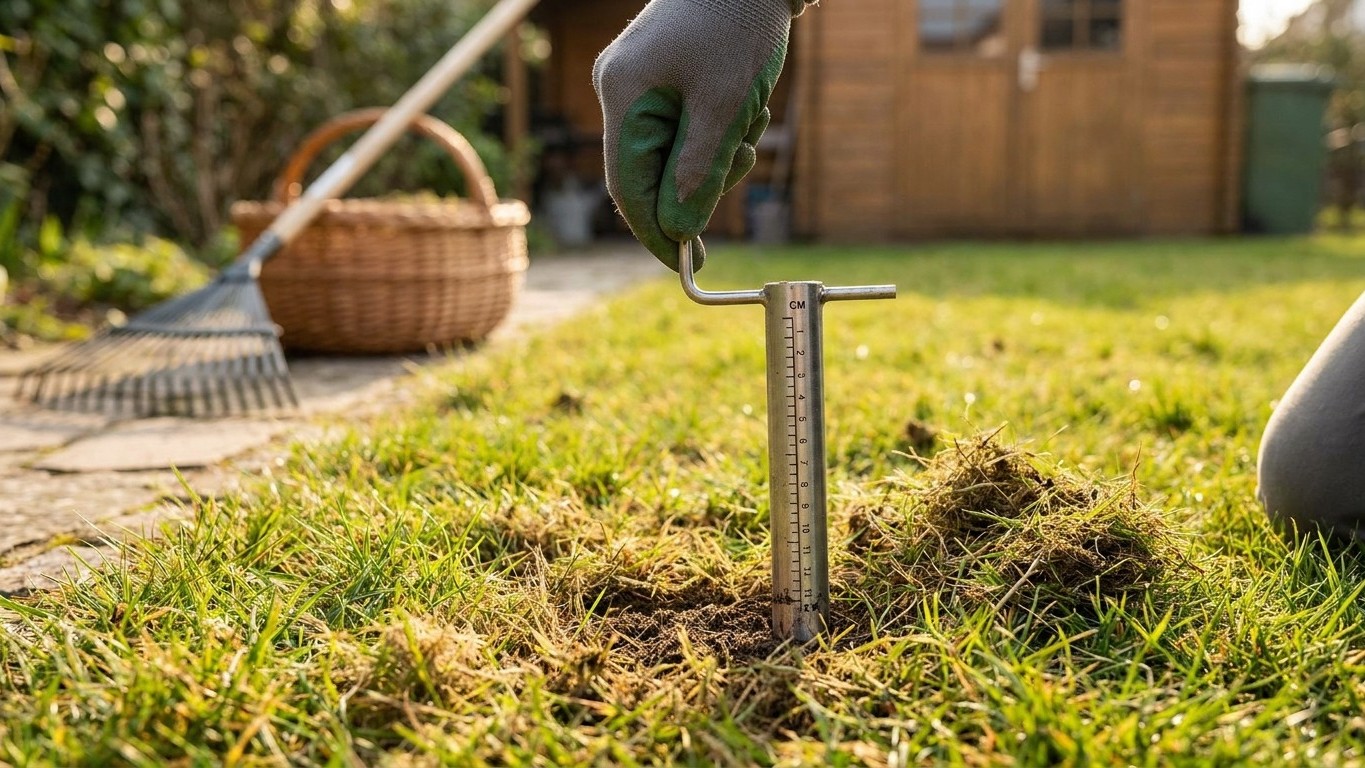

Pull a wedge of turf about four inches deep with a spade and look at what lies between the green blades and the soil surface. That spongy brown layer is thatch, and its thickness relative to the crown zone growing through it, not the color or density of the grass on top, is the one measurement that tells you whether to dethatch. If the layer is clearly thicker than the crowns sitting above it, plan to dethatch during the grass’s active growing season. If it’s thin, mow and water instead and leave the rake alone.
Why this matters
Dethatching sits near the back of any lawn care checklist, because it only makes sense once mowing height and watering are already right. A lawn does not show a bad dethatching decision the day you make it. Dethatch a dormant lawn, or run a power rake too deep, and the turf can still look green that afternoon.
The damage surfaces two to four weeks later, when the stressed crowns fail to push new shoots and bare patches show up right where the machine tore hardest. By the time you notice, the growing window for repair may already be closing on you for the season.
The opposite mistake costs just as much. A lawn that actually needs dethatching but never gets it develops a mat that sheds water instead of absorbing it, so fertilizer and irrigation sit on top and never reach the root zone. The thickness of that layer, checked directly, is the only way to tell which problem you actually have. Guessing from appearance alone is the most common error, because thin, yellowing turf can mean thatch, compacted soil, or a nutrient shortfall, and each of those has a different fix. Treating the wrong problem wastes an entire growing season, and the mistake doesn’t become obvious until the next stress event finds a lawn already weakened by the wrong treatment.
When to do it
Cool-season grasses and warm-season grasses are active in opposite halves of the year, and the right time to dethatch follows that split exactly. Get the category wrong and you’re pulling a rake through turf that’s shutting down, not growing, with no energy left to recover from the wounds.
Cool-season lawns
Fine Fescues, Kentucky Bluegrass, Perennial Ryegrass and Rough Bluegrass are cool-season species, according to Penn State Extension’s Lawn Establishment guide, and Tall Fescue is cool-season as well, per Clemson Cooperative Extension’s HGIC 1214. All five grow most actively in spring and again in fall, once summer heat breaks. Fall, while the grass is still actively growing but before it slows for winter, is the safer of the two windows, because the recovery period runs into the grass’s strongest growth phase instead of into summer stress. For the rest of the sequence dethatching fits into, the fall lawn care routine covers what comes before and after it.
Warm-season lawns
Bahiagrass, Bermudagrass, Carpetgrass, Centipedegrass, Seashore Paspalum, St. Augustinegrass and Zoysiagrass are warm-season species, per Clemson Cooperative Extension’s HGIC 1214. They green up in late spring and grow hardest through summer, so that’s the dethatching window, once the lawn is fully green and growing, not at the first sign of color. Clemson publishes a maintenance calendar for several of these species individually, including HGIC 1215 for Centipedegrass, HGIC 1216 for Bermudagrass, HGIC 1217 for Zoysiagrass and HGIC 1218 for St. Augustinegrass, and each lays out that species’ own seasonal task list. Tall Fescue, despite being cool-season, gets its own calendar too, HGIC 1219, because it’s grown widely enough in warmer regions to need separate treatment from the true warm-season species.
How to do it

Run the plug test first
Confirm the thatch layer before committing to a machine. Cut a wedge about four inches deep and three inches wide with a spade, angle it out of the ground, and look at the cross-section: green blades on top, then a spongy tan or brown layer of undecomposed stems and roots, then soil. Roll that layer between your fingers. If it’s dense enough that you can’t see soil through it and roots are running sideways through the mat instead of down into soil, dethatch. If it’s thin and roots are clearly anchored in soil, skip it this cycle.
Mow low before you dethatch
Set the mower to the low end of your grass’s normal range a few days beforehand, so the tines reach the thatch instead of just clipping blades. Kentucky Bluegrass and Perennial Ryegrass mow at 2 to 3 inches, Fine Fescues and Tall Fescue at 2.5 to 3.5 inches, and Bermudagrass as low as 0.75 to 1.5 inches, all per Penn State Extension and Clemson Cooperative Extension’s HGIC 1214. Never drop below the bottom of your species’ published range, even temporarily, since scalping the crown removes the same growing point the thatch is already smothering.
Choose the tool for the job
- Dethatching rake: a stiff, curved-tine hand rake, workable on a light layer over a small lawn, slow on anything larger.
- Power rake (vertical mower): spinning vertical blades that slice thatch and pull it to the surface, the standard rental for a moderate to heavy layer.
- Core aerator: pulls plugs of soil and thatch together instead of slicing, gentler on the turf and useful when the lawn is thin rather than obviously matted.
Work in one direction on the first pass and rake up debris before it dries into a mat on top of the grass. A lawn this size sheds more material than most people expect, plan on filling several tarps or a truck bed for an average yard.
Water and feed afterward
Dethatching opens wounds in the crown zone, so irrigate right after to help recovery and keep exposed soil from drying out. Hold off on nitrogen until new growth is visible, then follow the rate for your species in Clemson Cooperative Extension’s HGIC 1201, Fertilizing Lawns, rather than guessing at a number.
What goes wrong
The most common failure is timing, not technique. Dethatching a cool-season lawn in the heat of summer, when it’s naturally slowing down, or a warm-season lawn before it has fully greened up in spring, hits the grass while it has the least energy to recover. The tell is bare, thin patches that show up two to four weeks after the work, right where the machine ran hardest, long after the rental equipment is back at the counter.
Setting the tines too deep is the second failure, and it’s easy to do on an unfamiliar rental machine. Instead of skimming the thatch, the blades gouge into soil and shred the crowns the grass regrows from. If you see soil being thrown up along with brown debris on the first pass, stop and raise the depth setting before running the rest of the lawn.
Skipping irrigation afterward is the third failure. A dethatched lawn left dry for even a few days loses the exposed crowns to desiccation faster than an undisturbed lawn would, and that damage looks identical to a bad dethatching job even though the tool did its work correctly.
The last failure is treating dethatching as the fix for every thin, patchy lawn. Compacted soil produces the same symptoms, thin turf and water running off instead of soaking in, but the fix is aeration, not raking. A soil test settles whether the problem is compaction, a nutrient issue, or the thatch layer itself, before you spend a weekend on the wrong tool.
How this changes across the country
A cool-season grower and a warm-season grower are working on opposite clocks, and the biggest regional difference is simply which season counts as active growth. In northern lawns growing Kentucky Bluegrass, Perennial Ryegrass or Fine Fescues, fall is the low-risk window, per Penn State Extension. In the Deep South, where Bermudagrass, Centipedegrass, St. Augustinegrass and Zoysiagrass dominate, per Clemson Cooperative Extension’s HGIC 1214, the window sits in late spring through summer instead, and dethatching in what feels like early spring often means working before the grass has actually greened up.
The transition zone, the band of states hot enough in summer to stress cool-season grass but cold enough in winter to damage warm-season grass, is where neither answer fits cleanly. Homeowners there often grow Tall Fescue, Zoysiagrass or Bermudagrass within a few blocks of a neighbor running a different species entirely, and Clemson Cooperative Extension gives Tall Fescue its own maintenance calendar, HGIC 1219, separate from the true warm-season species, precisely because its growth pattern doesn’t match either extreme.
Grass choice is part of the regional picture too, because tolerance for the wear dethatching adds on top of everyday traffic varies by species:
| Species | Season | Mow height | Drought tolerance | Wear tolerance |
|---|---|---|---|---|
| Tall Fescue | Cool-season | 2.5 to 3.5 in | Fair | Fair |
| Kentucky Bluegrass | Cool-season | 2 to 3 in | Fair | Good |
| Zoysiagrass | Warm-season | 0.75 to 2 in | Good | Very good |
| Bermudagrass | Warm-season | 0.75 to 1.5 in | Excellent | Excellent |
| St. Augustinegrass | Warm-season | 2.5 to 4 in | Good | Fair |
Penn State Extension publishes the Kentucky Bluegrass figures and Clemson Cooperative Extension’s HGIC 1214 publishes the rest, and they matter here because a species rated only fair for wear, like Tall Fescue or St. Augustinegrass, shows dethatching stress longer than one rated good or excellent, like Bermudagrass or Zoysiagrass.
Common questions
Can I dethatch and aerate on the same day?
Yes, and aerating first is usually easier because it loosens the soil the dethatching machine then has to work through. Water the lawn a day or two beforehand so the aerator pulls clean plugs, then run the dethatcher once the surface has dried enough to walk on without leaving footprints.
How much thatch is actually too much?
There’s no single figure that applies to every lawn, because tolerance depends on the grass species and on how the soil underneath behaves. The plug test is more reliable than any published number, since it shows the actual condition of your own lawn rather than a general guideline.
Will dethatching kill my grass?
Not if it’s done in the right season and at the right depth, though the lawn will look rough for a few weeks afterward. Brown, thinned turf right after dethatching is stress, not death, and a lawn treated at the correct time typically fills back in during its next active growth phase.
Do I need to dethatch every year?
Most lawns don’t build up thatch fast enough to need it annually. Check with the plug test each season instead of working on a fixed schedule, since a lawn with healthy soil biology can go several years between treatments while a compacted or overfertilized one may need it sooner.