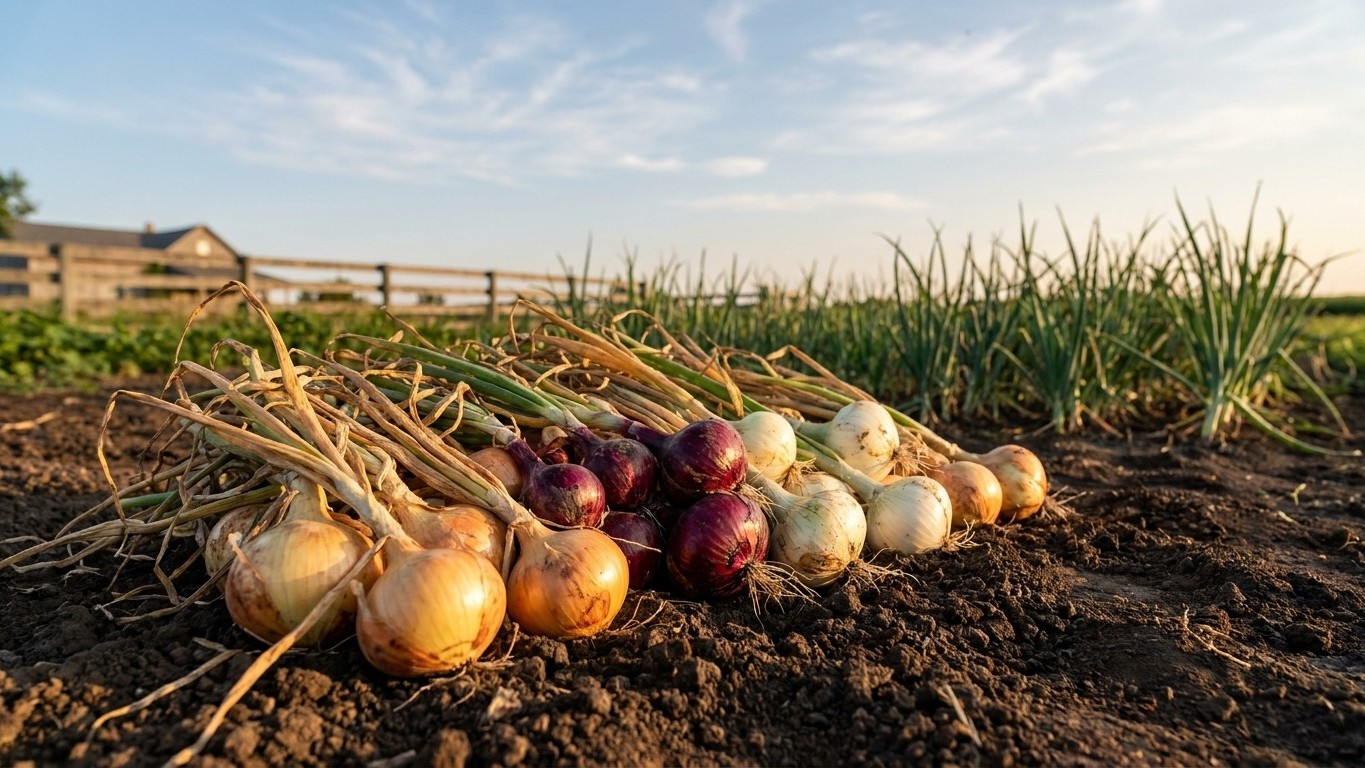

Lift Louisiana onions once the tops fall over and the necks go soft, then cure them in dry, shaded, moving air until the necks are tight and the skins turn papery. Only then do they go into storage. Skip the curing and a bulb that looked perfect in the garden turns soft in the pantry within weeks. The plant’s own signals matter more than the calendar, and those signals trace back to how an onion decides to stop making leaves.
The short answer for Louisiana
New Orleans sits at 29.99 degrees north, and its longest day, at the June solstice, delivers 13 h 56 of daylight. That figure is calculated from the latitude of the NOAA NCEI station used for this site’s climate normals, with a geometric horizon, so real daylight runs a few minutes longer. Short-day onions begin bulbing at about 12 hours of daylight, according to Clemson Cooperative Extension. Louisiana clears that line early in spring and keeps climbing well past it, so a short-day onion here swells early and finishes early.
Reading the tops
Each green leaf becomes one ring of the bulb. Once day length triggers bulbing, the plant stops adding leaves, and what it has is what you get. When the tops start to yellow and fall over, the plant is telling you the job is done. Bend a few over yourself if the rest are slow, wait for the necks to soften, then loosen the soil with a fork and lift on a dry day. Pulling while the tops are still stiff and green leaves a thick, wet neck that rots first.
Curing, step by step
Curing dries the outer skins and seals the neck so rot has no easy way in. Louisiana’s humid air makes this the hard part. Spread the bulbs in a single layer on screens or racks, somewhere shaded, roofed against rain and breezy: a covered porch, an open carport, or a garage with a box fan running. Leave the tops on while they dry. When the necks are tight and the skins are papery, trim the dry tops and roots and brush off loose soil. Do not wash them.
The brief version of storage comes from Clemson’s Home & Garden Information Center: “Ideal conditions are between 45 °F and 55 °F, and 50 to 60 percent humidity.” Dry, which is the opposite of what carrots and other roots want. One cellar cannot serve both well. For the wider picture of growing them here, see Onions in Louisiana.
What will not work here
Several common habits fail in Louisiana, and none of them fail gently. A long-day onion planted here makes leaves all season and never forms a proper bulb, because the day never reaches the 14 to 16 hours it waits for. Then it rots in the ground. There is no harvest to time.
Lateness fails differently. Planting late does not push the harvest back, it shrinks it. Whatever size the plant has reached when day length triggers bulbing is the size of the bulb, and a seedling set out after the trigger will bulb small whatever you feed it.
- Long-day varieties (14 to 16 hours): they cannot bulb at 13 h 56, so they give leaves, no bulb, then rot. Anything labeled long-day belongs to the north.
- Late-planted transplants: the bulb stops growing when the plant has made its leaves, so a small plant at bulbing time means a small onion.
- Onions lifted with green, upright tops: the neck is still wet and thick, and it is the usual entry point for rot.
- Uncured bulbs in storage: loose skins and open necks spoil the whole crate, not one bulb.
- Bruised, nicked or insect-damaged bulbs: eat these first. What Eats Onion in Louisiana, and When covers which damage to expect.
- Sweet varieties held past winter: they do not keep, however well you cure them.
Variety choice decides most of this before you ever plant. The Best Onion Varieties for Louisiana sorts the short-day types that fit here.
What changes across Louisiana
The 29.99 figure belongs to New Orleans, not the whole state. Louisiana stretches from the Gulf marshes to the Arkansas line, roughly three degrees of latitude, and that gap is enough to shift the schedule. Day length grows with latitude in summer, so a gardener in the northern parishes gets more daylight than the 13 h 56 shown for New Orleans.
| Where | Latitude | What it changes |
|---|---|---|
| New Orleans (reference city) | 29.99 degrees north | Longest day of 13 h 56; short-day onions bulb early and mature early |
| Gulf coast, south of the reference | Slightly lower than 29.99 | Slightly shorter summer day; earliest, warmest and wettest curing conditions |
| North Louisiana | Check your own; several degrees farther north than the Gulf | Longer summer day, later frosts in spring ending later, harvest can trail the coast by a couple of weeks |
That “couple of weeks” is a reasonable expectation, not a published figure, so verify it against your own garden. Day length for specific northern parishes is not published here. The practical effect is that a gardener in the far north is still in short-day territory, but sits closer to the line where intermediate types make sense.
The reference city also colors your curing odds. Coastal humidity makes the drying stage slower and riskier, so a fan and a roof matter more there than on a hillside in the north of the state.
Sweet now, or onions that last
Louisiana’s short-day onions run sweet, and that is a trade, not a bonus. The bite of an onion comes from volatile sulfur compounds, and those same compounds protect the bulb in storage. A sweet variety carries fewer of them. It tastes better raw and spoils sooner.
University of Missouri Extension states the rule plainly: “As a rule, ‘sweet’ onions do not store as well as the more pungent types.” It lines up with day length too. Short-day types run sweeter, long-day types keep longer, so a southern garden gives onions to eat soon and a northern one gives onions that feed a household into March.
So what does your pantry look like in March? If you grew sweet short-day onions and cured them well, expect a thinning crate: some bulbs sprouting, a few going soft at the neck, the sweetest ones long gone. A sharper short-day variety will hold firmer and longer, though nothing grown here will last like a northern storage onion. Plan accordingly. Eat the sweet bulbs first, within the first weeks after curing, and save the more pungent ones for later in the year. Never expect a sweet onion to be the one still sound in March.
Checking this against your own garden
Everything above is anchored to one station in New Orleans. Your garden may differ, so run these checks this week:
- Look up your own latitude, especially if you are in north Louisiana or well off the Gulf coast, and compare it with 29.99.
- Find your local frost dates from your parish extension office (Louisiana counts in parishes, not counties). The LSU AgCenter office serves each parish.
- Note when your own tops start to fall, and keep a record. Your garden’s pattern beats any general date.
- Test your curing spot with a cheap hygrometer. If the air is damp, add a fan and a roof.
- Check your storage spot against 45 °F to 55 °F and 50 to 60 percent humidity.
Common questions
Can I lift onions before the tops fall over?
You can, and some gardeners eat them fresh that way. For storage, wait. Green onions pulled early have thick, wet necks that do not cure well and usually rot first.
How long should I cure Louisiana onions?
No set number of days is published here. Cure until the necks are tight and the skins are papery. Damp, humid weather stretches that time, so a fan and good airflow help.
Should I wash onions before storing them?
No. Brush off loose soil after curing. Water on the skins invites rot, and storage wants dry conditions.
Can I store onions in the refrigerator?
Whole, cured onions prefer a dry space at 45 °F to 55 °F, which a household refrigerator usually is not. Keep them dry and ventilated, and store them away from damp root crops.