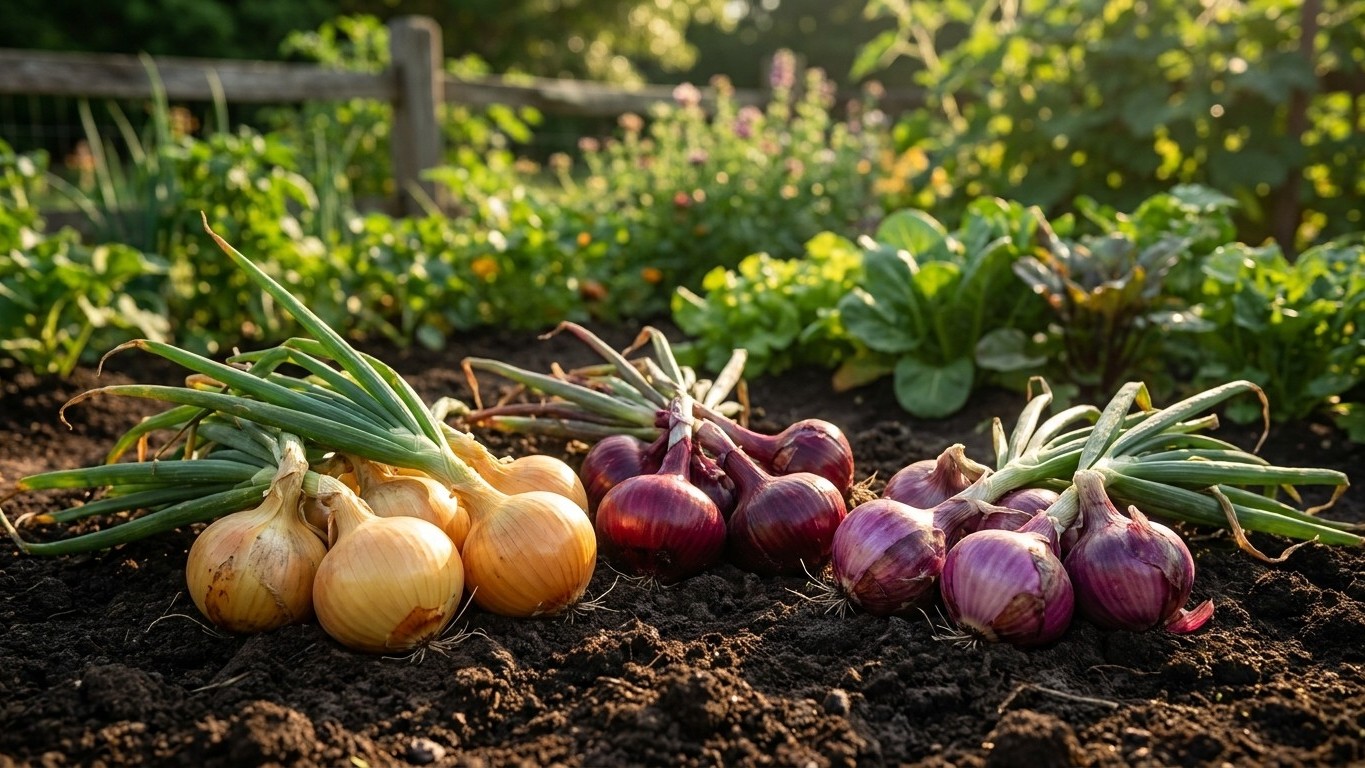

Louisiana sits at 29.99 degrees north, and on the longest day of the year the sun gives it 13 hours and 56 minutes of daylight. That number decides everything. Onions read day length, not temperature, to know when to stop growing leaves and start building a bulb, and at this latitude the answer is short-day varieties: Texas Grano 1015Y, Vidora, Red Sensation, Gabriella, and Madalyn. Everything else on the seed rack is built for a different sun.
The short answer for Louisiana

Short-day onions begin bulbing once the day length reaches roughly 12 hours, a threshold documented by Clemson Cooperative Extension’s Home & Garden Information Center. Louisiana’s 13 hours and 56 minutes at the summer solstice clears that bar easily, which is exactly why short-day types are the only group that reliably finishes here. Five varieties with a published range that covers the reference latitude of 29.99N, the coordinates of a National Weather Service station near New Orleans, fit this garden without qualification: Gabriella and Madalyn, both rated for 20 to 35 degrees north, and Red Sensation, Texas Grano 1015Y, and Vidora, all rated for 25 to 35 degrees north.
Two more sit close enough to the edge of their published range that they belong in the “probably, but check” pile rather than the “yes” pile: Red Rock, rated 30 to 36 degrees north, and White Castle, rated 30 to 38 degrees north. Both start their range just north of the reference latitude. A gardener in New Orleans is sitting right at the boundary, not comfortably inside it, so treat these two as a gamble worth trying in a small bed rather than a sure thing for the whole plot.
None of this has much to do with warmth. Louisiana’s winters are mild enough that gardeners often Plant Onions in fall rather than waiting for late winter, the way growers further north have to. But the variety choice itself is governed entirely by how many hours of daylight the plant gets once it’s actively growing, and at just under 14 hours on the longest day, this state simply never generates the day length that other onion types are waiting for.
What will not work here
This is the part of onion-growing advice that gets skipped most often, and it’s the part that actually saves a gardener a wasted season. Intermediate-day and long-day onions are not slower or weaker performers in the Deep South. They are varieties bred to trigger bulbing at 13 to 16 hours of daylight, a threshold Louisiana’s sun never reaches even on June 21. Plant one anyway and the result isn’t a smaller onion. It’s leafy growth all summer, followed by rot, with no bulb ever forming. Twenty-four varieties documented on this site fall into that category for this latitude:
- Ailsa Craig (long-day, 38-60N), needs far more daylight than the Gulf Coast ever provides
- Barolo (long-day, 38-55N), same gap, no bulb trigger reached
- Blush (long-day, 38-55N), built for northern summers
- Bridger (long-day, 35-50N), waits for daylight this state can’t supply
- Cabernet (intermediate-day, 35-45N), starts five degrees north of Louisiana’s border
- Calibra (intermediate-day, 35-45N), same shortfall
- Candy (intermediate-day, 33-40N), closest of the intermediates, still out of range
- Elsye (intermediate-day, 32-45N), misses the threshold by a few degrees
- Expression (intermediate-day, 32-45N), same issue
- Frontier (long-day, 40-50N), a northern-plains onion
- Monastrell (intermediate-day, 35-46N), needs longer summer days
- New York Early (long-day, 38-50N), the name says it all
- Patterson (long-day, 38-55N), storage-type, wrong latitude
- Powell (long-day, 43-47N), a narrow northern band
- Red Carpet (long-day, 40-45N), no path to bulbing here
- Red Long of Florence (intermediate-day, 38-50N), out of reach
- Red Long of Tropea (intermediate-day, 35-48N), same
- Redwing (long-day, 43-65N), the most extreme mismatch on this list
- Rossa di Milano (long-day, 38-50N), northern-summer variety
- Safrane (long-day, 42-50N), needs 42N minimum
- Scout (intermediate-day, 32-46N), still north of the state
- Sierra Blanca (intermediate-day, 32-45N), same story
- Talon (long-day, 42-50N), far outside range
- Walla Walla Sweet (long-day, 35-55N), the famous Pacific Northwest onion, and a poor fit for Louisiana soil regardless of variety fame
None of these “may struggle.” They won’t bulb at all. A gardener who plants Walla Walla Sweet or Candy in a Louisiana bed gets a full season of green tops and nothing at the root, because the plant is still waiting for a day length the calendar here can’t deliver.
What changes across Louisiana
Louisiana runs from the Gulf Coast marshes near 29 degrees north up to the Arkansas border above 33 degrees north, a span of roughly four degrees of latitude. The 13 hours and 56 minutes figure belongs specifically to the reference city near 29.99N, close to New Orleans, and it describes the southern half of the state well. A gardener near Shreveport, closer to 32.5 degrees north, gets a longer summer day than that, though the difference amounts to minutes rather than hours.
| Region | Approximate latitude | What it changes |
|---|---|---|
| Southern Louisiana (New Orleans area) | 29.99N | 13h56 on the longest day; short-day onions bulb well within range, Red Rock and White Castle sit at the low edge of their listed range |
| Northern Louisiana (Shreveport area) | ~32.5N | Slightly longer summer day; short-day onions still bulb reliably, and Red Rock and White Castle move more comfortably inside their published 30-36N and 30-38N ranges |
That extra sliver of daylight in the north doesn’t come close to reaching intermediate-day territory, so the exclusion list above still applies statewide. What it does mean is that a gardener in the northern parishes has slightly more room to try the two edge-case varieties, Red Rock and White Castle, with a bit less risk than someone gardening right on the coast. Anyone near either edge of the state, whether that’s the marshes below New Orleans or the hill country near the Arkansas line, is better off checking their own coordinates than assuming the New Orleans figure applies exactly to their yard.
Sweet now, or onions that last
Every short-day onion suited to Louisiana carries the same trade-off, and it isn’t a marketing quirk. The compounds that give an onion its bite are volatile sulfur compounds, and those same compounds are what protect the bulb from breaking down in storage. Fewer sulfur compounds means a milder, sweeter onion on the cutting board, and also a bulb that starts softening within weeks rather than months. University of Missouri Extension puts it plainly in its onion-growing guidance: sweet types don’t store as well as pungent ones, because pungency and shelf life come from the same chemistry.
Short-day varieties, the only ones that work at this latitude, run toward the sweet, short-keeping end of that spectrum almost by definition. Texas Grano 1015Y and Vidora are grown specifically for mild flavor, which is a selling point in July and a limitation in January. A Louisiana gardener isn’t choosing between sweet and long-keeping. The latitude has already made that choice.
What that means in practical terms is a pantry that looks different from one further north. A gardener in Minnesota growing long-day, high-sulfur onions can reasonably expect some of that harvest to still be sound in March. A Louisiana gardener growing short-day onions should plan to eat or preserve most of the crop within a few months of harvest, because the bulbs that taste mildest in the kitchen are also the ones with the least natural defense against rot. Pickling, freezing chopped onion, or simply timing meals around the harvest window covers the gap that variety choice alone can’t close.
Checking this against your own garden
Every figure in this article is tied to one specific point on the map, near 29.99 degrees north. Louisiana gardeners outside that immediate area, especially those closer to the northern border, are working with a slightly different day-length curve, and the difference matters more the further you get from the reference point. A few checks take care of that gap before a single seed goes in the ground:
- Look up your own latitude, not just “Louisiana,” especially if you garden north of Alexandria or right along the coast
- Confirm your local average first and last frost dates, since Louisiana’s mild-winter timing for fall planting can still shift by a few weeks between the coast and the northern parishes
- Call or check the website of your parish office of the LSU AgCenter Cooperative Extension Service for planting windows calibrated to your specific parish
- If you’re considering Red Rock or White Castle, treat them as a trial planting in a small section rather than your main crop, since both sit right at the edge of their documented range here
- Keep a note of which variety you planted and how it bulbed, since that record is more reliable for your own yard than any statewide average