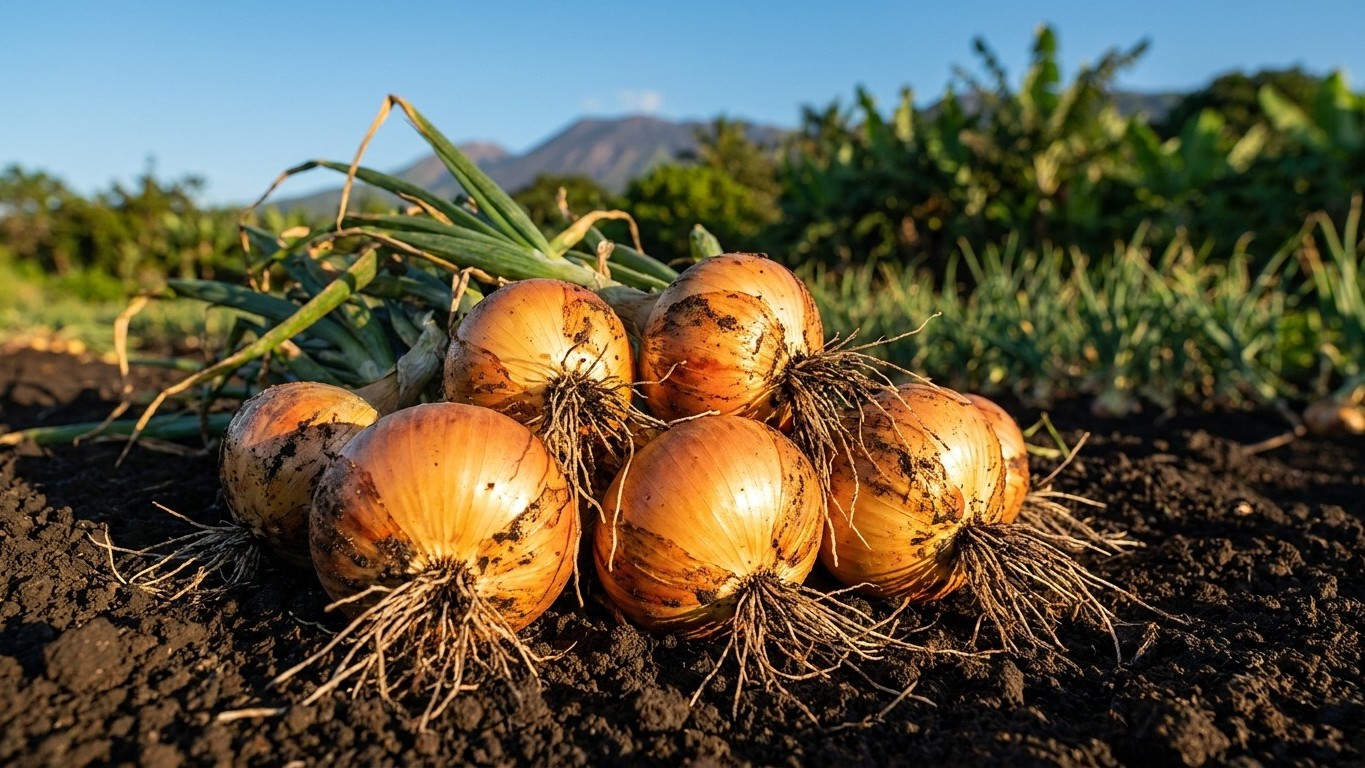

Lift onions in Manitoba once most of the tops have yellowed and flopped over, on a dry day, then cure them in a warm, airy, rain-free spot until the necks are tight and the skins rustle like paper. Only then do they go into storage. The calendar matters less than the plant. Tops that are still green and upright mean the bulb is still filling, and pulling it now costs you weight.
The short answer for Manitoba
Winnipeg sits at 49.92 degrees north, and on the longest day of the year it gets 16 h 08 of daylight. That number explains most of what follows. Onions don’t bulb because the weather warms up. They bulb when the days reach a certain length, and a long-day variety waits for 14 to 16 hours before it switches from making leaves to making a bulb. Winnipeg clears that bar with room to spare, which is why long-day onions are the natural fit here (the variety question gets its own treatment in The Best Onion Varieties for Manitoba).
The tops tell you when
Each leaf of an onion becomes one ring of the bulb, so the leaf growth the plant has made before bulbing starts sets the ceiling on bulb size. After that, the plant draws sugars down from the foliage into the bulb. When the neck softens, the tops fall over and the leaves start to brown, that transfer is nearly done. A bulb pulled earlier is smaller and has a thick, wet neck that invites rot in storage. A bulb left far too long, in a wet spell, can start to regrow roots and split its skins.
Pick a dry day, loosen the soil with a fork if it’s heavy, and lift the bulbs gently. Bruising matters. A dent you can barely see on harvest day becomes a soft spot by midwinter.
Curing is a drying job, not a waiting game
Curing dries the outer skins and seals the neck, the place where decay gets in. Lay the bulbs in a single layer on screens, racks or slatted crates, tops still attached, somewhere warm with moving air and shelter from rain. A covered porch, an open garage or a shed with the door propped open all work. Don’t set a clock on it. This page doesn’t publish a fixed number of days, because the answer depends on how humid the weather is. The test is physical: the neck should be tight and dry when you squeeze it, and the outer skins should be papery.
Once cured, trim the tops to an inch or so and brush off loose soil without washing. Clemson Cooperative Extension puts ideal storage conditions at “between 45 °F and 55 °F, and 50 to 60 percent humidity.” That is dry air, the opposite of what carrots and beets want.
What will not work here
Most failed onion harvests in Manitoba come from a handful of habits rather than from the climate. Late planting is the first. Planting late does not delay the harvest, it shrinks it. Whatever size the plant has reached when day length triggers bulbing is the size of the bulb, and the plant won’t wait for a seedling that got a late start. A transplant set out weeks behind its neighbors heads into the longest days with a few small leaves and produces a small bulb on the same schedule as everyone else’s.
Short-day varieties are the second. They start bulbing at about 12 hours of daylight, and Manitoba passes that mark in spring, long before the plants have grown much foliage. The result is early bulbing on tiny plants and onions that stay small, however good the soil is. In a garden at this latitude they are a poor use of space.
The mistakes that cost you bulbs
- Pulling onions with green, upright tops: the bulb is still filling, and the thick, moist neck stays open to rot.
- Storing bulbs straight from the ground: uncured skins and necks hold moisture, so decay starts in the first weeks.
- Curing in the rain or in a damp basement: the skins never dry, and the bulbs mold instead of curing.
- Cutting the tops off green at harvest: an open, wet stump is a doorway for rot, so leave the tops on until the neck is dry.
- Washing bulbs before storage: the added moisture undoes the curing and loosens the protective skins.
- Keeping onions with carrots or other damp-loving roots: onions want 50 to 60 percent humidity, and a single cellar cannot hold both well.
- Storing bruised or damaged bulbs with sound ones: one soft bulb spreads rot to its neighbors, so eat the damaged ones first.
Pest damage belongs on that list too. A bulb that has been tunneled by maggots or chewed at the base rarely keeps, and the opening is the same entry point for decay. What Eats Onion in Manitoba, and When covers what to look for, and anything with obvious damage should go to the kitchen first rather than into the storage crate.
What changes across Manitoba
The figures above come from Winnipeg, a single station at the southern end of a province that stretches from the U.S. border at the 49th parallel to the 60th parallel in the far north. Most Manitoba gardeners live in the southern strip, so Winnipeg is a fair reference. But the province is more than ten degrees of latitude tall, and a garden near the edge of that range behaves differently.
| Location | Latitude | Longest day | What it changes |
|---|---|---|---|
| Winnipeg (reference city) | 49.92 degrees north | 16 h 08 | Long-day onions get the 14 to 16 hours they need |
| Southern edge, near the U.S. border | About 49 degrees north | Slightly shorter than Winnipeg | Long-day onions still bulb; bulbing starts a little later in the season |
| Far north, toward the 60th parallel | Approaching 60 degrees north | Longer than Winnipeg; not calculated here | Day length is no obstacle, but the season for leaf growth and curing is shorter |
Why the north is about the season, not the daylight
Moving north gives onions more summer daylight, not less. That is why northern gardens suit long-day onions and southern gardens farther down the map cannot grow them. The constraint in northern Manitoba is the calendar. A shorter frost-free window leaves less time to build leaves before bulbing starts and less time to lift and cure before cold, wet autumn weather arrives. A grower there should expect to lift later in relation to the season but earlier in relation to the first hard weather, so the curing spot matters more.
The same logic applies in the south, only milder. A gardener near the border may see bulbing begin a touch later than in Winnipeg, and the lifting window may stay open a little longer. None of this changes which group of onions belongs in Manitoba. It changes how much margin you have between lifting and the first stretch of wet or freezing weather.
Checking this against your own garden
Winnipeg’s numbers are a starting point, not a verdict on your plot. The longest-day figure and the lifting window both shift as you move away from the reference station, and no province-wide figure applies to every garden in it. A few checks you can make this week:
- Look up your own latitude, using a map app or a weather-station page for your town, and compare it with 49.92 degrees north.
- Find your local first-frost date, and don’t borrow Winnipeg’s. This page does not publish one.
- Walk the onion bed and note how many tops have fallen over, how thick the necks are, and whether any bulbs show damage.
- Pick your curing spot now: somewhere dry, warm and airy, with shelter from rain and room for a single layer.
- Measure the temperature and humidity where you plan to store the crop, with a cheap thermometer and hygrometer, against the 45 °F to 55 °F and 50 to 60 percent range.
Where to get local answers
Your local Manitoba Agriculture office or regional extension contact can give you frost dates and conditions for your own area, and they know how the season has run locally. For a broader view of what to grow and when, Onions in Manitoba is the parent page for this whole set.
Common questions
Can I leave onions in the ground after the tops fall over?
For a short time, yes, if the weather stays dry. Sitting in wet soil after the tops go down invites rot and can trigger new root growth, so lift once the tops are down and the forecast is clear. If heavy rain is coming, pulling the bulbs and curing them under cover is safer than leaving them in the ground.
How long does curing take?
This page doesn’t carry a fixed number of days, because warm dry air cures onions faster than a damp week does. Use the feel test instead. The neck should be tight and dry with no moisture when squeezed, and the outer skins should be papery. If you still find a soft or damp neck, keep curing.
Can I store onions in the same cellar as carrots?
Not well. Onions keep best in dry air, 50 to 60 percent humidity, while carrots and other roots need damp conditions to avoid shriveling. If you have only one cool space, give the onions the driest corner, away from the roots, and check them more often.
What should I do with thick-necked or damaged bulbs?
Set them aside and use them first. A thick neck usually means the bulb never finished maturing, so it holds moisture and rots before the others do. Bruised or pest-damaged bulbs also don’t keep. Cure them with the rest if you like, then keep them in a separate container near the kitchen so one bad bulb never spoils a whole crate.