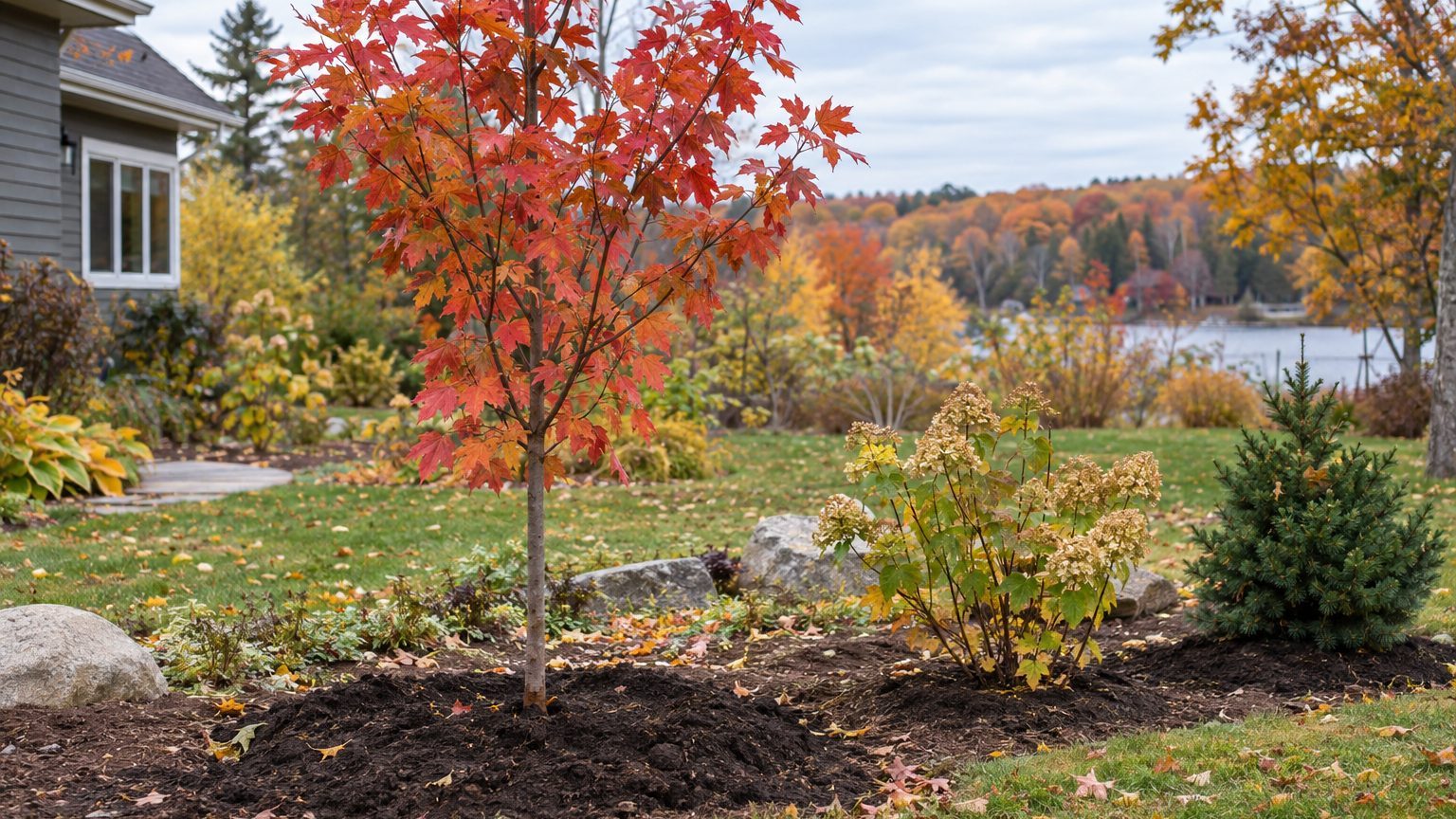

There is no fall planting deadline in lowland Hawaii. The ground does not freeze where people live, so the mainland rule of finishing weeks before a freeze has nothing to count back from. Fall and winter rank among the best times to put trees and shrubs in the ground, because the sun is gentler and the cooler months tend to bring more rain to many areas. What limits you here is rainfall, elevation, and which side of the island you garden on. What follows covers how to use that freedom well.
The deadline in Hawaii
Fall planting rules exist because roots, not leaves, decide whether a tree survives its first year. Roots keep growing as long as the soil is workable and above freezing, long after the air has turned cold. Cornell Cooperative Extension in Orleans County, New York, states the northern version in a single sentence: “Fall is an excellent time for transplanting, provided you get them to their new home at least 6 weeks before the ground freezes, allowing them time to establish roots before winter dormancy.” (Cornell Cooperative Extension, Orleans County). Note what the clock runs from. It is the day the ground freezes, not the first frost in the air, and the soil freezes later than the air does.
What the Honolulu numbers say
To use that rule, you need a freeze date. Hawaii does not supply one. The NOAA NCEI 1991-2020 Climate Normals for the Honolulu reference station (USW00022521) show zero days per year at or below 32°F. Every freeze percentile at 32°F and 36°F comes back flagged as not computable, which is the data’s way of saying there is no freeze to measure. The mean daily minimum of the coldest month is 66.8°F, according to the same NOAA normals. Soil under those conditions never comes near freezing.
So Cornell’s six-week countdown has no endpoint to start from. In the inhabited parts of the islands, the deadline simply does not apply. Plant whenever the site and the plant are ready, from fall straight through winter, because no frost-based cutoff exists.
Cool-season planting still has real advantages. Roots spread into warm soil while the sun is less punishing, and in many places the rains return and do some of the watering for you. A tree set out in the cooler months gets a head start before the next stretch of dry, hot weather.
A statewide range, one reference city
The USDA Plant Hardiness Zone Map (2023 edition, built on 1991-2020 normals) lists 9a-13a for Hawaii. That figure rests on one variable, the average annual extreme minimum temperature, and it covers the entire territory. It is a range, not a verdict for your yard. For dated advice, this article uses Honolulu as the reference city, and other parts of the territory differ, especially up the slopes where nights run cooler.
Frost does occur in Hawaii, but only on the high volcanic summits: Mauna Kea, Mauna Loa and Haleakala. It never reaches the places where people garden. If you want the fuller picture of why a frost calendar makes no sense here, see First and Last Frost Dates in Hawaii. For a contrast, gardeners in Texas still have to work back from a real freeze, and How Late Can You Plant Trees and Shrubs in Fall in Texas? shows what that countdown looks like.
What to plant late, and what to wait on
In a place where cold never ends the growing season, the usual sorting of “safe” and “risky” plants gets reshuffled. The questions are no longer about surviving a freeze. They are about whether the plant matches the rainfall, wind and temperature of the exact spot you chose.
Plants that settle in easily
Container-grown trees and shrubs that suit your site are the easiest to plant at any point from fall through winter. Their roots already sit in a defined mass, and when that mass goes into warm soil, the plant can push roots outward right away. Balled-and-burlapped trees work too, though the ball is heavy and holds only part of the root system the tree once had, so plant them promptly and keep the ball from drying out while it waits. Set either type at the same depth it grew, and remove twine and any wire or synthetic wrapping that would later girdle the trunk. The general technique is laid out in Planting and Caring for Trees, Shrubs and Perennials.
“Fully hardy” means something different here than on the mainland. At the Honolulu reference station, the coldest month still has a mean daily minimum of 66.8°F, so cold hardiness is rarely the limiting factor at low elevation. Plants that suit your rainfall and sun exposure will settle in whenever you plant them.
Plants worth waiting on
Two groups deserve more caution. The first is plants rated for warmer conditions than your own location offers. The 9a-13a range covers the whole territory, so it tells you little about a cool upland site. Check a plant’s rating against the conditions where you actually garden, not against a statewide figure. The second group is evergreens and other plants that lose a lot of water through their leaves. On the mainland these are the ones that suffer through frozen winters. Here, nearly everything is evergreen, and the threat is dry wind and a long rainless stretch on a leeward slope. If your site is dry, either wait until the rains are reliable or commit to a watering schedule you can actually keep.
| Plant type | Fall and winter planting | What to check |
|---|---|---|
| Container-grown, suited to the site | Good at any point in the cool months | Circling roots; plant at original depth |
| Balled-and-burlapped | Good if planted promptly | Ball kept moist; wrapping removed |
| Plants rated for warmer conditions than your site | Wait or choose another plant | Your own location’s coolest nights, not the statewide range |
| Leafy evergreens on dry, windy sites | Plant when rain is dependable, or irrigate | Wind exposure and a realistic watering plan |
The decision worth writing down: choose plants by rainfall and exposure, not by a frost date, and hold off on any plant whose needs your site cannot meet.
Watering and mulch until the ground freezes
Elsewhere, this advice has an end date: keep watering until the ground freezes. In Hawaii the ground never does, so the stopping point is different. You water deeply until the roots have spread beyond the original planting hole and the rains (where they come) carry the load. That takes longer on a dry leeward coast and less time on a wet windward slope.
Water deeply, then step back
A new tree or shrub has lost much of its root system on the way from nursery to hole. Its top is still sized for the old roots. For that reason the first season is about roots, not growth. Whatever leaf flush you see in the first months says little about how the root system is doing underground, and pushing top growth with heavy fertilizer or hard pruning works against the plant. Let it spend its energy rebuilding below ground.
Water slowly enough that moisture soaks well past the original root ball, so roots are drawn outward into the surrounding soil. Then let the top layer dry a little before the next watering. Frequent shallow sprinkling keeps roots near the surface, which is the opposite of what you want. On a windward site where rain falls often, a new planting may need only occasional help. On a dry leeward lot, weekly deep soaks may be the difference between an established tree and a failed one. Watch the soil, not the calendar.
Mulch in a ring, not a volcano
Mulch helps most where water is the main worry. NC State Extension’s Gardener Handbook (chapter 11, Woody Ornamentals) gives two guidelines with the same order of depth. For weeds: “A 2-inch to 3-inch layer of mulch suppresses most annual weed seeds and makes it easy to hand-pull any that do germinate.” For trees: “Provide a 3-inch layer of mulch to reduce water loss and maintain uniform soil moisture and temperature around roots.”
Apply it as a wide, flat ring around the planting area, and keep it pulled back from the trunk so bark stays dry and visible. Keep the layer within the 2-inch to 3-inch range; more is not better, and heaping it against the trunk is how a ring turns into a volcano that holds moisture against the bark and invites rot. The practical details are in Mulching Without Killing the Plant. In heavy-rain areas, that discipline matters even more, since a thick, soggy mulch pile never gets a chance to dry out.
What goes wrong
The northern problems that don’t travel
Most fall-planting warnings come from freezing climates: planting too late for the ground to stay workable, winter burn on evergreens from frozen soil that cannot supply water, and shallow root balls pushed up by freeze and thaw. None of these has a mechanism in lowland Hawaii, where the ground does not freeze and the NOAA normals for the reference station show zero days per year at or below 32°F. Transposing a northern deadline onto the islands would only cost you the best planting months. Skip the northern deadline and plan around rainfall, elevation and exposure instead.
The problems that do show up here
Drying out is the big one. A tree planted on a leeward slope and left to depend on rain can run short of water quickly, especially when winds are steady. The same tree on a windward slope may face the opposite problem, with roots sitting in saturated soil after heavy rain and poor drainage turning a healthy plant into a struggling one.
Several quieter mistakes follow from the same root cause:
- Choosing a plant that wants more or less water than the site delivers
- Planting too deep, which buries the trunk flare and invites rot
- Piling mulch against the trunk instead of leaving a clear ring
- Judging success by leaf flush instead of by how the plant holds up through its first dry spell
Most of these come down to the same rule: in a place without a freeze, the site tells you more than the calendar does. Learn how your own lot handles rain and wind before you pick a plant, and the planting date mostly takes care of itself.
Common questions
Is there a cutoff date for fall planting in Hawaii?
Not from frost. The NOAA normals for the Honolulu reference station show no fall freeze, so there is no fall planting deadline from frost. Rainfall, elevation and windward versus leeward exposure are the real limits.
Does the Cornell six-week rule apply here?
No. Cornell Cooperative Extension counts back from the day the ground freezes. In the inhabited parts of Hawaii, the ground does not freeze, so there is nothing to count back from. The rule matters only where soil actually turns hard.
Can I plant trees and shrubs in winter?
Yes, and the cooler months are often a good choice. Mean daily minimums in the coldest month stay at 66.8°F at the Honolulu reference station, and roots can keep growing. Confirm that the plant suits your site’s rainfall and exposure, and that your location is not a cooler upland where nights run colder than the statewide zone range suggests.
How deep should I mulch new plantings?
NC State Extension recommends a 2-inch to 3-inch layer for weed suppression and a 3-inch layer for trees to reduce water loss. Keep it in a ring pulled back from the trunk. For more on conditions across the islands, the Hawaii guides cover local differences in climate and gardening.