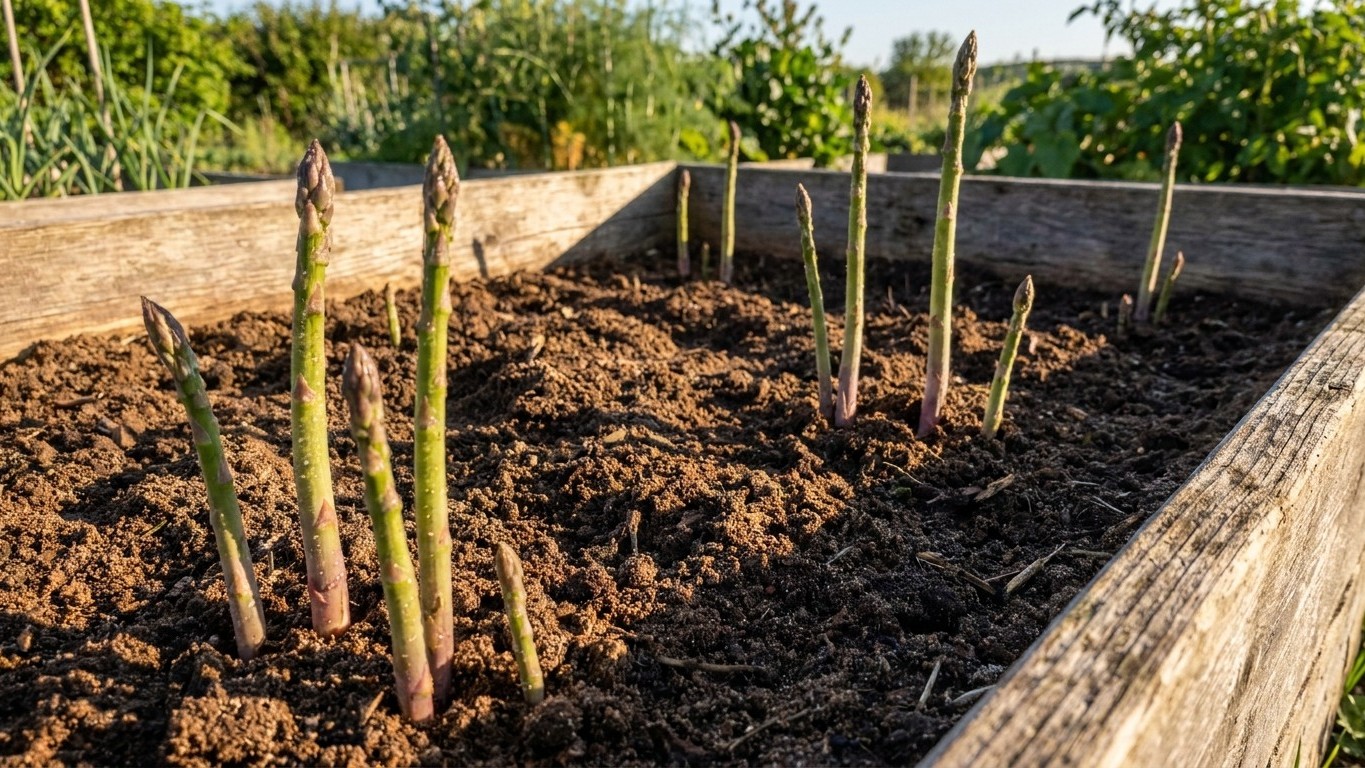

Stop cutting when most of the spears coming up are thinner than a pencil. No calendar date replaces that signal. The age of the bed also caps the season: no harvest at all until year 3, then four weeks, then six, then eight. What makes those spears worth keeping (drainage, water, planting time) gets settled years earlier, as laid out in Growing Asparagus in Delaware.
The short answer
A bed of asparagus lasts 10 to 15 years. That makes the ground underneath it a long commitment rather than a seasonal choice. The only soil requirement Utah State University Extension gives is that the soil drains, and most soils will do if they do. So the real question for a Delaware gardener is whether the local ground sheds water or hangs onto it.
What the state soil suggests
Delaware’s official state soil is the Greenwich series, and by the numbers it passes the test. It is well drained, a loam to silt made of 48 percent sand, 9 percent clay and 43 percent silt, with about 1.7 percent organic matter. It is also an Ultisol, an old, heavily weathered and leached soil that is naturally acid and low in nutrients. The surface pH of the series runs about 6.0, slightly acid. That is the series’ figure, not yours, and the Extension source is silent on pH for asparagus, so there is no published asparagus target to compare it with here.
Low fertility can be fixed. A bed that stays wet cannot. Elsewhere on this site, a heavy soil is an annual nuisance you amend each season. With asparagus, you choose a spot for up to fifteen years, so poor drainage becomes a decision you cannot undo once the crowns are down.
If your ground does not drain
The Greenwich series represents the state, not your back yard. Delaware holds hundreds of soil series, and low ground, river bottoms and any lot a builder scraped or filled can behave nothing like it. A new-construction yard with compacted fill is the classic trap. Before committing, dig a test hole where the bed would go, fill it with water, and watch how long it takes to empty. If water lingers well after it should have sunk in, pick another spot. A raised bed filled with free-draining soil is the usual fallback, though I would treat it as a second choice to naturally drained ground. A soil test through your county Extension office gives you your own numbers. For the longer version of this decision, see Will Delaware Soil Hold an Asparagus Bed for Fifteen Years?
The slow clock
Crowns go into furrows 8 inches deep, and the bed is not harvested until year 3. The first cutting season runs four weeks, the next six, and after that eight. Those are ceilings, not targets. If most spears are already thinner than a pencil before the window closes, you stop early. Spears that keep coming after the last cut grow out into ferns, and that leafy growth is what the bed lives on until the next spring.
Will the summer here water it for you?
Delaware summers are not dry. The reference station records about 13.1 inches of rain across June, July and August, out of 45.3 inches for the whole year. June brings 4.67 inches, July 4.41, and August, the driest of the three, 3.98. These are 30-year normals for one station. They describe what the region can usually expect, not a forecast, and not the reading on your plot.
Setting the rain against the bed’s appetite
A young bed wants 1 to 2 inches every other week for the first two years, then every three weeks. Spread evenly, the summer normals work out to roughly 2 inches in any two-week stretch, even in August. On paper, the sky covers the bill. Real rain does not arrive evenly. A single thunderstorm mostly runs off rather than soaking in, and days at or above 90°F pull moisture out of the ground faster than a drizzle can replace it. Here is how to work out what you actually need to add:
- Put a rain gauge on the bed itself. A slope, a city block or a tree line can make your plot differ from the reference station, and only your own gauge settles it.
- In the first two years, read the gauge every two weeks and compare it with the 1 to 2 inches the bed wants. Add the gap by hand. A fortnight with 1.5 inches in the gauge needs little or nothing. A fortnight with almost none may need the full 1 to 2 inches from the hose.
- Discount storm rain and heat. If most of the gauge total came from one downpour, or the fortnight was full of 90°F days, dig down a few inches and check that the soil is actually damp before you skip watering.
- Account for your soil. Loam to silt like the Greenwich series holds water longer than sand. A sandy patch lets the same inch through within the day, so a plot like that can need more frequent watering even in a wet summer.
- After the second year, stretch the rhythm to every three weeks and use the same gauge method.
When to put the crowns in
Crowns go in during early spring. For Delaware, the 30-year normals from NOAA NCEI put the last 32°F freeze at around April 3 to April 14, using the 30 to 70 percent probability band at the reference weather station, an airport station. A mean frost date is an average, so some springs will freeze later and some earlier. Suburban and rural gardens typically see the last spring frost one to two weeks later than the airport, and more at elevation. Check the date for your own county before you mark a calendar.
Planting the furrow
Crowns are set in an 8-inch furrow, and the furrow is not filled at once. Backfill it gradually across the year, about 2 inches every other month, so the shoots always have a short climb to daylight. Dumping the whole 8 inches back on the first day buries them.
Choosing a variety
The Extension source names four varieties and tells you only their sex. Jersey Giant and Jersey Knight are all-male. UC 157 F1 and Purple Passion are male and female. It publishes no flavor notes, no yield figures, and no reason to prefer one over another, so any claim of a “best” variety here would be invented. I name no nursery, because the only authority behind this page is Utah State University Extension.
The seed route
Growing from seed is the alternative to buying crowns. The planting method and the no-harvest-until-year-3 rule here are given for crowns, and the material behind this page holds no seed timing, so I will not invent one. Nothing published here suggests seed is quicker, so treat the crown schedule as the best case.
Common questions
How do I know it is time to stop cutting this season?
Look at the spears, not the calendar. When most of them come up thinner than a pencil, stop cutting and let the rest grow out into ferns. The four, six or eight week cap is a limit you may hit before that. Once the ferns are up, they draw their own visitors, which What Eats Asparagus in Delaware, and When covers.
Can I take a few spears in the first or second year?
No. The bed is not harvested until year 3. Then comes four weeks of cutting, six the next season, and eight after that. Taking “just a few” early cuts into a plant that is still building the root system meant to carry it for 10 to 15 years.
How do I keep cut spears fresh?
The target is 32 to 35°F with near-saturated air, 95 to 100 percent relative humidity, according to the UC Davis Postharvest Technology Center. Both edges of that window bite. Above 50°F, spears toughen within hours. At about 31°F or lower, they freeze and go soft and water-soaked when thawed. In a home kitchen, high humidity means standing the cut ends in a little water or wrapping them in a damp towel, since spears lose water through the cut end faster than anywhere else. It is worth checking your refrigerator with a thermometer, because the door shelf can run warmer than the back.
Is the airport frost date good enough for my garden?
Use it as a reference, not a guarantee. The April 3 to April 14 range belongs to one airport station, and gardens outside the city typically freeze one to two weeks later. Your county Extension office can tell you what your own area tends to see.