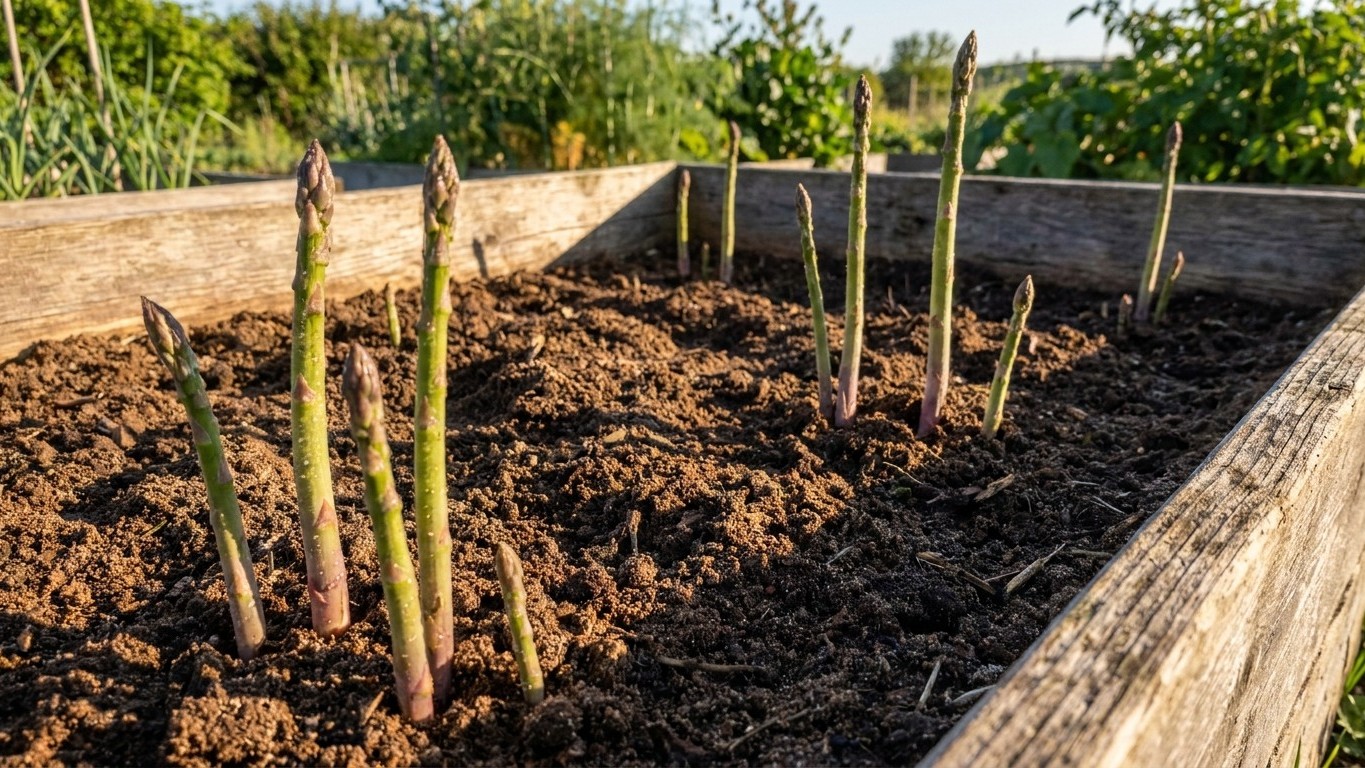

This page carries no verified data on insects or diseases, so it is not a pest list. For a New Mexico bed that has to last 10 to 15 years, what does the real damage is the wrong ground, too little water, and a badly timed planting. The state’s representative soil drains fast, summer rain covers only a slice of what the bed wants, and crowns go in around the first week of April. For the full growing picture, start with Growing Asparagus in New Mexico.
The short answer
Asparagus asks for a long commitment. Crowns go into 8-inch furrows in early spring, nothing gets harvested until year 3, and after that the bed produces for 10 to 15 years. Utah State University Extension, the only authority behind this page, sets one soil requirement: most soils will do, provided they are well drained. That is the whole test.
New Mexico’s state soil is the Penistaja series, an Aridisol. That is a dry-climate soil, usually alkaline and often carrying salts. The values USDA records for its surface layer are sandy: 69 percent sand, 15 percent clay and 16 percent silt. Surface pH is about 7.5, and organic matter is about 1.4 percent. USDA classes it as well drained.
On the one question the source cares about, then, the dominant soil passes. Water moves through sand quickly, so the crown-rot risk that worries gardeners in heavy ground is low here. The trouble sits on the other side of the ledger. A soil with 1.4 percent organic matter holds very little, which pushes the burden onto irrigation (more on that in the next section). The salt note matters too, since salts are one more thing a soil test can put a number on.
Then there is the caveat that decides everything. Penistaja represents the state. It is not the ground in your yard. New Mexico spans hundreds of soil series, and river bottoms, hill country and any lot a builder has scraped or filled can behave nothing like it. The figures above describe the mapped surface layer, not a worked garden bed, and the pH is the state soil’s, never yours.
If your spot does not drain, the decision is harsher than with other crops. A heavy soil in a tomato bed is an annual nuisance you amend each season. Under asparagus it is a fifteen-year problem sitting in a furrow you cannot easily redo. Test before you plant: fill a hole with water and watch it. Water still standing the next morning is a bad sign. The options are to choose a different spot, build the bed up above the existing grade, or give that patch to a shorter-lived crop. A soil test from your county Extension office gives you your own numbers, and Will New Mexico Soil Hold an Asparagus Bed for Fifteen Years? walks through reading them.
Will the summer here water it for you?
No. The bed wants 1 to 2 inches of water every other week for its first two years, then every three weeks after that. Summer in the reference record for this state delivers about 3.5 inches of rain across June, July and August combined, out of 8.8 inches for the whole year. Here is how that plays out.
- Add up what the bed asks for. Across the 13 weeks of summer, a schedule of 1 to 2 inches every other week comes to roughly 6 to 13 inches in the first two years. Once the bed shifts to every three weeks, that drops to about four waterings, but each one is still 1 to 2 inches.
- Set the rain beside it. The monthly normals run 0.57 inches in June, 1.64 in July and 1.31 in August. June is the driest month, and its rain would not cover even a single minimum watering. These are normals for NOAA station USW00023050 over the most recent 30-year reference period, so read them as what the region can usually expect, not a forecast.
- Adjust for sand. On a sandy surface like the state soil, rain passes through within the day. Nothing is banked for the following week the way a clay soil would bank it. Count a rainy week as a modest top-up, not a skipped watering.
- Adjust for heat and storms. Days at or above 90°F drive evaporation. Much of the summer rain also arrives as a single thunderstorm, and a hard downpour mostly runs off instead of soaking in. A half inch in ten minutes is not the same as a half inch spread over a gentle afternoon.
- Measure your own plot. A rain shadow, a slope or a city lot can shift the picture away from the station’s. A cheap rain gauge next to the bed settles the question. Subtract what the gauge reads from the 1 to 2 inches due, and let the hose supply the difference.
The practical takeaway is blunt. Over a summer, irrigation will supply most of the water, with rain playing a supporting role. A gardener who plans on the sky should expect a thin, struggling bed in its first seasons, which is exactly when the crowns are building the roots that carry the next decade.
When to put the crowns in
Early spring. At the reference weather station, the last spring frost falls around March 31 to April 12, based on the 30 to 70 percent probability band for a 32°F freeze in NOAA NCEI’s U.S. Climate Normals. That is an average, and a mean frost date is not a promise. Some years the last freeze comes earlier, some years a week or two later.
Those dates describe one airport. Suburban and rural gardens typically see the last spring frost later than the reference city, often by one to two weeks, and more at elevation. A gardener in the mountains should not copy the April figure. Check the dates for your own county before you mark the calendar, and treat the reference-city dates as a starting line only. The longer discussion lives in When to Plant Asparagus Crowns in New Mexico.
Once the crowns are in the 8-inch furrow, the furrow does not get filled in all at once. It is backfilled gradually through the year, 2 inches every other month, until the ground is level. Rushing that step buries the new growth before it has the strength to push through.
Then comes the long wait. Nothing is harvested until year 3. Not a few spears, not a taste. After that the harvest window grows: 4 weeks in the first harvest season, then 6, then 8. The stopping rule is an object, not a date. When most of the spears are thinner than a pencil, the harvest is over for the year and the plants need their foliage to rebuild.
The seed route
Starting from seed is the alternative to buying crowns. It puts a step ahead of the furrow, since the gardener has to grow the plants before there is anything to set out, so the whole timeline shifts later. The facts behind this page carry no seed-starting dates or depths, so check Utah State University Extension’s asparagus guidance before you commit to that route.
Four varieties are named in that source, and only by sex. Jersey Giant and Jersey Knight are all-male. UC 157 F1 and Purple Passion are male and female. No flavor, yield or reason to prefer one over another is published, so any claim that one tastes better or produces more is not backed here.
Common questions
Does this page cover asparagus beetles, aphids or other pests?
No. The verified facts here cover soil, water and timing, and none of them describe an insect or a disease. Rather than guess, take pest identification to your county Extension office, which can tell you what is active in your area and when.
Can I cut spears the first spring after planting?
No. Nothing is harvested until year 3. After that, the first harvest season runs 4 weeks, the next 6, then 8. Stop when most of the spears are thinner than a pencil.
Which variety should I plant?
The source names four, and only by sex: Jersey Giant and Jersey Knight (all-male), UC 157 F1 and Purple Passion (male and female). It publishes nothing on flavor or yield, so no one can honestly rank them from this evidence. Pick on availability and ask Extension what has done well locally.
How should I store spears after cutting?
The target, per the UC Davis Postharvest Technology Center, is 32°F to 35°F with air at 95 to 100 percent humidity. Both edges bite. Above 50°F, spears toughen rapidly, and at about 31°F or lower they freeze and turn mushy on thawing. In a home kitchen, stand the cut ends in water or wrap them damp, because the cut end loses moisture faster than anywhere else.