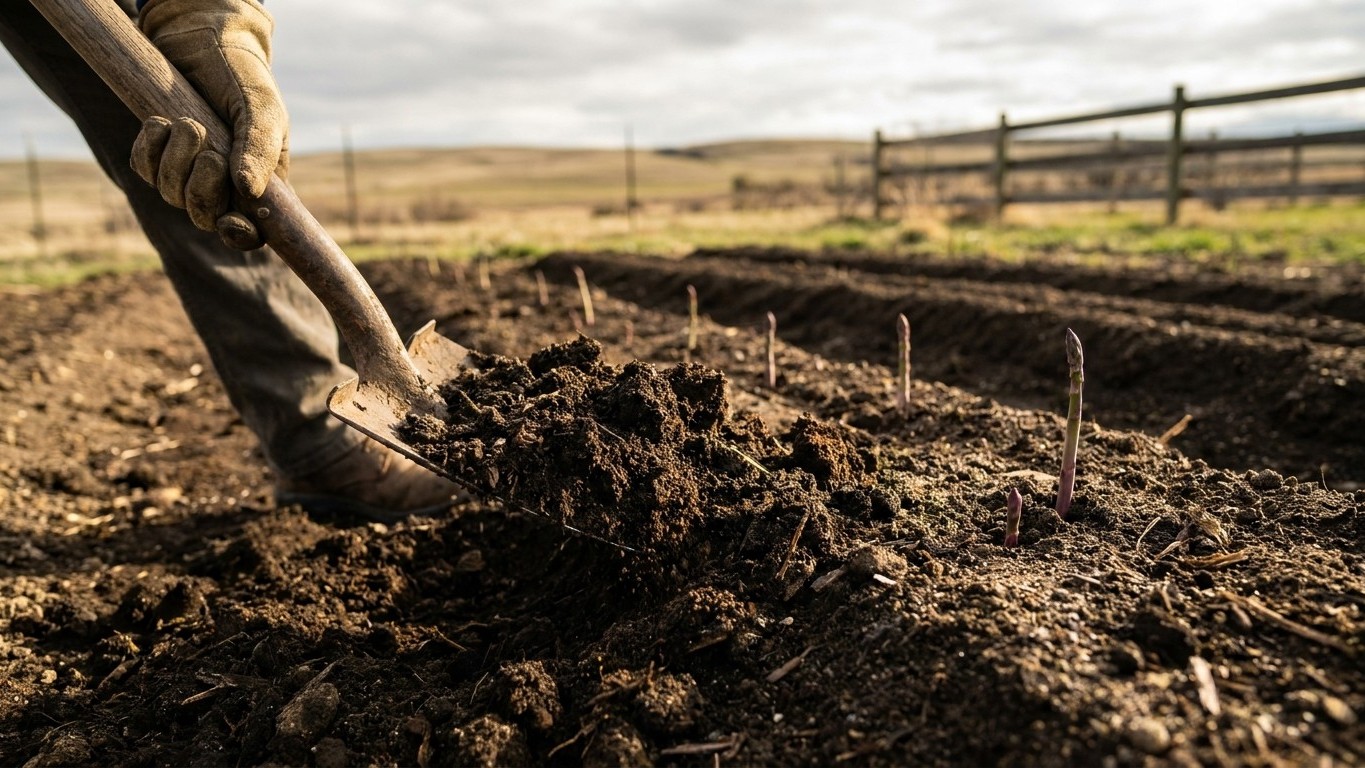

Will New Mexico Soil Hold an Asparagus Bed for Fifteen Years? Asparagus can work in the state for the full 10 to 15 years a bed is expected to produce, and the state’s representative soil gives that plan a reasonable head start: it drains well. But “the state soil” is a single mapped series, not a verdict on any one backyard, and the real answer depends on what a rain gauge and a shovel tell you about your own ground before those crowns go in.
The short answer
Asparagus is a one-decision crop. You pick a spot, plant crowns in furrows about 8 inches deep, wait three full years before cutting a single spear, and then that bed keeps producing for 10 to 15 years. There’s no annual do-over, no rotating it to a better corner of the yard next season. Whatever the soil does in that one spot, it does for over a decade. The source on this, Utah State University Extension, is blunt about what the plant actually needs from the ground: it will tolerate most soils, provided they are well drained. That’s the whole requirement. Not a pH number, not a fertility target, not a chilling requirement, just water moving through and not sitting still. For the specifics on timing that first step, see When to Plant Asparagus Crowns in New Mexico.
Here’s where New Mexico’s representative soil actually helps. The Penistaja series, the soil the USDA lists as representative of the state, is a dry-climate Aridisol that’s about 69 percent sand, 15 percent clay, and 16 percent silt in its surface layer, with organic matter around 1.4 percent. Sandy ground like that sheds water fast, which is exactly the profile asparagus tolerates well. The series is also classed as well drained outright. If your own yard resembles this profile, drainage isn’t the thing that will make or break a 15-year bed.
The catch is that this is a representative series across dozens of mapped components, not a reading of your garden. New Mexico spans river bottoms, high desert flats, and mountain valleys, and any ground a builder has graded or filled will behave nothing like the mapped norm. If a bed of standing water lingers 24 hours after a hard rain, that spot is not the Penistaja profile, no matter what the state series says. The fix in that case isn’t to abandon asparagus, it’s to build up rather than dig down: a raised bed or mounded row lets the crowns sit above a slow-draining subsoil instead of in it.
Variety choice is a smaller decision, and the source is narrow on it. Four are named, distinguished only by whether the plant is all-male or a male/female mix: Jersey Giant and Jersey Knight are all-male, while UC 157 F1 and Purple Passion are male/female. Nothing is published on taste, yield, or a reason to favor one over another, and no nursery is named here. Buy crowns from whatever supplier your local extension office trusts, and don’t expect a flavor argument to settle the choice for you.
The harvest calendar is the part gardeners underestimate. Year three, you cut spears for four weeks. Year four, six weeks. From year five on, harvest can run up to eight weeks. The stopping point every season isn’t a date on a calendar, it’s a visual cue: when most of the spears coming up are thinner than a pencil, harvest is over for the year, full stop, regardless of how many weeks have passed.
Will the summer here water it for you?
Asparagus has a two-stage watering target. For the first two years while roots are establishing, the bed wants 1 to 2 inches of water every other week. After that, once the crowns are settled in, the schedule relaxes to roughly the same amount every three weeks. Neither number changes based on where you live, but what falls from the sky to meet that target changes a lot.
- What the target actually asks for: over a 13-week summer, watering every other week at 1 to 2 inches means somewhere around six to seven watering cycles for a young bed, adding up to roughly 6 to 13 inches of water across June, July, and August combined.
- What New Mexico’s summer delivers: the 1991-2020 normals for this reference station put summer rainfall at about 3.5 inches total across June, July, and August, out of 8.8 inches for the whole year. That’s well under even the low end of what a young bed is asking for.
- Where the shortfall is worst: broken down by month, June is the driest at just 0.57 inches, July climbs to 1.64 inches as the monsoon arrives, and August holds at 1.31 inches. Whatever rain New Mexico gets in summer is concentrated in July and August; June is close to bone dry on its own.
- What that means at the hose: a young bed in its first two summers will need supplemental watering to close a gap of several inches a month, especially through June, when rainfall alone covers only a small fraction of the every-other-week target.
- After the bed is established: the target eases to every three weeks, which lightens the load, but June’s near-drought normal means most New Mexico gardens will still lean on irrigation rather than rainfall to hit that number, even in a mature bed.
None of this is a forecast for your yard specifically. A rain shadow, a slope, or even a nearby building changes how much rain actually reaches your bed compared to the reference station. A simple rain gauge on your own property, checked weekly through the growing season, is what tells you whether you’re really meeting that 1-to-2-inch target or just assuming you are.
When to put the crowns in
Crowns go into the ground in early spring, timed around the last hard frost rather than strictly after it, since a dormant crown underground tolerates cold that would damage an emerging spear. For this reference station, the last spring frost falls somewhere around March 31 to April 12. That’s a mean date built from 1991-2020 records at one weather station, not a promise for any specific spring, and it’s worth treating as a rough window rather than a hard line on the calendar.
That window also tends to run later in suburban and rural gardens than at the airport station the average is drawn from, sometimes by a week or two, and more if your property sits at higher elevation than the valley floor. A garden tucked into a canyon or sitting a few hundred feet higher than town can see frost linger well past when the in-town average says it’s safe. Treat “around March 31 to April 12” as a starting point for planning, then watch your own soil and local forecast before you actually dig the furrows.
The furrow itself runs about 8 inches deep, with crowns spaced along the bottom and only a couple inches of soil pulled over them at first. That furrow isn’t backfilled all at once. As the season goes on, more soil is worked back in gradually, about two inches every other month across the year, rather than filling the whole trench the day you plant. This gradual approach lets the emerging shoots keep pushing up through loose soil instead of fighting through a deep, compacted fill from day one.
Seed is the alternative route, though it adds time rather than saving it. Starting asparagus from seed means an extra year of growth before you have anything resembling a crown ready for the permanent bed, since seedlings first need a season to build up a root system before they’re transplanted out. For most home gardeners, buying crowns and planting them directly in that early-spring window is the more direct path to a bed that starts its three-year wait sooner rather than later.
Checking this against your own county
Everything above describes New Mexico in general terms: a representative soil series, a single reference weather station, statewide normals. None of it substitutes for what your own county extension office can tell you about your specific elevation, microclimate, and soil test results. New Mexico State University’s Cooperative Extension Service, at aces.nmsu.edu, is the named land-grant resource for exactly this kind of local check.
Before committing a 15-year decision to one patch of ground, a call to your county office or a soil sample sent through their program will tell you whether your garden matches the well-drained profile this state’s soil is known for, or whether you’re dealing with something heavier that calls for a raised bed instead. It’s a short phone call against a decade-long commitment.
Common questions
How long does an asparagus bed actually last once it’s producing?
Ten to 15 years is the window from Utah State University Extension, starting only after the first harvest, which itself doesn’t begin until the crown’s third year in the ground.
Is New Mexico’s soil generally suited to asparagus?
The state’s representative soil series, Penistaja, is well drained and sandy, which fits the plant’s only real soil requirement. But that’s a mapped average across dozens of components, not a reading of any single yard, so a local soil check still matters.
When should crowns go into the ground?
Early spring, generally around the last frost window, which for the reference station used here runs about March 31 to April 12. Suburban and higher-elevation gardens often see that date shift later.
Does it matter which variety I plant?
Not according to what’s published. Jersey Giant and Jersey Knight are all-male varieties; UC 157 F1 and Purple Passion are male/female. No flavor, yield, or performance ranking between them is documented in the source used here.