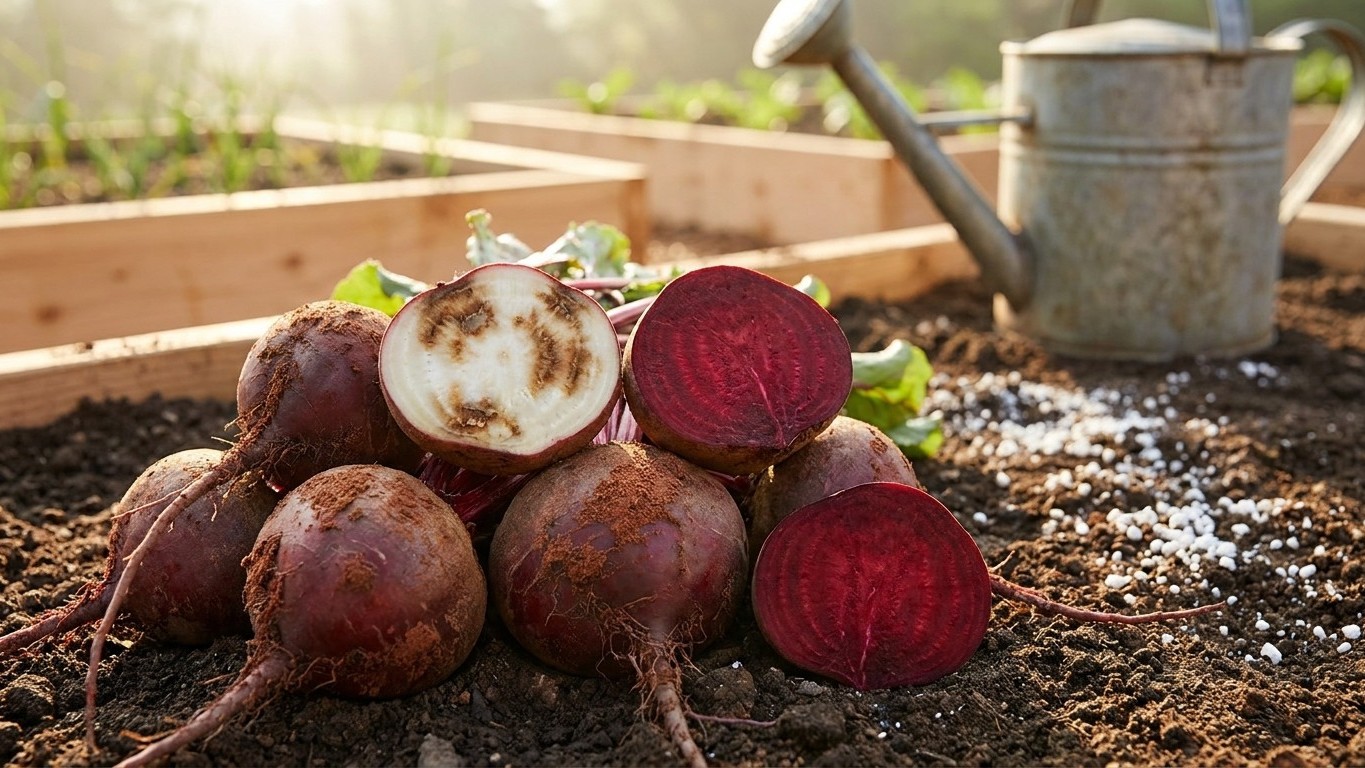

Thirst and heat do most of the damage to a Nevada beet crop, and they hit in different weeks. Water stress in the first six weeks after seeding pushes plants toward flowering. Heat above 85 F combined with water stress later turns the root woody. Storage rot comes last. Insect and disease timing is not covered by the figures behind this page, so your county extension office is the place to ask about local pests.
The short answer
What the state soil says about a beet
Start with the ground. Nevada’s official state soil is the Orovada series, an Aridisol, which is a dry-climate soil that is usually alkaline and often carries salts. USDA’s representative values for its surface layer read 66 percent sand, 8 percent clay and 26 percent silt, with a surface pH of about 7.5 and organic matter near 1.4 percent. It is well drained.
For a beet, that is half good news. Utah State University Extension describes the ideal as deep, sandy, well-drained soil rich in organic matter, so the texture and drainage line up. The 1.4 percent organic matter does not. Sand lets water through fast and holds little of it, which means a bed like this runs dry quickly. The same extension guidance caps compost at no more than 1 inch per 100 square feet, so you can improve a lean bed, but you cannot build one in a single season.
Treat all of this as a starting point. A state spans hundreds of soil series, and these are the values USDA records for the mapped surface of the major components of this one, not a measurement of a worked garden bed. Your pH is not 7.5 because the state soil’s is. River bottoms, hill country and any lot a builder has scraped or filled can differ completely. A soil test gives your number, and it is worth getting before you plan anything else. Our page on Beet Soil in Nevada: What the Root Will Meet goes deeper on that.
Heat is a separate problem from thirst
The second half of the answer is temperature. According to the same extension source, heat above 85 F with water stress makes the root woody: tough, fibrous, and disappointing in the kitchen. That is a late-season failure, the one that shows up when roots are sizing up and the weather turns hot.
How many days a year the reference city passes 90 F is not among the figures published for this page, so there is no number to quote. The 85 F threshold matters more anyway, because it arrives earlier than 90 F and it is the line that counts for a beet. In the low desert it is easy to cross. At higher elevations it comes later or less often. Either way, the woodiness has a different cause and a different timing than the flowering problem covered next.
The six weeks that decide it here
Beets are sown in place, so the clock runs from seeding, and the crop takes 60 to 80 days from there. Sowing 2 to 3 weeks before the last spring frost puts the first six weeks inside a predictable stretch of the year. Where that stretch falls depends entirely on where you garden.
Why one frost date cannot cover the state
The NOAA NCEI climate normals for the Las Vegas airport put the last 32 F freeze somewhere between January 7 and February 1, depending on the probability band. Do not use that as a Nevada planting window. It describes a desert urban heat island, the warmest extreme in the state. Reno, Carson City and anywhere at elevation see frost months later in spring, and months earlier in fall. A sowing date that works at the airport would be a mistake in most of the state.
So the “2 to 3 weeks before last frost” rule is sound, but the calendar date it produces slides across a wide range. Your county extension office can give you the frost range for your own town. Our piece on When to Sow Beets in Nevada covers how to work that out.
Where the bolting risk sits
Nevada springs tend to be dry, and they swing: warm, bright afternoons, then cool nights, with wind that strips moisture from the top inch of soil. For a seedbed on sandy, well-drained ground, that is a tough combination. A surface that was damp at breakfast can be dust by mid-afternoon.
This is where the bolting risk lives. Utah State University Extension is plain that water stress in the first six weeks causes premature flowering. A beet that flowers early has spent its energy on a seed stalk instead of a root, and you cannot undo it. The weeks right after sowing deserve the closest watching of the whole season, more than the hot weeks that come later.
Sowing on time helps with both failures. A crop seeded early enough has done more of its root building before temperatures climb past 85 F. If you want the wider picture of the crop in this state, Growing Beets in Nevada is the parent guide.
What goes wrong here
- Bolting from early thirst. A dry seedbed in the first six weeks sends plants toward flowering. Keep the bed evenly moist from seeding onward, and check the soil below the surface, because on sandy ground the top dries long before the root zone does.
- Woody roots from later heat. This is a different failure with a different cause: heat above 85 F combined with water stress. Time sowing so roots size up before the hottest weather, and keep watering steady once it arrives. Steady watering in the first six weeks does not prevent woodiness later, and the reverse is also true.
- Sand that sheds water. A sandy, well-drained bed with low organic matter dries fast. Work in compost, but stay within 1 inch per 100 square feet, and test your own soil before deciding how much it needs.
- Salts and alkalinity. Aridisols often carry salts, and the state soil’s surface pH is about 7.5. Your ground may or may not match, so ask for a test that reports your own pH and salinity rather than assuming either way.
- Storage rot from over-chilling. Here the usual root-crop advice backfires. USDA Handbook 66 says more black spot and rot occur at 32 to 34 F than at slightly higher temperatures, and puts topped beets at 33 to 36 F and 98 percent relative humidity. Pits and cellars should stay between 31 and 41 F. Colder is not better.
- Bunched beets going limp. Beets stored with their leaves on last 10 to 14 days at 32 F and above 98 percent humidity, and no longer. Top them first if you want to store them. Keep the large roots for storage and eat the small ones first, since large roots lose water and shrivel more slowly.
- Insect and disease damage. A pest calendar for Nevada is not published in the figures behind this page, so none is given here. Your county extension office can say what is active in your area and when.
Common questions
What is the biggest threat to beets in Nevada?
Water stress, in two forms that need to be kept apart. Thirst in the first six weeks causes premature flowering. Heat above 85 F combined with water stress later makes the root woody.
Is Nevada’s state soil good for beets?
Its texture and drainage suit them: 66 percent sand, 8 percent clay, 26 percent silt, well drained. Its 1.4 percent organic matter is low, and the series is only a starting point because the state holds hundreds of soil series. Test your own bed.
What insects eat beets in Nevada, and when?
That timing is not published in the verified figures behind this page, so none is given here. The county extension office can tell you which pests are active near you in a given month.
How cold should I keep stored beets?
Topped beets keep best at 33 to 36 F with 98 percent humidity. At 32 to 34 F, black spot and rot increase. Store large roots and eat the small ones first.