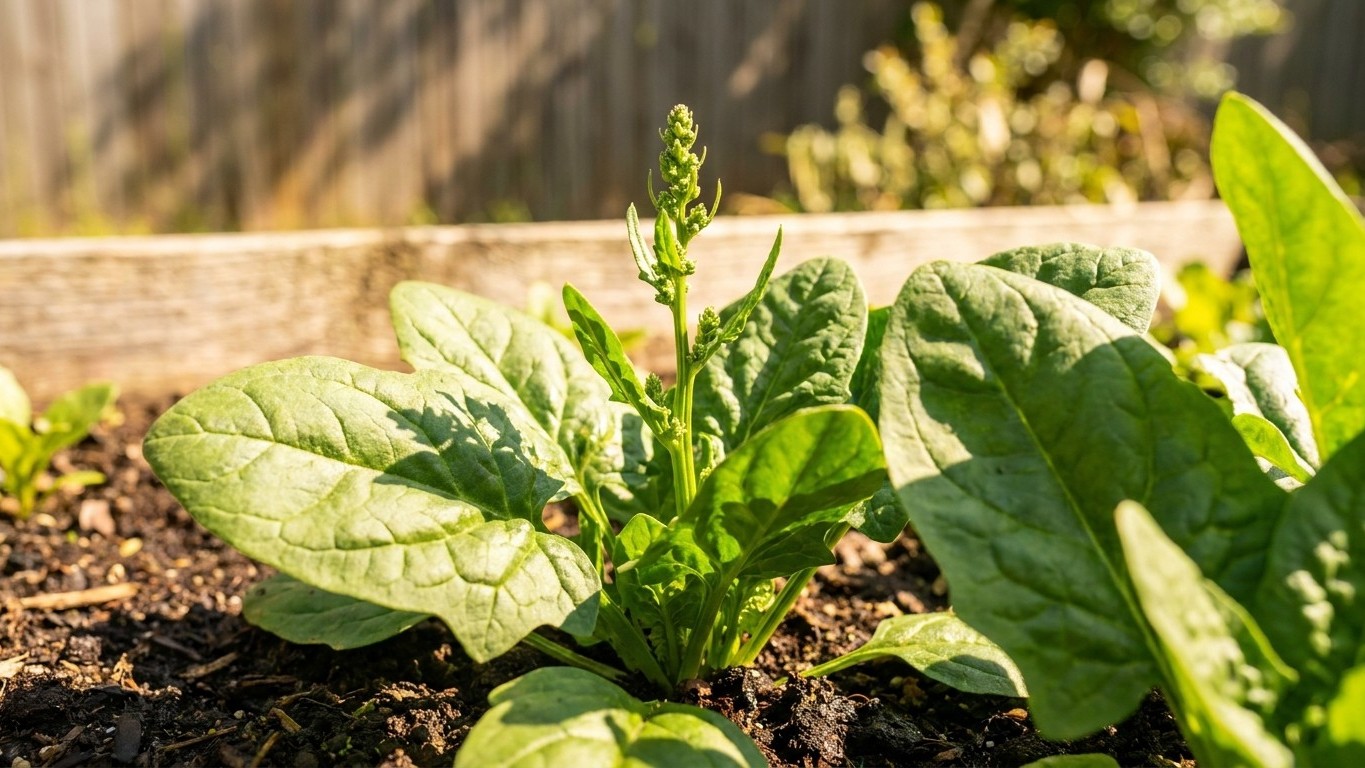

Heat, long days, warm soil and the first freeze are what eat spinach’s calendar in Tennessee, and they take turns. Spring offers a short opening in March, summer closes it, and autumn reopens only after the ground cools. Insects and animals do feed on the crop, but the sources behind this page publish no pest data, so they stay out of the numbers. What follows is the calendar and the figures that set it.
The short answer
On the longest day of the year, Tennessee gets 14 h 28 of daylight. That figure is calculated from the latitude of the Nashville reference station, and it counts the geometric horizon only. Atmospheric refraction adds roughly seven more minutes of real daylight.
Here is what that number does to spinach. According to Utah State University Extension, spinach bolts during long days and warm temperatures. Long days alone are enough to push it toward flowering. A cool summer doesn’t change that, because the sun’s schedule doesn’t care what the thermometer says. A mild June in the Tennessee hills still delivers a 14 h 28 day on the solstice, so cool weather does not buy extra weeks of leaf production.
So is the limit day length or heat? Both. They run on separate clocks. Day length is fixed by latitude and the calendar, and it is the same in a cool summer and a scorching one. Heat varies from year to year, but it is hard to escape here. Nashville reaches 90 F or higher on 40 days in an average year, according to NOAA’s climate normals. Spinach grows best where temperatures stay at or below 75 F, and that same 75 F is where the leaves start turning bitter. One number, two consequences: growth slows and flavor goes.
East Tennessee and the Cumberland Plateau run cooler and later in spring than Nashville. That helps the heat clock and does nothing for the day-length clock. A gardener on the Plateau might keep spinach sweeter a little longer in late spring, but the plants still respond to the lengthening days. Expect no miracle, only a modest cushion.
The practical result is two seasons, not one long one. Spinach goes in early in spring and comes out before the heat and the light finish it. It goes in again in late summer or early autumn, when the soil allows and the days are shortening. The mechanics of flowering get their own treatment in Will Spinach Bolt Early in Tennessee?, and the broader picture sits in Growing Spinach in Tennessee.
One caution on a common mix-up. Long days are what push spinach toward flowering. They are not something spinach needs. Onions are the crop that responds to day length by building bulbs, and the two should never be confused.
How long the spring window really is
The rule is to sow spinach two to three weeks before the last spring frost, and to expect growth to stop being good above 75 F. Tennessee’s last spring frost falls between March 31 and April 12, according to NOAA NCEI’s most recent 30-year climate normals (the 30 to 70 percent probability band for a 32 F freeze). Here is how that turns into a window, step by step.
- Find your frost date. Start with the March 31 to April 12 range. Middle Tennessee sits in that band. East Tennessee and the Cumberland Plateau run later, so shift your date toward the back end of the range or past it.
- Count back two to three weeks. From March 31, three weeks back lands around March 10. From April 12, two weeks back lands around March 29. So the sowing opening runs from roughly the second week of March to the end of March, a span of about three weeks. Hold to the early side if the ground is workable.
- Sow as soon as the soil allows. Every week you wait is a week taken from the end of the season, not the beginning. The end has no flexibility.
- Watch for afternoons above 75 F. Past that point, growth stops being good. The data behind this page does not give the date when Tennessee’s daily highs cross 75 F, so no honest calendar date can be put on it. The reliable method is to keep a thermometer where the bed is and treat a run of afternoons above 75 F as the end of quality growth.
- Remember the second clock. While you wait on heat, the days keep lengthening toward 14 h 28. Flowering pressure builds even in a cool May, so a late sowing loses on both counts.
The source publishes no days to maturity for spinach, so counting harvest weeks from a sowing date would mean inventing a figure. What can be said is that the window has a fixed start and a floating end. The start is set by the frost range. The end is set by the first stretch of afternoons above 75 F, and in a state that logs 40 days a year at 90 F or more, that stretch does not hold off for long. Spring spinach here is a sprint, and the sprinters who start earliest finish with the most leaf.
The autumn crop, and when the soil lets you sow
Autumn is the better season for spinach in most of Tennessee, but it starts with a problem that has nothing to do with cold. Nobody has trouble getting spinach through a mild fall. The trouble is getting it started in the leftover heat of late summer.
Warm soil blocks the start
Seed germination drops when soil is above 80 F, according to Utah State University Extension. In a state with 40 days a year at 90 F or more, late summer soil can easily sit above that mark. The window therefore opens when the soil falls, not when the calendar says so. The data here does not date that cooling, so the soil thermometer is the real authority. A few inches down, in the morning, tells you more than any printed date.
Seed sown into soil above 80 F is a gamble with poor odds: patchy stands, slow emergence, wasted packets. Waiting a week costs less than reseeding. For timing details by area, see When to Sow Autumn Spinach in Tennessee.
The first frost ends the calendar
The first fall frost arrives between October 28 and November 8, again from NOAA NCEI’s 30-year normals using the 30 to 70 percent band. Treat that range as the end of the calendar the figures here support. The sources behind this page don’t say how much cold the plants will take beyond it, so nothing is promised past that range.
Now count back. The source says to plant 50 to 75 days before the date you want to harvest. Take a realistic last harvest of October 28, the early edge of the frost range. Fifty days back is about September 8, and 75 days back is about August 14. Take November 8 instead and the span runs from roughly August 25 to September 19. Put together, the arithmetic points to sowing somewhere between mid-August and the third week of September.
The two obstacles collide here. The early end of that span lands in the hottest part of the year, when soil is most likely above 80 F. If the soil is still too warm in late August, the sowing slips later, and a later sowing means a harvest crowding the frost. That tradeoff, not any pest, is what takes the biggest bite out of an autumn crop. Sow when the soil allows, and accept that a September start gives a shorter harvest than an August one would have.
Common questions
Do bugs and deer eat spinach in Tennessee?
Surely some do, but the sources behind this page carry no pest species or timing, so there is nothing to put a number on. The measured threats are heat, long days, warm soil and frost.
Does a cool East Tennessee or Plateau summer give spinach extra weeks?
Only on the heat side. Long days alone trigger flowering, so cooler air does not stretch the season the way it seems it should. Later spring frost dates in those areas also push sowing later.
Which variety should I grow?
The Utah State University source names Bloomsdale, Melody, Teton and Olympia. It publishes no data on any of them, so no honest comparison of bolting, heat or timing can be made here.
How long does harvested spinach keep?
UC Davis Postharvest says spinach is highly perishable and will not maintain good quality for more than two weeks, even at the ideal 32 F with 95 to 98 percent humidity. That is a ceiling, not a plan. At the 41 to 50 F a fridge door actually holds, it yellows within days. Store it at the back of the bottom shelf, where it’s coldest, and use it early.