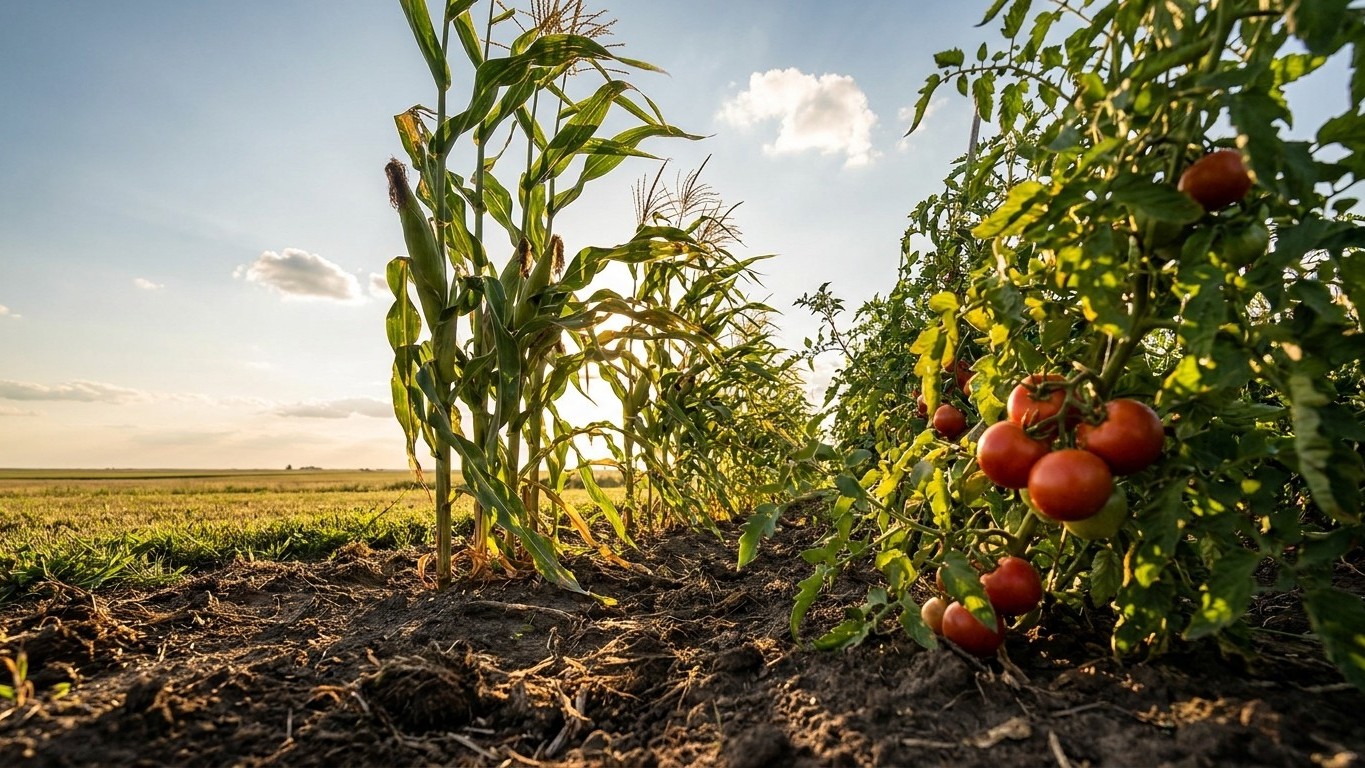

No frost date sets the clock for sweet corn in Hawaii’s inhabited areas. What decides it is soil temperature at planting, then 60 to 90 days of growing, then a harvest window of days rather than weeks. A late variety fits the calendar here. Sweetness is the part that runs out fast, because sugar starts leaving the kernel the moment the ear is picked, and heat speeds that up.
The short answer
Soil first, then the calendar
On the mainland, 60 F soil arrives well after the last spring frost, and gardeners who confuse the two lose seed to cold ground. Hawaii removes the frost half of that puzzle. NOAA’s 30-year climate normals for the station checked show zero days per year at or below 32 F, and every freeze percentile is flagged “not computable” because the freezes simply do not occur. Frost reaches only the high volcanic summits of Mauna Kea, Mauna Loa and Haleakala, never the places people garden.
That leaves the 60 F soil threshold as the real gate. Utah State University Extension says sweet corn needs soil above 60 F. Clemson Extension splits it by type: “Do not plant before the soil temperature at the 4-inch depth is at least 50 ºF. Wait to plant extra-sweet varieties until soil temperatures reach 65 °F.” The depth matters, because a surface reading runs warmer than the root zone. The two numbers are not interchangeable. A supersweet (sh2) seed sown at 50 F tends to rot rather than sprout, which is why a gardener can do fine one year and fail the next after changing varieties.
I won’t give a soil reading for Hawaii, because none is published here. Elevation is the variable to watch. A thermometer pushed 4 inches into the bed answers the question better than any date, and it matters more the higher and cooler your garden sits. Whether a given month suits your site is covered in When to Sow Sweet Corn in Hawaii.
On the season question, the answer is yes. There is no first fall frost to slam the door, so 60 to 90 days from planting never runs into a freeze. Rainfall, elevation and windward versus leeward exposure do the limiting instead.
Two clocks, and a fast fade
Two different clocks run on one crop. The first counts 60 to 90 days from planting and tells you whether a variety fits the season. The second counts roughly 17 to 24 days from the first silk emergence and tells you which week to pick. Don’t merge them into one number.
Ripeness takes three signs together, never one alone:
- The silks have dried and turned brown.
- The husks are still moist and green.
- A punctured kernel gives milky juice.
Once picked, the fade starts. Clemson Extension puts it plainly: “Sweet corn loses sugar from the kernel rapidly at high temperatures… Sweet corn can be stored under optimal conditions for about five days, but will lose sweetness with each day of storage.” Read “about five days” as a ceiling under ideal conditions, not a promise. Genotype changes the pace. Standard su types lose sugar fastest, se types hold it longer, and sh2 types hold it longest. Source: Clemson Cooperative Extension.
Does a late variety fit here?
A 60-day variety
Count it out. Sow when 4-inch soil clears the threshold for the type you chose: 50 F for ordinary sweet corn, 65 F for extra-sweet. Sixty days later the plants reach the end of their growing clock, and silks appear around then. The picking window opens roughly 17 to 24 days after that. With no fall frost to beat, a short variety fits with room to spare.
The advantage of a short variety in Hawaii has little to do with frost. Fewer days in the ground means fewer days of exposure to wind, downpours and insects. A gardener on a wet windward slope or a gusty ridge has good reason to prefer it. The cost is a narrower harvest window, so the sugar-loss clock matters more: pick at the right week and eat the ears soon.
A 90-day variety
Does the late one fit? As far as the calendar goes, yes, and plainly so. Ninety days from planting still ends before a frost that never comes in lowland gardens. This is the reverse of cold-winter states, where a 90-day variety can run out of season. Nothing here stops it by freezing.
What it does cost is a month of extra exposure, roughly 30 more days than the short one. That’s 30 more days for rain to flatten stalks, for wind to tear leaves, and for pests to find the planting (What Eats Corn in Hawaii, and When covers who shows up and when). Heat adds to it. The Honolulu reference station averages 18.7 days a year reaching 90 F or more, a measure of summer heat load and water demand. Hot days stress plants and also speed sugar loss in ears waiting on the counter.
Cooler ground at elevation can stretch the 60 to 90 days, but no figure for that is published here. If you garden upslope, treat the longer variety as a bigger bet. The general rules are in Growing Sweet Corn in Hawaii.
What goes wrong here
Three failures account for most disappointing corn. Only two come from the climate.
- Soil sown too cold. Frost-free does not mean warm everywhere. Higher-elevation beds can sit below the threshold, and extra-sweet seed is the least forgiving. Remedy: push a thermometer 4 inches down and wait for 50 F (ordinary types) or 65 F (extra-sweet). Go by the reading, not the month.
- A variety too long for your spot. Frost won’t end your season, so the mistake is choosing by days alone. A 90-day corn on a wet, windy or cool exposure stays exposed a month longer than a 60-day one. Remedy: match the days to your exposure, and lean shorter where rain, wind or elevation work against you.
- Sweetness lost to the neighbors. This one has nothing to do with climate. Utah State University Extension warns that su, se and sh2 types lose their sweetness if they tassel at the same time. The source gives no isolation distance, so don’t trust anyone who quotes one. Remedy: keep the types from tasselling together by growing one type per planting, or by sowing different types in separate plantings timed so their tassels don’t overlap. Check a neighbor’s patch too, since a nearby planting can tassel in sync with yours.
The third failure is the sneakiest, because the plants look healthy. Ears fill out, kernels form, and the corn tastes starchy instead of sweet. By then the cause is long past.
Common questions
Is there a last frost date I should wait for?
Not in lowland Hawaii. NOAA’s climate normals record zero days per year at or below 32 F at the station checked, and frost occurs only on the highest summits. Wait for 4-inch soil temperature instead, and for rain and exposure conditions that suit your site.
How do I know an ear is ripe?
Look for three signs together: dry brown silks, husks still moist and green, and milky juice when you puncture a kernel. Count roughly 17 to 24 days from silk emergence to know which week to start checking. One sign alone can mislead you.
How long can I keep picked corn?
Clemson Extension says it can be stored “for about five days” under optimal conditions, and it loses sweetness with each day. That is a ceiling, not a guarantee. Su types fade fastest, se holds longer, sh2 longest, so a gardener who can’t cook within hours should lean toward the later two.
Can I plant su and sh2 side by side?
Only if they won’t tassel together. The problem is simultaneous tasselling, and no safe distance is published. Plant corn in blocks of three or more rows rather than a single long row, which is a matter of garden shape, not timing. Stagger the types or stick to one per planting.