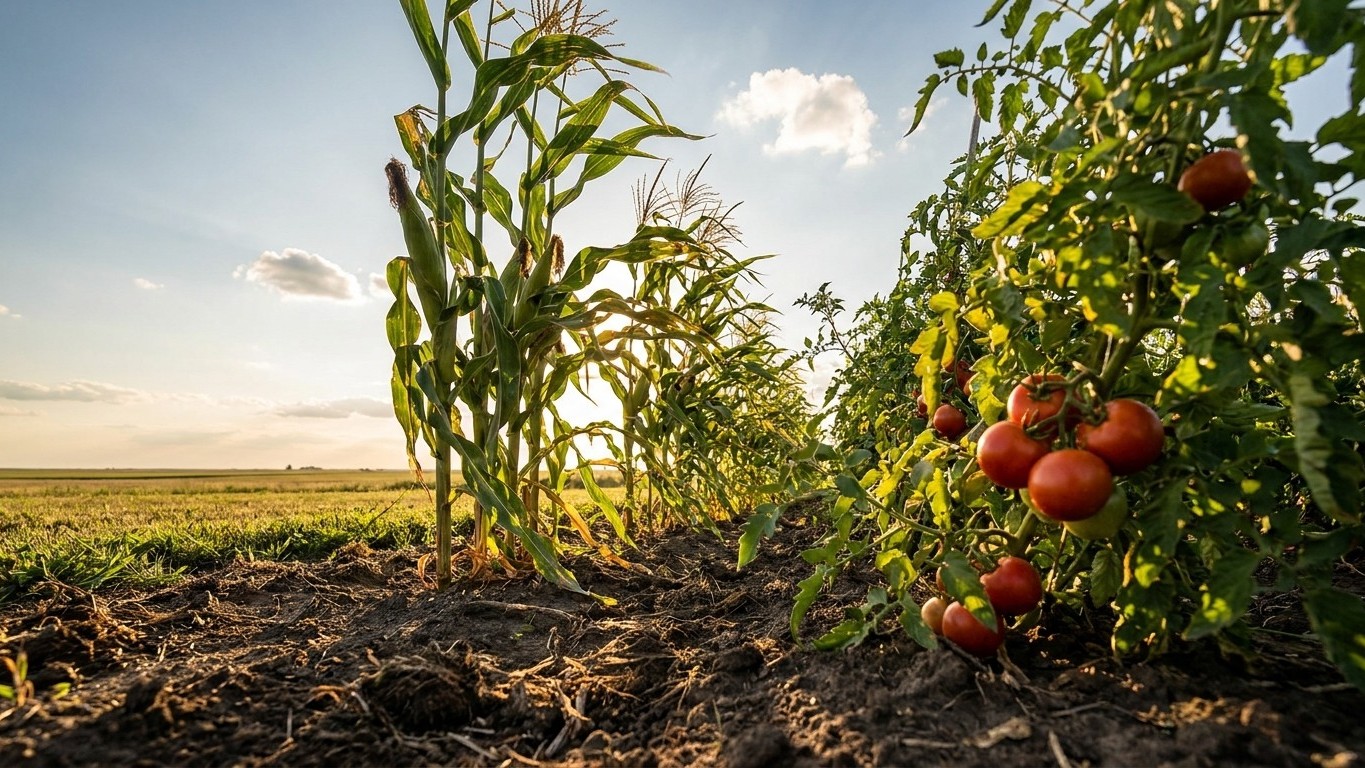

Sweet corn in Illinois is ready roughly 60 to 90 days after planting, and the seed belongs in the ground only once the soil has reached 60 F. That moment arrives well after the last spring frost, not on it. The season has room for the whole span. The short part of the story comes after harvest: a picked ear starts losing sugar immediately, and heat speeds the loss.
The short answer
Soil first, the calendar second
For the Chicago reference station, NOAA NCEI Climate Normals put the last spring frost between April 11 and April 22 (the 30 to 70 percent band of 32 F freeze probabilities, taken at an airport weather station). Those dates are not planting dates. Soil holds on to winter far longer than the air does, so 60 F at planting depth comes well after the last frost. This page publishes no calendar date for it, because soil temperature is the instruction and a date would be a different claim.
Clemson Extension gives the working numbers: “Do not plant before the soil temperature at the 4-inch depth is at least 50 ºF. Wait to plant extra-sweet varieties until soil temperatures reach 65 °F.” Keep the depth in mind. A thermometer pushed into the top half inch reads warmer than the seed will experience. Ordinary sweet corn has a floor of 50 F, extra-sweet (sh2) types need 65 F, and Utah State University Extension asks for soil above 60 F as the general mark. A thermometer costs less than a packet of seed.
One caution on those frost figures. They describe an airport, and suburban and rural gardens typically see the last spring frost later and the first fall frost earlier, often by one to two weeks. Check your own county before treating any of these as yours.
Ready, then fading
Two clocks run on a corn patch, and they answer different questions. The 60 to 90 days from planting tell you whether a variety fits the season. A shorter count, 17 to 24 days from the first silks appearing, tells you which week to pick.
On that second clock, check three signs together: dry brown silks, husks that are still moist and green, and milky juice when you puncture a kernel. One sign alone misleads. Silks can brown while kernels are still watery, and a husk can look fine over an ear that has gone past its best.
After picking, the fade begins. Clemson’s Cooperative Extension fact sheet says: “Sweet corn loses sugar from the kernel rapidly at high temperatures… Sweet corn can be stored under optimal conditions for about five days, but will lose sweetness with each day of storage.” Read “about five days” as a ceiling under ideal conditions, not a promise. Illinois averages 14.0 days a year at 90 F or more at the reference station, so an ear sitting on a warm porch in August is losing sugar faster than one in a cool kitchen. Pick in the cool of the morning and get the ears cold.
The type you grow matters as well. Standard su loses sugar fastest, se holds it longer, and sh2 holds it longest. That is the practical reason to pick one over another. For the bigger picture of the crop, see Growing Sweet Corn in Illinois.
Does a late variety fit here?
A 60-day variety
Yes, with room to spare. Take the later reference-city last frost, April 22, and the earlier reference-city first fall frost, October 24. About 185 days separate them. Soil warmth cuts into that, since planting waits for 60 F, but a 60-day crop uses only a third of what is left.
That leftover time has a use. A second sowing after the first is a reasonable reading of the arithmetic (not a published rule), and it spreads the harvest so you are not facing four dozen ears in a single weekend. It also ties into a problem covered below: staggered plantings keep different corn types from tasseling together. The earliest plantings also ripen before the worst of summer’s heat, which matters given how fast warm weather strips sugar.
A 90-day variety
It fits too, and it is worth saying so plainly, since 90 days sounds long. Start from the same 185 days. Now be pessimistic. Say a cold wet spring costs a month of waiting for the soil, and your garden sits in the suburbs or countryside, where the frost dates run one to two weeks worse at both ends, so take off another 28 days. That leaves about 127 days, and the crop needs 90. The margin is thin only if the planting itself goes late.
That is the real risk with a long-season type. The variety fits Illinois, but a late replanting of that variety may not. If a cold snap rots the first sowing and the second goes in weeks later, the margin shrinks quickly, and a frost near the end of October on the reference-city dates, earlier in many gardens, ends the crop before the ears fill. Count 90 days forward from the day the seed actually goes in. For timing the sowing itself, see When to Sow Sweet Corn in Illinois.
What goes wrong here
Most failed corn patches trace back to one of three causes. Two come from the calendar, and one has nothing to do with climate. Animals and insects at harvest are a separate subject, covered in What Eats Corn in Illinois, and When.
Two failures that come from the season
- Seed sown into cold soil. Air warms in April, soil does not. Seed that goes in because the frost has passed may sit in soil under 60 F and rot instead of sprouting. This is also why a gardener can succeed one year and fail the next after switching varieties: an extra-sweet seed sown at 50 F rots rather than germinates, because that type needs 65 F at the 4-inch depth. The remedy is a thermometer at 4 inches, a morning reading, and the right threshold for the seed packet in your hand.
- A variety too late for the season. Ninety days of growth cannot be squeezed once the first fall frost is near. The remedy is to count forward from your real planting date, using your county’s frost dates rather than the airport’s, and to choose a shorter-season type if the planting slipped.
The failure that has nothing to do with climate
- Sweetness lost to the neighbors. Sweetness is decided by what tassels nearby. If su, se and sh2 types tassel at the same time, the sweetness is lost, and the ears come out starchy instead of sweet. No published rule gives a safe distance, so the advice here rests on timing: do not let different types shed pollen together. Stagger plantings or choose varieties with different maturity so the tassels do not overlap, or grow a single type. Plant in blocks of three or more rows, not one long single row, so pollen lands where it should. Utah State University Extension is the authority for both points.
Common questions
How do I know an ear is ready to pick?
Look for three signs at once: dry brown silks, husks still moist and green, and milky juice when you puncture a kernel. The timeline helps you know when to start checking, since ears generally come 17 to 24 days after the first silks appear. Once all three signs agree, pick.
How long does picked sweet corn keep?
Clemson Extension says sweet corn “can be stored under optimal conditions for about five days, but will lose sweetness with each day of storage.” Treat five days as the most you could hope for, not a guarantee. Standard su types lose sugar fastest, se holds longer, and sh2 holds longest, so the type you plant sets how much time you have.
Is the last frost date the day to plant?
No. For the reference city that date falls between April 11 and April 22, but soil at 60 F arrives well after it. Plant when the soil reads the right number at 4 inches: at least 50 F for ordinary sweet corn and 65 F for extra-sweet types.
Can I grow two types of sweet corn in one garden?
You can, as long as they do not tassel at the same time. The sweetness is lost when su, se and sh2 types shed pollen together, and the source gives no distance for separating them. Stagger the sowings, or grow one type, and plant in blocks of three or more rows. A single long row pollinates poorly even when every other condition is right.