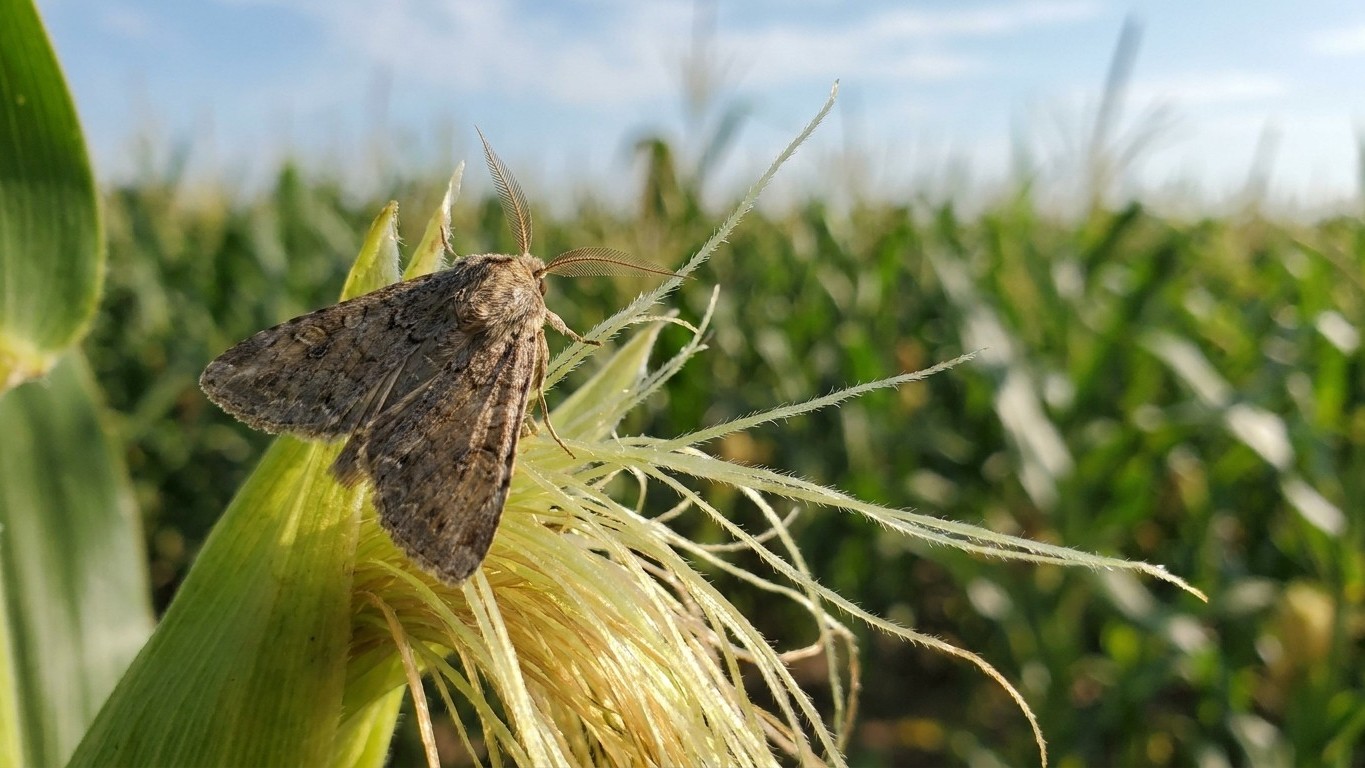

University of Illinois Extension documents two pests from its state pest list that actually feed on corn: the Japanese beetle, which clips silks right as pollination starts, and the brown marmorated stink bug, which punctures ears and stunts young seedlings. Both track a calendar set by soil temperature and frost dates, not by the calendar month. The rest of the extension’s list, bagworm, jumping worms, spotted lanternfly among them, feed on entirely different plants.
Which pests attack corn in Illinois
University of Illinois Extension documents eight pests across its home, yard, and garden resources for this state: Bagworm, Brown marmorated stink bug, Colorado potato beetle, Japanese beetle, Jumping worms (Amynthas spp.), Spotted lanternfly, Squash bug (Anasa tristis), and Squash vine borer. That’s the full list the service tracks. Only two of the eight actually feed on corn, and knowing which ones don’t matters as much as knowing which ones do.
Bagworm feeds on arborvitae, junipers, and other conifers and shrubs. It never touches row crops, and a corn plant showing chewed leaves isn’t hosting bagworm no matter how bare the foliage looks. Colorado potato beetle is a nightshade specialist, sticking to potato, tomato, and eggplant leaves; it has no reason to cross into a cornfield. Jumping worms live in soil, not on plants. They chew through leaf litter and disrupt soil structure, but they don’t feed on stalks, ears, or leaves, so they can’t be blamed for damage above ground. Spotted lanternfly targets tree of heaven and grapevines, both woody hosts unrelated to corn. Squash bug and squash vine borer are both cucurbit specialists, restricted to squash, pumpkin, and cucumber vines and stems. Neither one will bother a corn stalk.
That leaves the Japanese beetle and the brown marmorated stink bug as the two documented species with any real business in a corn planting. Japanese beetle adults are the more familiar culprit for home gardeners: they cluster on silks during pollination and chew them down, which interferes with kernel fill on the ear. Brown marmorated stink bug behaves differently. It uses piercing mouthparts rather than chewing, feeding on stems and developing kernels, and it can do real damage to seedlings early in the season by feeding near the growing point.
If a pest isn’t on this list, University of Illinois Extension isn’t documenting it as a state pest here, and naming one anyway would just be a guess dressed up as an answer. A short list isn’t an incomplete list. It’s the list the service actually publishes.
When each one shows up, and what it does first
Corn’s calendar starts after the last spring frost, which for the reference station runs April 11 to April 22, and it doesn’t really get moving until the soil itself warms. Sweet corn needs soil above 60°F before planting makes sense at all, a threshold that always lands after the frost date, never on it. From that planting date, the crop needs 60 to 90 days to reach maturity, and the first fall frost, October 24 to November 3, sets the hard outer edge of that window.
Brown marmorated stink bug shows up early in that window, close to when seedlings emerge. It feeds on tender young stems and near the growing point, and the first thing a gardener usually notices isn’t a bug at all, it’s a seedling that looks wilted, stunted, or oddly twisted for no obvious reason. That’s the piercing feeding at work before the plant has any real size to absorb the damage.
Japanese beetle arrives later, once the crop is well into its growth and pushing out silks ahead of pollination. Its activity tracks with the hottest stretch of summer: the reference station averages 14.0 days a year at 90°F or above, and that heat load is exactly when beetle populations are most active and most visible on silks. The first sign here isn’t a beetle sighting either, it’s ragged, browning, or shortened silks, sometimes clipped down close to the husk, right as the ear should be receiving pollen.
Both pests fall off sharply once the season turns. The first fall frost, October 24 to November 3, ends active feeding for both, since the plants themselves are senescing by then and there’s nothing left worth attacking. Between the two frost dates and the 60-to-90-day maturity clock, the vulnerable stretch for a given garden is really just the middle of the season, not the whole thing.
Telling the damage apart from everything else
Corn shows plenty of stress that has nothing to do with insects, and mixing them up leads to spraying a plant that’s actually just thirsty or short on nitrogen. The single most useful habit is checking for a physical feeding mark before assuming a pest is responsible. Chewed silks with visible tooth marks are different from silks that dried out and turned brittle from heat alone, and that difference is the whole diagnosis.
| Symptom | Possible cause | What tells them apart |
|---|---|---|
| Ragged, shortened silks | Japanese beetle feeding vs. heat stress during a hot stretch | Beetle damage shows visible chew marks and often beetles clustered nearby; heat damage leaves silks uniformly brown and brittle with no bite marks |
| Shriveled, discolored kernels near the ear tip | Stink bug feeding vs. drought during grain fill | Stink bug punctures leave small corky spots at each feeding site; drought stress shrinks the whole ear evenly, without isolated marks |
| Wilted or twisted seedling soon after emergence | Stink bug feeding near the growing point vs. nitrogen deficiency or mechanical injury | Feeding leaves a small puncture wound at the base of the plant; nutrient deficiency shows even yellowing with no wound at all |
None of these symptoms are exclusive to one cause, which is exactly why the puncture or bite mark matters more than the general look of the plant. A gardener can’t reliably tell a nitrogen-starved seedling from an early stink bug hit just by looking at leaf color from a few feet away. When the cause still isn’t clear after checking for a feeding mark, that’s the point to send a photo or a sample to a local extension office rather than guess and treat.
What actually works here, and what is a waste of time
Timing beats product choice on a growing season this compressed. A physical barrier placed before the vulnerable stage arrives works better than any treatment applied after damage is already visible. Floating row covers over seedlings can block early stink bug feeding, but they have to come off before tasseling, since corn depends on wind carrying pollen between plants grown in blocks of three or more rows, and a covered plant can’t participate in that at all.
Handpicking Japanese beetles works surprisingly well in a home garden, especially early in the morning when the beetles are sluggish and easy to knock into a container. It’s tedious, but it’s also free, and it doesn’t risk hitting anything beyond the pest itself.
What doesn’t work is spraying on a fixed schedule without matching the timing to when a pest is actually active. Treating a field in early June for a beetle that doesn’t show up until the hottest weeks of summer is wasted effort, and so is treating in August for a stink bug problem that already peaked back when seedlings were emerging. This site doesn’t name specific products or active ingredients, because what’s registered for use on corn changes and varies by state; a county extension office is the source that actually knows what’s currently labeled and legal to use in Illinois.
Where to check this for your own county
A statewide pest list doesn’t say what’s actually in one garden, and pest pressure inside Illinois varies enough between counties that a problem showing up in one area may be rare fifty miles away. The right next step is a call or a photo sent to the local office of University of Illinois Extension, the same service that documents the pest list used throughout this article.
County offices track pest activity at a finer scale than any statewide resource can, and they’re set up to look at an actual photo or sample rather than a general description. That matters here specifically because both corn pests on this list, Japanese beetle and brown marmorated stink bug, can be confused with heat stress or nutrient issues without a close look at the feeding marks.
The next useful move isn’t researching more pest names online. It’s finding the county office, sending a clear photo of the damage with the feeding marks visible, and asking directly whether what’s showing up matches known activity in that county this season.
Common questions
Do all eight pests on the Illinois list ever touch corn?
No. Only Japanese beetle and brown marmorated stink bug are documented feeders on corn from that list. The other six, bagworm, Colorado potato beetle, jumping worms, spotted lanternfly, squash bug, and squash vine borer, feed on unrelated hosts like conifers, nightshades, cucurbits, or soil litter.
When is corn most at risk from these pests?
Stink bug pressure concentrates near seedling emergence, shortly after planting once soil has warmed above 60°F. Japanese beetle activity concentrates later, during the hottest weeks of summer, right as silks emerge ahead of pollination.
Can heat stress alone cause the same damage as a pest?
It can look similar from a distance, especially with dried or shortened silks, but heat-damaged silks are uniformly brittle with no bite marks, while insect feeding leaves visible chew marks or puncture wounds.
Where should isolation distance between sweet corn types come from?
Not from a fixed number of feet. The source behind the sweet corn planting guidance describes the problem as su, se, and sh2 types tasseling at the same time, not as a distance requirement, so timing the plantings apart matters more than measuring space between them.