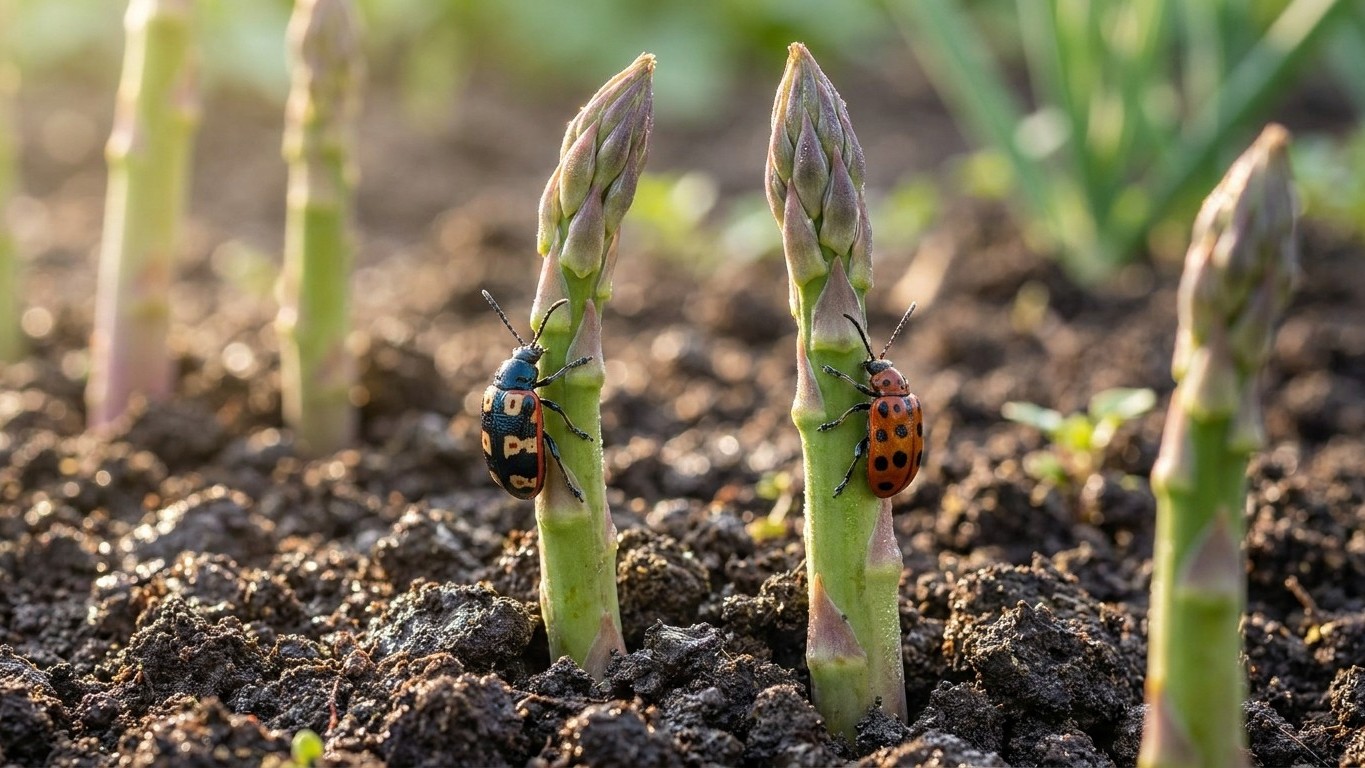

Stop cutting when most of the spears coming up are thinner than a pencil. That is an object, not a date, so it works near Philadelphia and on an Allegheny ridge alike. Cut spears keep best at 32 to 35°F in near-saturated air, with the cut ends standing in water. A new bed has to earn that first cutting, though. Nothing is harvested until year 3.
The short answer
Pennsylvania’s state soil is the Hazleton series, and a bed dug in it is a 10-to-15-year decision. Asparagus goes in as crowns in 8-inch furrows, and once harvesting starts it produces for 10 to 15 years. Utah State University Extension, the only authority behind this page, asks little of the ground: most soils will do, provided they are well drained. Drainage is the one soil requirement it names.
On drainage, the Hazleton series passes. USDA classes it as an Inceptisol, a young soil that has not developed strong horizons yet. Its representative surface layer is loam to silt, at 46 percent sand, 12 percent clay and 42 percent silt, with organic matter around 3.0 percent. USDA lists it as well drained. Twelve percent clay is not enough to hold water in a puddle around a crown. Those figures are the representative values for the surface horizon of the major components of the series (389 of them), not a measurement of anyone’s worked bed.
The same record puts the surface pH at about 4.6, which is strongly acid. That is the series, not your garden. Utah State is silent on soil pH for asparagus, so no target number is offered here. Get your own reading from a soil test before you dig.
For most crops, a heavy or poor patch is an annual nuisance you amend each season. Asparagus is the exception. You pick the spot once and live with it for up to fifteen years, so a drainage mistake cannot be corrected next spring. A state spans hundreds of soil series, and the ground in your yard may share little with the one that represents Pennsylvania. River bottoms, low corners where runoff collects, and any lot a builder scraped or filled are the usual trouble spots. After a hard rain, dig a hole where you plan the bed. If water is still standing in it long after the rain has stopped, that spot fails.
If it does fail, move the bed. A slope, a rise, or the edge of the yard where water leaves is a better choice than a hollow. Building a raised bed on top of poor ground is a workaround worth considering, though that is this page’s judgment, not something Utah State publishes. Will Pennsylvania Soil Hold an Asparagus Bed for Fifteen Years? goes deeper on reading your own ground, and Growing Asparagus in Pennsylvania covers the whole bed from start to finish.
Will the summer here water it for you?
Partly. A new bed wants 1 to 2 inches of water every other week for its first two years, then every three weeks after that. Philadelphia’s reference station, using NOAA NCEI’s recent climate normals, records about 12.7 inches of rain across June, July and August, out of 44.1 inches for the full year. By month it runs June 4.04 inches, July 4.38 and August 4.29. June is the driest of the three, which is a surprise for anyone who expects July to be the problem.
Averaged out, that is roughly 2 inches in a typical two-week stretch, which sits at the top of what the bed asks for. Averages hide a lot, though. Summer rain often arrives as one thunderstorm, and much of a downpour runs off instead of soaking in. Hot days drive evaporation on top of that. Pennsylvania’s well-drained soil also lets water through quickly, so a wet month on paper can still leave the crowns dry. Here is a practical way to work it out:
- Set a rain gauge at the bed. These are normals for one station, not a forecast, and a slope, a ridge or a city changes the numbers. Your own gauge settles it.
- Add up what fell over the past two weeks, counting only gentle rain. A single hammering storm counts for less than its total suggests.
- Top up the gap. If the gauge shows less than 1 inch, water until the total reaches somewhere between 1 and 2 inches. If it shows 2 or more spread over several days, skip the hose.
- Keep that every-other-week rhythm for two full years. These are the years when the crowns are building the root system that will feed the bed for a decade or more.
- After year two, stretch to every three weeks, with the same gauge-and-top-up logic.
In a normal Pennsylvania summer, rain covers most of the work, and the gardener fills in dry spells. A few weeks with no meaningful rain mean the hose becomes the main supply. Whatever the gauge says, the bed has its own opinion, so check how dry the soil is a few inches down.
When to put the crowns in
Early spring is the window. In Philadelphia, the last spring freeze at 32°F falls around March 29 to April 6, based on NOAA NCEI’s 30-to-70-percent probability band. A mean date is an average, so some years the freeze comes earlier and some years it comes later. Philadelphia is also the mildest corner of the state. The northern tier and the Alleghenies run two to four weeks later, which works out to roughly mid-April through early May. Count from your own area’s frost, not the city’s.
Crowns go into furrows 8 inches deep. Do not fill the furrow all at once. Backfill gradually across the year, about 2 inches every other month, so the growing shoots are never buried in a single pass. A furrow dug in the same week the crowns arrive is easier to manage than one dug during a cold snap, so have the ground ready before the crowns come.
What to buy, and the seed route
Utah State’s guide names four varieties and gives only their sex. Jersey Giant and Jersey Knight are all-male. UC 157 F1 and Purple Passion are male and female. No flavor, yield or reason to prefer one over another is published, so there is no ranking to offer here. No nursery is named either. Buy from any source you trust and keep to the crown route if you can.
Seed is the alternative. It adds a stage before the bed exists, since seedlings have to grow into plants worth setting out. This page carries no published seed-start date, so follow the packet in your hand, and expect the clock to start earlier than the crown calendar above. Seed does not change the harvest rule either. The bed still waits until year 3.
Common questions
When do I stop cutting each season?
Stop when most of the spears are thinner than a pencil. That rule has no week number attached, because the plants set the calendar, not you. A bed in its first harvest year gets about 4 weeks of cutting. The next season it gets 6, and after that 8. Once the spears thin out, leave them standing.
Can I take a few spears before year 3?
No. Asparagus is not harvested until year 3. The bed spends the first two years building roots, and a single early cutting steals from that work. That is why the watering schedule above matters so much in years one and two.
How do I keep the spears after cutting?
The window is narrow, and both edges bite. UC Davis Postharvest lists the optimum as 32 to 35.6°F with 95 to 100 percent relative humidity. Above 50°F, spears toughen rapidly. At about 30.9°F or lower, freezing injury sets in, and the spears turn water-soaked and collapse once thawed. In a home kitchen, stand the butts in water, like flowers in a jar, or wrap the cut ends in damp paper. The cut end loses water faster than anything else. If your refrigerator runs warmer than 35°F, use its coldest shelf.
What else threatens the bed once cutting stops?
Pests are the next problem. What Eats Asparagus in Pennsylvania, and When lays out who shows up and which part of the season to watch.