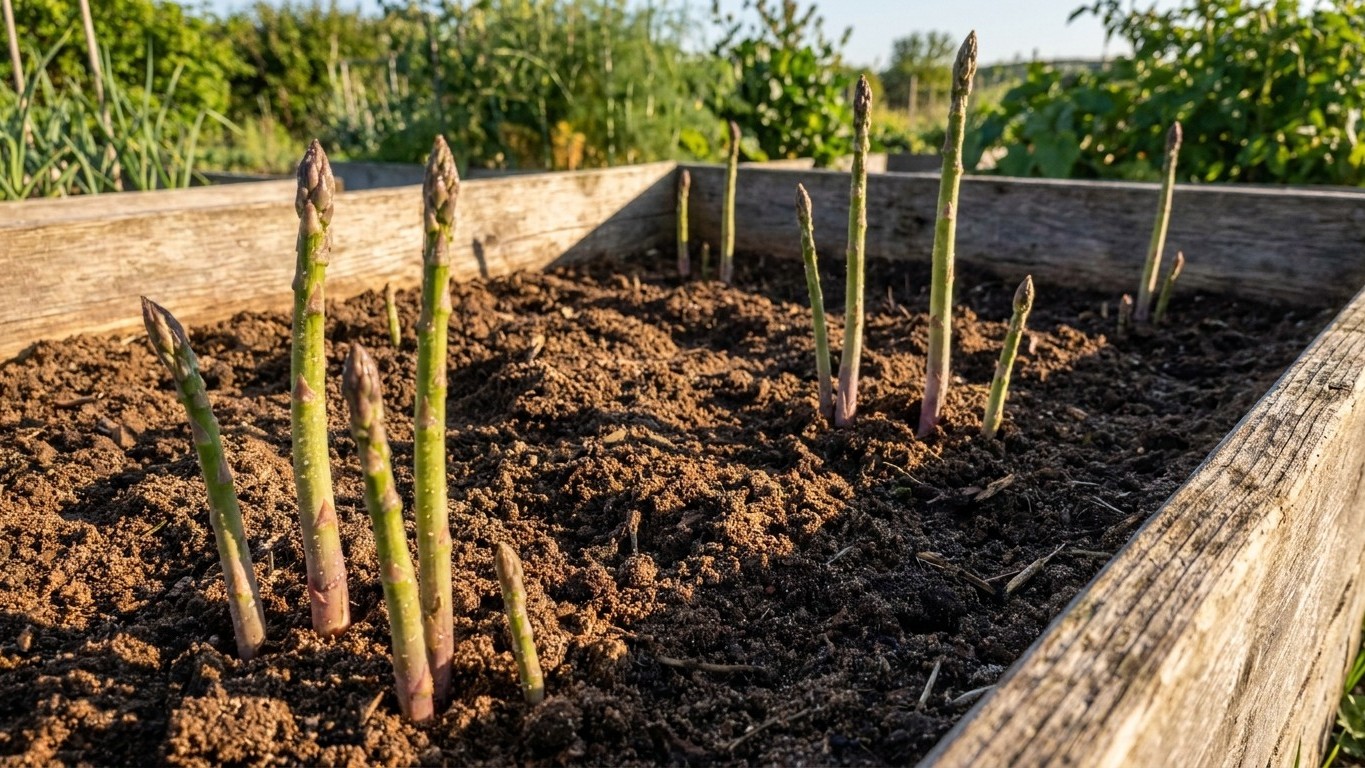

Nothing in the verified material behind this page covers insects, so there is no month-by-month pest calendar here, and one won’t be improvised. What is documented is what the bed itself asks of a Pennsylvania gardener: ground that drains, water through the summer, and crowns planted at the right moment. Those three set the terms for everything else. For the full picture of the crop, start with Growing Asparagus in Pennsylvania.
The short answer
Start with the ground. USDA lists the Hazleton series as the representative soil of Pennsylvania. It is an Inceptisol, a young soil that has not developed strong horizons yet. Its surface runs loam to silt: 46 percent sand, 12 percent clay and 42 percent silt, with organic matter around 3.0 percent. It is rated well drained. Those are representative values for the surface layer of the mapped components of that series, not a reading from a worked garden bed.
The commitment is what makes this matter. Asparagus goes in as crowns, set in 8-inch furrows in early spring. Nothing is harvested until year 3. After that the bed produces for 10 to 15 years. Utah State University Extension, the only authority used for this page, says most soils will do provided they are well drained. That is the whole soil requirement, and it is a short one.
Elsewhere in the garden, a heavy soil is an annual nuisance you amend each season. Here it is a decision you live with for fifteen years, because you can’t dig up a mature bed and start over without losing the crop. So the question is simple: does the dominant soil drain well enough? On the evidence, yes. The state’s representative soil is well drained, and with only 12 percent clay, the typical surface has little to seal it up and hold water for days.
If your plot does not drain
A state spans hundreds of soil series, and the Hazleton is a starting point, not a diagnosis of your yard. River bottoms, hill country and any lot a builder has scraped, compacted or filled can behave completely differently. A cheap field check helps: dig a hole where the bed would go, fill it with water, and see whether it empties or stands. If water is still sitting there the next day, that spot is the wrong one.
The fix is a different spot, or a bed built up above the surrounding grade. The raised-bed idea is practical judgment, not something the source states. Pennsylvania gardeners can find the longer discussion in Will Pennsylvania Soil Hold an Asparagus Bed for Fifteen Years?
One more caution. The state soil’s surface pH is about 4.6, which is strongly acid. That is the series, not your pH. The Utah State source is silent on soil pH, so this page supplies no target. A soil test gives you your own number, and it is worth doing before the crowns go in.
Will the summer here water it for you?
Mostly, yes, on paper. The bed wants 1 to 2 inches of water every other week for its first two years, then every three weeks after that. The Philadelphia reference station for NOAA’s 30-year climate normals records about 12.7 inches of rain across June, July and August, out of 44.1 inches for the year. June is the driest of the three summer months at 4.04 inches, then July at 4.38 and August at 4.29.
Spread across roughly thirteen weeks, 12.7 inches works out to about an inch a week. That is arithmetic on an average, and it is more than a two-week schedule of 1 to 2 inches calls for. The trouble is that normals are not a forecast, and rain rarely falls in neat weekly portions. A single summer thunderstorm can drop an inch in an hour, and much of that runs off instead of soaking in. Hot days pull water back out of the ground quickly, so a wet month can still leave a bed dry.
How much the gardener adds
The honest answer is “the gap, and no more.” Here is how to work it out:
- Put a rain gauge on the bed itself. Station normals describe the region, and a slope, a city lot or a rain shadow changes what your plot receives. The gauge settles it.
- Tally two weeks of rain in the first two years. If the gauge shows 1 to 2 inches, you add nothing. If it shows half an inch, you add the difference.
- Add the difference by hand when rain falls short. A normal Pennsylvania summer should leave you adding little, and a dry stretch in June, the driest of the three months, is when you will most likely be out with the hose.
- Stretch the interval after year two. The same 1 to 2 inches, but every three weeks, is the target for the established bed.
- Check the soil, not just the calendar. Hazleton-type loam and silt hold moisture reasonably well. A sandy patch lets an inch of rain through within the day, so on sand the bed may need water more often than the schedule suggests.
Notice that the schedule is light. Asparagus is not a crop that needs soaking every few days, which is why drainage, not irrigation, is the real gatekeeper in Pennsylvania.
When to put the crowns in
Early spring is the window. The source gives no day count and no soil-temperature trigger, so the useful anchor is the last frost. At the Philadelphia reference station, NOAA NCEI’s 30-year normals put the last spring 32°F freeze at around March 29 to April 6 (the 30 to 70 percent probability band). Because that is a mean, treat it as “around,” not a deadline. Some years the last freeze comes earlier, and some years it comes later.
Philadelphia is also the mildest corner of the state. The northern tier and the Alleghenies run two to four weeks later in spring. Add that to the Philadelphia dates and the same freeze lands roughly from mid-April to early May there. If you garden in the mountains, plan your planting day by your own last-frost experience, not the southeast’s. Our guide to When to Plant Asparagus Crowns in Pennsylvania covers timing in more detail.
The seed route, and what happens after planting
Seed is the alternative to crowns. The facts for this page carry no seeding date, so follow the seed packet and don’t borrow the crown schedule. Four varieties are named in the source, each with only its sex listed: Jersey Giant and Jersey Knight are all-male, while UC 157 F1 and Purple Passion are male/female. No flavor, yield or reason to prefer one is published, so a choice among them is a coin flip as far as this source goes.
Once crowns are in, the furrow is backfilled gradually through the year, 2 inches every other month, not all at once. Then comes the hard part, which is waiting. There is no harvest until year 3. When harvesting begins, it runs four weeks, then six, then eight. Do not soften that into “a few spears here and there.” Stop each season when most spears are thinner than a pencil, because that is the signal, not a date on the calendar.
Common questions
What insects eat asparagus in Pennsylvania, and when?
The verified facts behind this page do not include any pest species or timing, so none are listed here. A county Extension office is the right place for a current local answer. What this page can say is that a bed in well-drained ground, with steady water and a correct planting date, starts from the best position.
Can I cut spears the first spring?
No. Crowns planted in early spring are not harvested until year 3. The bed then produces for 10 to 15 years.
How do I keep cut spears fresh?
The window is narrow. UC Davis Postharvest gives an optimum of 32°F to 35.6°F with 95 to 100 percent relative humidity. Above 50°F the spears toughen rapidly, and at about 30.9°F or lower they suffer freezing injury, going water-soaked and extremely soft. In a home kitchen, the practical way to reach that humidity is to stand the cut ends in water or wrap the butts in something damp, because spears lose water through the cut end faster than anywhere else.
Is Pennsylvania soil too acidic for asparagus?
The Hazleton series has a surface pH around 4.6, but that is the state’s representative soil, not yours. The Utah State source is silent on pH, so this page gives no target. Test your own ground and use that number.