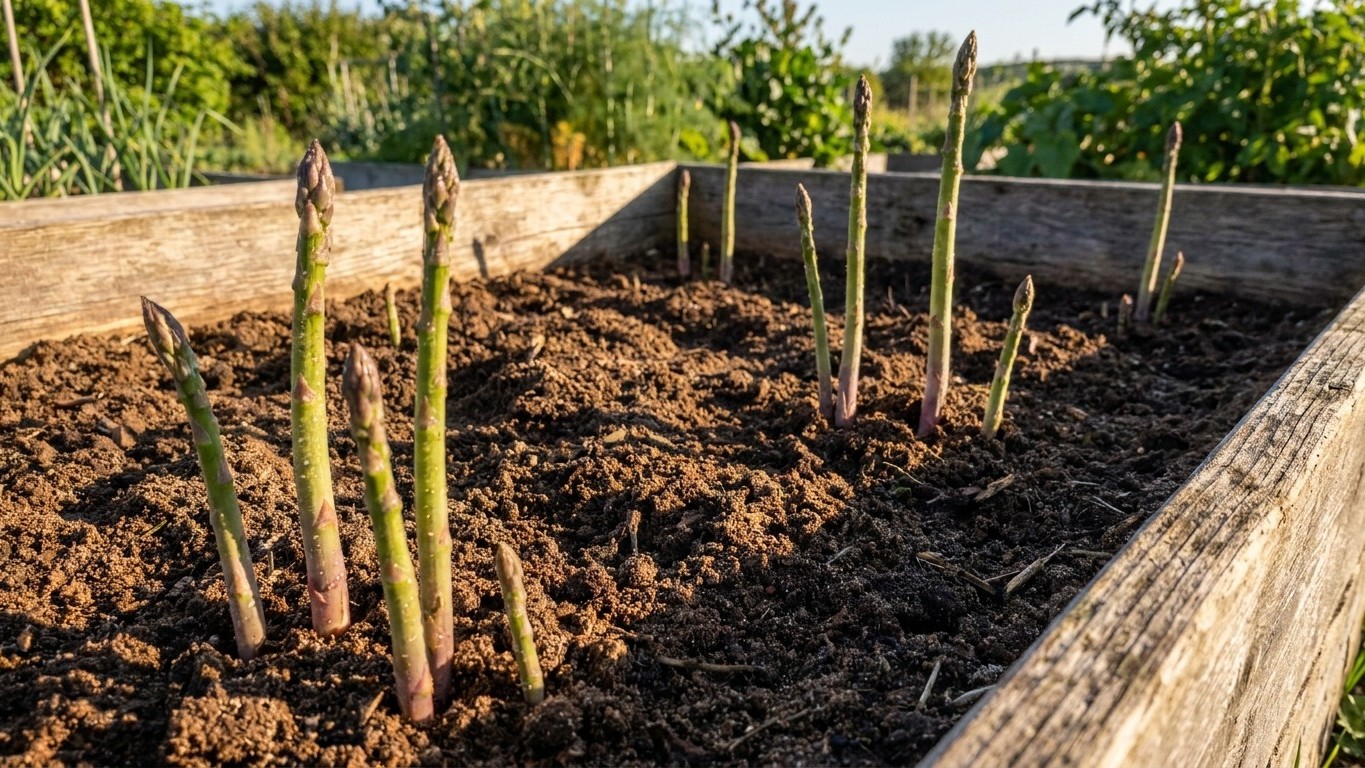

Stop cutting when most of the spears coming up are thinner than a pencil. That is the signal, and it beats any week on the calendar. In Saskatchewan the first cutting doesn’t come until year 3, so the rule has to wait for you. Cut spears keep best at 0 to 2°C (32 to 35.6°F), with the butts standing in water. Both halves of the answer start with the bed, and the bed starts with the ground it sits in.
The short answer
What the soil data says
An asparagus bed is a fifteen-year decision. Utah State University Extension says a planting produces for 10 to 15 years, and its only soil requirement is that the ground drains: most soils will do, provided they are well drained. Elsewhere in a vegetable garden, a heavy soil is a nuisance you amend every season. Here it is a mistake you live with for a decade and a half.
Saskatchewan’s dominant ground passes that test. Across the 3,675 mapped soil components in the Canadian Soil Information Service tables from Agriculture and Agri-Food Canada, the commonest soil order is Chernozem, the deep, dark grassland soil of the prairies. It covers 68 percent of the mapped surface, with Solonetzic next. The median surface layer is loam to silt (43 percent sand, 22 percent clay, 35 percent silt), holds about 4.0 percent organic matter, and is classed as well drained. Median surface pH is about 6.8, near neutral. The asparagus source says nothing about pH, so there is no target to hold that number against.
Treat all of that as a starting point, not a diagnosis. A median describes a province, not your lot. The survey covers the agricultural regions only, so the far north isn’t represented. River bottoms, low wet ground, muskeg and any yard a builder has scraped or filled can behave nothing like the median. Solonetzic is the second most common order, and the data here doesn’t describe how it drains.
Before digging a furrow, dig a test hole where the bed would go, fill it with water, and come back the next day. If water is still standing, believe the hole over the map. Move the bed to higher ground or build it up above grade, because planting and hoping is the one option you can’t walk back. The longer treatment is in Will Saskatchewan Soil Hold an Asparagus Bed for Fifteen Years?
The harvest clock, and when it ends
No spears are cut until year 3. The first cutting season runs four weeks, the next six, and the one after that eight. Nothing in the source softens this into a “few spears” allowance in the early years.
The end of each season is an object, not a date: stop when most of the spears are thinner than a pencil. No week number is published for it, and a calendar date would only mislead you. Spears left standing leaf out into ferns, which is how the crown refills for next year, so the pencil is your cue to put the knife away and let the patch grow.
Will the summer here water it for you?
The bed wants 25 to 50 mm (1 to 2 inches) every other week for the first two years, then the same amount every three weeks. Against that, the nearest long-term record in the facts for this page is the Saskatoon Diefenbaker station. Here is how the comparison works out.
- Start with what falls. June, July and August together bring about 168 mm (6.6 inches) of rain, out of 353 mm (13.9 inches) over the whole year. By month, that is about 66 mm (2.59 inches) in June, about 60 mm (2.38 inches) in July, and 43 mm (1.68 inches) in August, the driest of the three. Canadian normals cover an earlier thirty-year span than the US figures on this site, so don’t line the two up directly.
- Convert it to the bed’s schedule. Spread evenly, that is roughly 1.2 inches per two-week stretch in June and 1.1 in July, which just reaches the low end of the target. August drops to about 0.8 inch. In the first two years, an August gardener should expect to add somewhere between a quarter inch and an inch and a quarter every other week. Once the bed moves to a three-week rhythm, August rain averages about 1.1 inches per cycle, close to the minimum. This is my arithmetic from the monthly normals, not a published watering figure.
- Discount for how rain arrives. A normal is an average, and an average hides thunderstorms. An inch that lands in twenty minutes on hot, hard ground mostly runs off. Days at or above 90°F also pull moisture out of the soil faster than the rainfall table suggests. Loam to silt sits between sand, which lets rain through within the day, and clay, which holds it for a week, so the ground is forgiving but not self-watering.
- Let a gauge settle it. Set a straight-sided can or a cheap rain gauge on your own plot, measure each two-week stretch, and add the difference by hand. Normals describe a reference station, not your yard, and a slope, a shelterbelt or a city lot changes the number.
Where the figure stops helping
The normals say what a region can usually expect, not what next August will do. A dry year breaks every row of the list above. In the first two years, when the crowns have no established root system to lean on, assume the sky covers June and July in a decent year and falls short in August. Plan the hose accordingly.
When to put the crowns in
Reading the frost date honestly
Crowns go in during early spring, set in 8-inch furrows. For Saskatchewan, Environment and Climate Change Canada’s normals for the Saskatoon SRC station put the last spring frost at around May 18. That is a mean, not a safe date. In one year out of two the last frost falls later than that, so treat May 18 as the middle of a window.
The source gives no other frost threshold, so I won’t invent a second date. In roughly half of years a frost can still arrive after the shoots show, which makes the forecast worth a look once spears start to emerge. Spring insects tend to turn up around the same weeks, and What Eats Asparagus in Saskatchewan, and When covers that timing.
One more caveat: the date comes from a single station, and a province is not one climate. Northern and upland districts run weeks behind Saskatoon, so shift your own expectations later if you garden there.
The furrow does not get filled all at once. Backfill it gradually across the first year, two inches every other month, until the soil is level with the surrounding ground.
The seed route and the crown choice
Starting from seed is the alternative to buying crowns. The source in hand publishes no sowing date for it, and it doesn’t say whether seed-grown plants follow the same year-3 harvest clock. Treat year 3 as the earliest cutting, never a guarantee.
Four varieties are named, and the source gives only their sex: Jersey Giant and Jersey Knight are all-male, while UC 157 F1 and Purple Passion are male and female. No flavor, yield or reason to prefer one is published, so any claim you read elsewhere about a “better” crown goes beyond what this source supports. No nursery is named either, so whoever you buy from, check what they actually ship.
Common questions
Can I take a few spears in the first or second year?
No. The planting isn’t harvested until year 3. After that the cutting seasons run four weeks, then six, then eight. The full planting plan is in Growing Asparagus in Saskatchewan.
How do I know the season is over?
Look at the patch. When most of the spears coming up are thinner than a pencil, stop cutting and let them grow into ferns. There is no published week number, and counting weeks from the first cut would only substitute a guess for something you can see.
How should I keep cut spears?
The UC Davis Postharvest Technology Center puts the optimum at 0°C to 2°C (32°F to 35.6°F) with 95 to 100 percent relative humidity, and the window bites on both edges. Above 10°C (50°F), spears toughen rapidly. At -0.6°C (30.9°F) or lower, freezing injury sets in, and the spears turn water-soaked and collapse on thawing. A fridge set near 32 to 35°F is the target. Stand the butts in water, or wrap them damp, because water leaves through the cut end faster than anywhere else. The full fact sheet is at UC Davis Postharvest.
Does all of this apply in northern Saskatchewan?
Only loosely. The soil survey covers the agricultural regions, so the far north isn’t in the data. The frost date comes from the Saskatoon SRC station, and northern and upland districts run weeks behind it. A soil test and a rain gauge on your own plot will give you numbers the province-wide figures can’t.