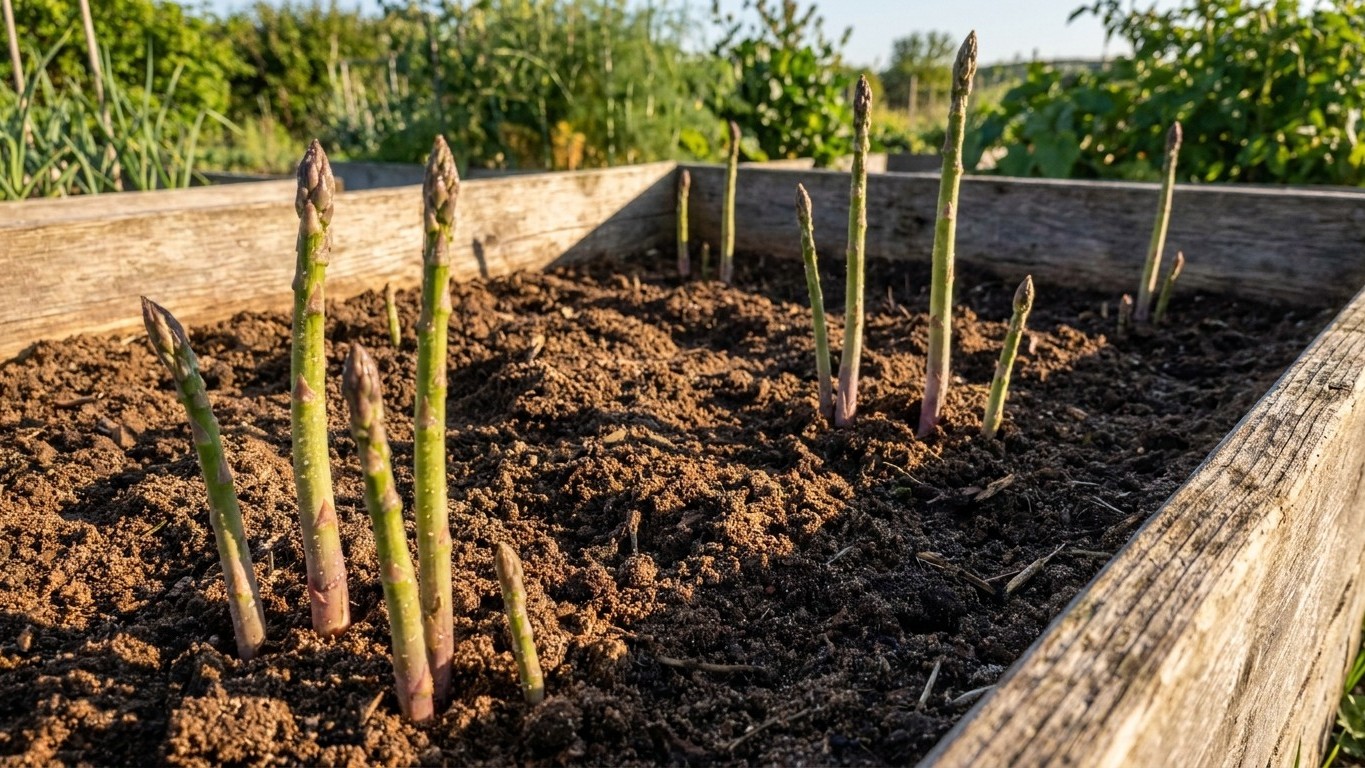

Yes, with a catch. The dominant soil across Saskatchewan’s farmed regions drains well by nature, which is the one requirement an asparagus bed actually has. But “dominant” doesn’t mean “yours”, and a bed you plant this spring is a bed you’re still harvesting when today’s toddlers are in high school. That’s the real question behind the soil question: not just will it drain, but will you still want it there in fifteen years.
The short answer
Saskatchewan’s farmed land is mapped, most commonly, as Chernozem: the deep, dark grassland soil the prairies are known for, rich in organic matter and naturally fertile. Across the surface horizons Agriculture and Agri-Food Canada has sampled, the texture runs loam to silt, roughly 43 percent sand, 22 percent clay, 35 percent silt, with organic matter sitting around 4 percent. Read as a whole, that profile is classed well drained. For a crop that asks for almost nothing except drainage, that’s a genuinely good starting point.
It’s a starting point, though, not a verdict on any one yard. That median comes from thousands of mapped components across the province’s agricultural zone, and it says nothing about the clay pocket behind a particular garage, the low corner where snowmelt sits into April, or the fill soil under a newer subdivision. Asparagus doesn’t ask for much, but the one thing it does ask for is non-negotiable: water has to move through the root zone and leave. Crowns sitting in standing water rot. There’s no fertilizer fix for that, no amendment that undoes a spot that stays wet.
So before anything else, watch the actual bed site after a hard rain or spring thaw. If water is gone within a few hours, the Chernozem pattern is likely holding true on that ground, and the province’s general reputation for well-drained soil applies to you too. If water is still standing the next day, don’t fight it in place. Raised beds or mounded rows solve the same problem without moving the garden, and they’re the standard fix wherever a gardener wants asparagus but the ground underneath doesn’t cooperate on its own.
Here’s what makes this crop different from nearly everything else grown in a home garden: the commitment is measured in years, not seasons. Utah State University Extension is blunt about the timeline. Crowns go into 8-inch furrows, and there’s no harvest at all in the first year, none in the second. The first cut doesn’t come until year three, and even then it’s limited, roughly four weeks of harvest that first cutting season, stretching to six weeks the year after, then eight weeks once the bed is fully established. After that, the planting simply produces for 10 to 15 years. There’s no shortcut and no “just this once” early harvest, pulling spears before year three weakens the crown’s root system for years afterward. The rule for when to stop cutting each season isn’t a date on a calendar either; it’s a visual one. Once most of the spears coming up are thinner than a pencil, the crown’s stored energy is running low, and it’s time to let the plant grow into fern for the rest of the season instead.
Will the summer here water it for you?
Established asparagus wants roughly 1 to 2 inches of water every other week through its first two seasons, then eases to about 1 to 2 inches every three weeks once it’s mature. Saskatoon’s climate normals put summer rainfall at about 6.6 inches total across June, July and August, with June the wettest at 2.59 inches, July at 2.38, and August the driest at 1.68. Here’s how that stacks up against the schedule the bed actually needs:
- Year one and two, June: the bed wants roughly 2 to 4 inches for the month on the every-other-week schedule. June’s normal of 2.59 inches gets partway there but likely falls short on the higher end, and rain that comes as one storm rather than steady soaking often runs off rather than reaching the root zone.
- Year one and two, July: demand stays in the same 2 to 4 inch range. July’s 2.38 inches tracks close to the low end of what’s needed, meaning a dry stretch mid-month can leave the bed short even in an average year.
- Year one and two, August: this is the gap month. Normal rainfall drops to just 1.68 inches, the lowest of the summer, right when a young bed still needs consistent moisture to build crown reserves for next year’s growth.
- Established bed, every three weeks: once the planting matures, the every-three-week rhythm is a lighter ask, and an established root system reaches deeper moisture the surface normals don’t capture. This is the stage where Saskatchewan’s summer rainfall comes closest to covering the bed without help.
Put plainly: a new bed here is unlikely to get through a typical summer, especially August, on rainfall alone. Supplemental watering isn’t optional in the first two years, it’s the difference between a crown that builds a strong root system and one that limps into its first harvest. A rain gauge on the actual plot, not just the area normal, is what tells a gardener whether a given week needs the hose.
When to put the crowns in
Crowns go into the ground in early spring, and in Saskatoon that window sits around the average last spring frost date of May 18. That figure is a mean, not a guarantee, in roughly half of all years, frost arrives later than that date, so treating May 18 as a safe planting cutoff misreads what a normal actually is. It’s the midpoint of a range, and a gardener working close to it should expect some years to run later, particularly away from the Saskatoon SRC station the figure is drawn from; northern and upland districts typically lag behind it.
Crowns are set into furrows roughly 8 inches deep, and the furrow isn’t filled in all at once. Soil goes back in gradually across the season, about 2 inches every other month, rather than burying the crown completely on planting day. That staged backfill lets the emerging spears push through loose soil rather than fighting their way up through a fully packed trench.
Seed is the other route, and it exists as an option alongside crowns, though the guidance behind this article centers on crown planting rather than seed-starting specifics. Crowns remain the more common home-garden path because they shortcut the earliest, slowest stage of the plant’s life.
On variety, Utah State University Extension names four, and the only detail attached to each is which flowers it carries, not flavor, not yield, not one being better suited to a given soil or climate:
| Variety | Type |
|---|---|
| Jersey Giant | All-male |
| Jersey Knight | All-male |
| UC 157 F1 | Male and female |
| Purple Passion | Male and female |
All-male varieties tend to be favored in home gardens because they don’t spend energy producing seed, but that’s a general pattern, not something the source ties specifically to Saskatchewan conditions or to how any of these four handles this province’s soil or winters. Chilling requirements and soil pH preferences for the crop simply aren’t addressed in the extension guidance this article draws from, so neither figure is offered here. What is clear: plant around that mid-May frost window, expect nothing from the bed until year three, and plan on watering through at least two summers before Saskatchewan’s own rainfall starts carrying more of the load.
Common questions
Can I test my own soil instead of relying on the provincial pattern?
A basic soil test through a local extension or agricultural lab will show your actual texture and drainage, which matters more for a 15-year planting than any provincial average. The Chernozem profile describes the region’s farmed land broadly; your own garden could differ from it entirely, especially if fill soil or grading was involved.
What happens if I harvest before year three anyway?
The extension guidance is explicit that harvesting shouldn’t begin until the third year. Cutting spears earlier draws down energy the crown needs to build its root system, and that shortfall carries into future seasons rather than staying contained to the year it happens.
Does the every-three-week watering schedule ever change again after the bed matures?
The source describes the two-year establishment schedule and the mature-bed schedule of roughly 1 to 2 inches every three weeks. No further adjustment beyond that point is addressed in the guidance behind this article.
Is there a hard-freeze date I should watch for in fall instead of just the spring frost?
Only the average last spring frost date for the Saskatoon SRC station is addressed here. No fall or hard-freeze threshold is published in the sources behind this article, so none is given.