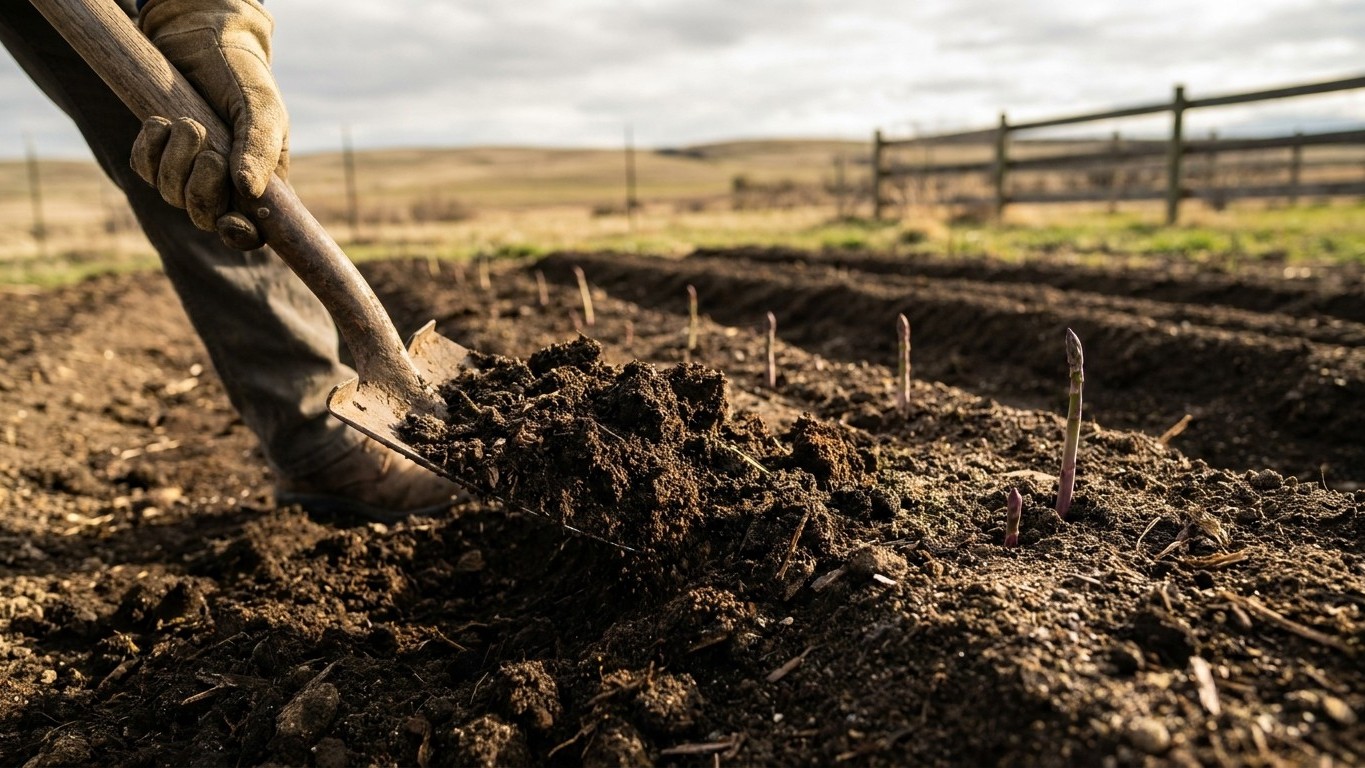

Saskatchewan’s dominant soil, the Chernozem that covers most of the province’s farmland, drains well enough for a fifteen-year asparagus bed in most cases. The real work is testing your own patch of ground, watering through two dry establishment summers, and knowing when to plant asparagus crowns in Saskatchewan, around the third week of May, after the frost risk has mostly passed.
The short answer
Saskatchewan’s farmland runs mostly on Chernozem, the deep, dark grassland soil that covers 68 percent of the province’s mapped surface. It’s a loam-to-silt mix, roughly 43 percent sand, 22 percent clay and 35 percent silt, with organic matter sitting around 4 percent and a median surface pH near neutral at 6.8. Classified as well drained, it’s a reasonable starting point for a crop that asks for exactly one thing from its soil: drainage. Utah State University Extension, the only authority behind the planting method described here, is silent on soil pH and silent on any winter chilling requirement, so neither gets invented in this article. What the source does say plainly is that asparagus crowns are set in 8-inch furrows, produce nothing for two full years, and then keep bearing for ten to fifteen years once they start.
Why the soil question only gets asked once
That fifteen-year span changes the math on soil, raising the question of whether Saskatchewan soil will hold an asparagus bed for fifteen years. A heavy, slow-draining patch is an annual nuisance for most vegetables, something you amend every spring and move past. For asparagus, it’s a decision made once and lived with for over a decade. The province-wide Chernozem figure, drawn from 3,675 mapped soil components across Saskatchewan’s agricultural zone, describes a tendency, not a diagnosis of your yard. A low spot that collects runoff, a lot near a slough, or any ground a builder has scraped and refilled can behave nothing like the median. If water sits on your bed after a hard rain instead of soaking in within a day, that’s the sign to build up rather than dig in: a raised bed or mounded row lifts the crowns above standing water without changing anything else about the planting method.
On choosing a variety
Utah State University Extension names four varieties, sorted only by sex: Jersey Giant and Jersey Knight are all-male, while UC 157 F1 and Purple Passion carry both male and female plants. The source publishes no flavor comparison and no yield data between them, so there’s no published reason to prefer one over another beyond that distinction. No nursery is named here either. Whichever variety you plant, the ground it goes into is the one variable worth checking yourself, with a soil test, before the crowns arrive.
Will the summer here water it for you?
Utah State University Extension’s watering schedule is specific: 1 to 2 inches every other week for the first two growing seasons, then a lighter 1 to 2 inches every three weeks once the bed is established. Saskatoon’s long-term summer normals, drawn from Environment and Climate Change Canada’s 1981-2010 records, come to about 6.6 inches across June, July and August, split unevenly across the three months. Lined up against each other, the numbers tell a fairly clear story.
- June, establishment years: the month averages 2.59 inches, which works out to roughly 0.6 inches a week. That sits close to the top of what a young bed needs, so a normal June may cover most of the requirement on its own.
- July, establishment years: 2.38 inches for the month, again close to 0.55 inches weekly. Similar story to June, adequate in an average year but with little cushion if a stretch runs dry.
- August, establishment years: the driest month of the three, at just 1.68 inches, or about 0.39 inches a week. That falls short of the 0.5 to 1 inch weekly pace the bed wants in its first two summers, which means August is the month most likely to need a hose.
- Year three and beyond: the lighter schedule of 1 to 2 inches every three weeks works out to roughly 0.33 to 0.67 inches a week. June and July rainfall clears that bar comfortably; August’s 0.39 inches a week lands right at the low end, adequate most years but worth watching in a hot, dry stretch.
These are long-term normals for one station, not a promise for any given summer. A rain gauge on your own bed, checked weekly through the growing season, is what actually tells you whether to water. Sandy soil lets an inch of rain through in a day; the clay fraction in a heavier Chernozem holds it closer to a week, which changes how often you’d need to top it up even under identical rainfall.
When to put the crowns in
Crowns go into the ground in early spring, set into those 8-inch furrows before backfilling. In Saskatchewan, “early spring” has to be measured against the last frost, and the mean last spring frost date at the Saskatoon SRC station is around May 18. That’s an average, not a guarantee: in one year out of two, frost arrives later than that date, so treat it as the midpoint of a window rather than a safe line to plant against. Gardeners further north or at higher elevation than Saskatoon should expect that window to run later still.
Backfilling the furrow
The furrow isn’t filled in all at once. Utah State University Extension describes a gradual process, adding about 2 inches of soil back into the trench every other month across the season as the crowns send up growth, rather than burying them the day of planting. That staged fill is part of why the first two years produce nothing above ground worth harvesting: the plant is spending that energy building the root system that has to carry it for the next decade.
What harvest looks like once it starts
No spears get cut in year one or year two, full stop. Year three brings the first harvest, and it’s short: about 4 weeks. Year four stretches that to 6 weeks, and from year five onward the harvest window runs about 8 weeks. The rule for when to stop cutting in any given year isn’t a date on the calendar, it’s a look at the spears themselves: once most of them are coming up thinner than a pencil, harvest ends for the season, whatever week that happens to fall in.
Utah State University Extension also lists seed as an alternative to crowns, for gardeners who’d rather start from scratch. Seed-grown plants take longer to reach the size that crowns already have when you buy them, adding time before that same three-year wait to first harvest even begins. The source doesn’t publish exact seed-starting timing beyond naming it as an option, so no specific schedule is given here.
Checking this against your own county
Provincial soil surveys and one weather station’s normals are a starting point, not a substitute for what’s happening on your own lot. Saskatchewan’s Ministry of Agriculture keeps resources and contacts for exactly this kind of question, from soil testing to local growing conditions, through its agribusiness and farmer resources page. A soil test through that office tells you your actual pH and drainage, rather than the provincial median. If you’re near a different city than Saskatoon, or at a different elevation, your own frost dates may run earlier or later than the figures cited here, and that’s worth confirming before you commit a bed to Fifteen Years in One Spot.
Common questions
Can asparagus grow in heavy clay soil in Saskatchewan?
Some clay content is normal in Saskatchewan’s Chernozem, which runs about 22 percent clay on average and is still classed as well drained at the provincial level. If your specific spot holds water after rain instead of draining within a day, a raised or mounded bed solves the problem without changing the planting method.
How long until you can actually eat asparagus from a new bed?
Three years minimum. Years one and two produce no harvest at all while the crowns establish; the first cutting comes in year three and lasts about 4 weeks.
Is there a best asparagus variety for Saskatchewan?
No variety-specific performance data for the province is published in the source used here. Utah State University Extension names four varieties by sex only, all-male Jersey Giant and Jersey Knight, and male-female UC 157 F1 and Purple Passion, without ranking their flavor or yield.
Do you need to water an Asparagus Bed all summer in Saskatchewan?
Likely yes, at least in August. Saskatoon’s summer rainfall normals cover most of the bed’s needs in June and July, but August’s normal of 1.68 inches falls short of what an establishing bed wants, so supplemental watering that month is the most reliable bet.