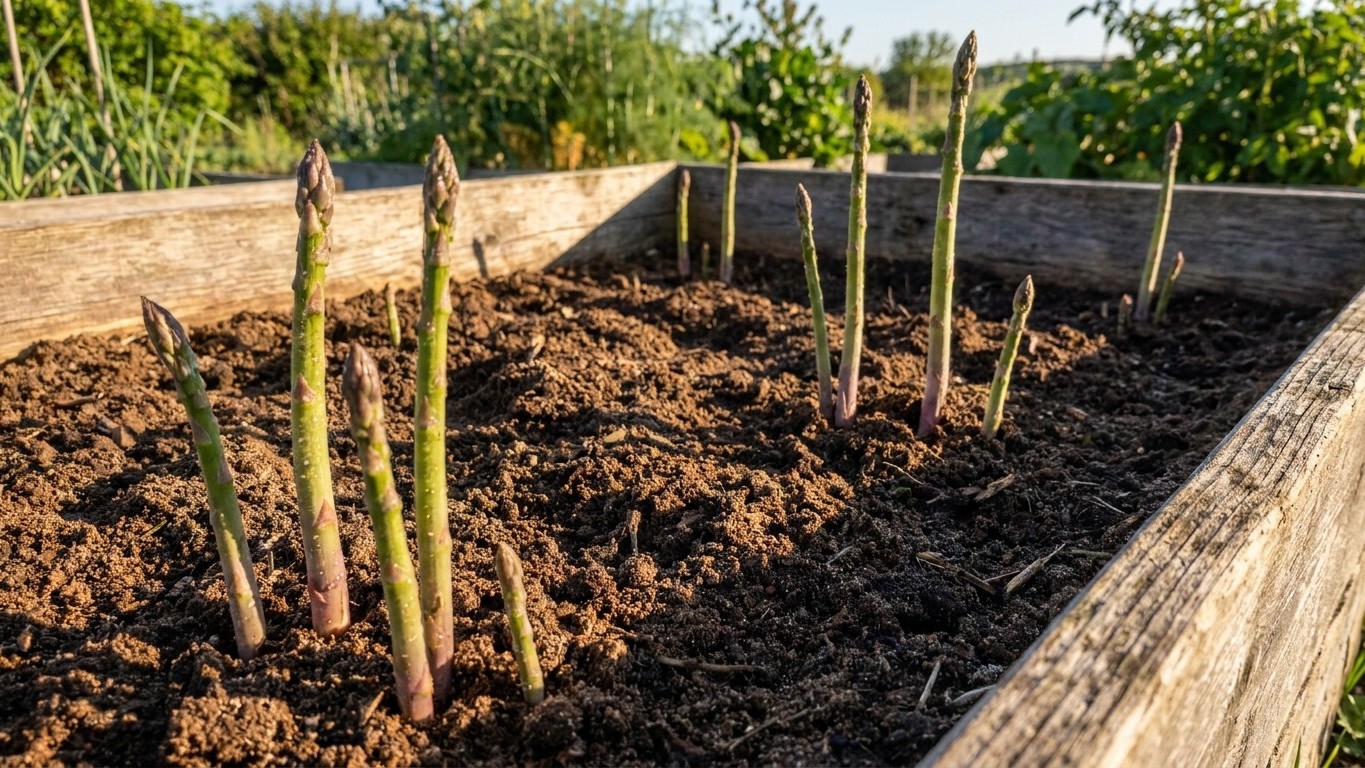

Stop cutting when most of the spears coming up are thinner than a pencil. That is an object to look at, not a date to circle. A new bed in Rhode Island gets no cutting at all until year 3. After that the season runs four weeks, then six, then eight. Cut spears keep best at 32 to 35°F with their butts standing in water. The rest of this page gets a bed to that point, and the Growing Asparagus in Rhode Island guide covers the full cycle.
The short answer
An asparagus bed is the one garden decision in Rhode Island that you make for 10 to 15 years. Crowns go into 8-inch furrows in early spring, nothing is harvested until year 3, and then the bed produces for a decade or more. Utah State University Extension, the only authority behind this page, asks one thing of the ground: that it drains. Most soils will do, provided they are well drained.
The state soil passes that test. USDA lists the Narragansett series as well drained, a loam to silt with 34 percent sand, 6 percent clay and 60 percent silt, plus about 4.0 percent organic matter in the surface layer. It is an Inceptisol, a young soil without strong horizons yet. USDA also records a surface pH of about 5.3, strongly acid, but the Utah State source is silent on asparagus and pH. So this page offers no target for that number and won’t invent one.
If your spot doesn’t drain
The Narragansett series represents the state. It is not a diagnosis of your yard. Rhode Island has river bottoms, hill country and plenty of lots where a builder scraped off the topsoil or trucked in fill, and any of those can behave nothing like the representative values above. Elsewhere in a garden, heavy soil is an annual nuisance you amend each season. Here it is a decision you can’t undo, because the crowns sit in that spot for fifteen years.
Before digging furrows, dig one test hole about as deep as the furrow will be, fill it with water, and watch. If the water is still sitting there a day later, treat that as a warning. The fix is to move the bed to better ground or build it up above the heavy layer, not to plant and hope. The Will Rhode Island Soil Hold an Asparagus Bed for Fifteen Years? page goes deeper on reading your own ground.
Will the summer here water it for you?
The bed wants 1 to 2 inches of water every other week for its first two years, then every three weeks after that. Rhode Island’s summer delivers about 10.3 inches of rain across June, July and August, out of 47.5 inches for the whole year (NOAA NCEI Monthly Climate Normals, 1991-2020, for the reference station). By month that is 3.81 inches in June, 2.91 in July and 3.59 in August. July is the driest.
What that rain amounts to
Spread evenly, which rain never is, a two-week stretch brings about 1.8 inches in June, 1.3 in July and 1.6 in August. Three weeks of an average July bring close to 2 inches. On paper, then, a normal Rhode Island summer covers most of what the bed asks for, and a gardener adds little. In a dry fortnight, the gardener adds the whole gap between the gauge and 1 inch, sometimes up to 2.
Two things shave that margin. Hot days at or above 90°F drive evaporation. And a single summer thunderstorm often runs off instead of soaking in. The well-drained silt loam of the state soil lets water move down rather than holding it for a week, which helps the crowns but also means the surface dries out between storms. These are normals, not a forecast, and a slope, a coastal breeze or a paved edge changes them for your plot.
- Set a rain gauge beside the bed, since only your own plot settles the question.
- In the first two years, add up the rain from the last two weeks.
- If the total is under 1 inch, water to make up the difference, aiming for 1 to 2 inches in all. Go slowly so it soaks in.
- If the gauge already shows 1 inch or more, skip the hose.
- From year 3, run the same count over three weeks instead of two.
A tuna can set out during a sprinkler session works as a cheap check on how much the hose actually delivers.
When to put the crowns in
Crowns go in during early spring. For Rhode Island, the reference weather station puts the last spring frost around April 7 to April 17 (NOAA NCEI Climate Normals, 1991-2020, 32°F freeze probabilities in the 30 to 70 percent band). That is an average, so some years it comes earlier and some later. It is also a city-station figure. Suburban and rural yards often see the last frost one to two weeks later, and higher ground later still, so check your own county before you mark a date.
Dig the furrow 8 inches deep and set the crowns in it. Then resist the urge to fill it in. The furrow is backfilled gradually across the year, about 2 inches every other month, not all at once. The source gives no exact date for the first planting beyond early spring, so use the frost window above as an anchor and not a deadline.
Seed, and the four named varieties
Starting from seed is the alternative to buying crowns. The Utah State source gives no seed-starting dates and no time to first harvest for the seed route, so follow the packet and don’t assume it matches the crown timeline. It does name four varieties, and only by sex. Jersey Giant and Jersey Knight are all-male. UC 157 F1 and Purple Passion are male and female. Nothing is published there about flavor, yield or any reason to prefer one over another, so this page won’t pretend otherwise.
Once crowns are in, the harvest clock is strict. Nothing is cut in the first two years and none in year 3 before the season begins. The first harvest runs four weeks, the next six, then eight. A few spears is not a softer option for the early years. Cutting stops when most of the spears are thinner than a pencil. What grows after that is left alone, and the What Eats Asparagus in Rhode Island, and When page covers what shows up on it.
Common questions
Is there a calendar date to stop cutting?
No. The rule is an object: stop when most spears are thinner than a pencil. The source gives no week number and no diameter in inches, so a date on this page would be invented. Watch the bed, not the calendar.
Can I take a few spears in the first two years?
No. Nothing is harvested until year 3. After that the season is four weeks, then six, then eight.
How do I keep cut spears fresh?
The window is narrow and both edges bite. UC Davis Postharvest puts the optimum at 32 to 35°F (0 to 2°C) with 95 to 100 percent relative humidity. Above 50°F the spears toughen rapidly. At about 31°F or lower they freeze, turn water-soaked and collapse on thawing. In a home kitchen, stand the butts in water or wrap them damp, because the cut end loses moisture faster than anything else. Check the fridge with a thermometer, since the back wall can run colder than the dial suggests.
Does the state soil figure tell me about my own bed?
It tells you what the region’s ground tends to do, which is drain well, not what yours does. The figures are USDA’s representative values for the mapped surface, not a measurement of a worked bed. A soil test gives you your own numbers, though the Utah State source sets no pH target for asparagus, so a test result has no asparagus benchmark here. Drainage, the one requirement it does give, you can check yourself with the water test above.