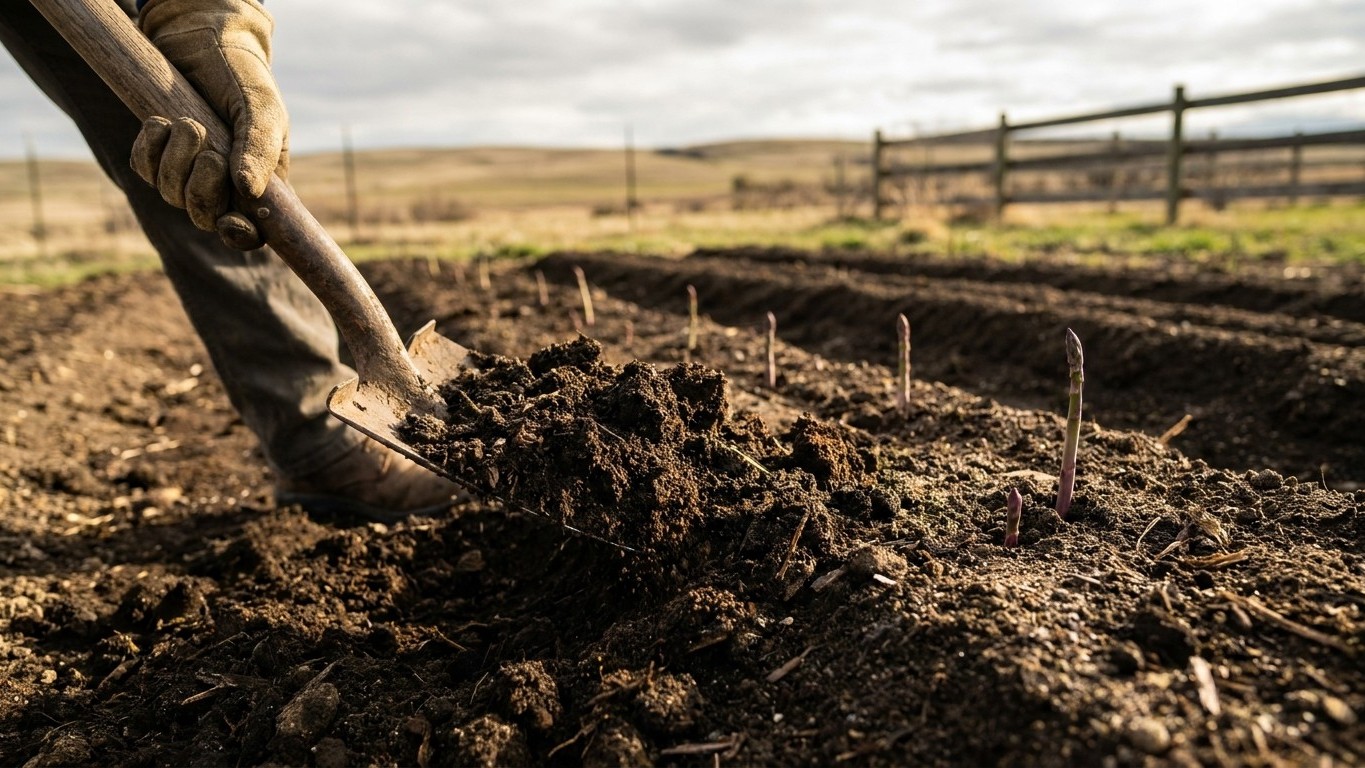

Rhode Island gardeners can grow asparagus successfully, but the decision carries more weight than most vegetable choices. A bed planted this spring will still be producing spears a decade and a half from now, on the same patch of ground, with the same drainage it started with. The only published requirement is that the soil drains well. Whether the ground under your feet does that is the question worth settling before the first crown goes in.
The short answer
Once asparagus crowns go into the ground, they stay there for 10 to 15 years, which is why When to Plant Asparagus Crowns in Rhode Island matters as much as the site itself. That single fact changes how you should think about site selection compared with, say, tomatoes or squash, where a bad spot this year just means moving the rows next spring. Asparagus doesn’t give you that do-over, which raises the real question: Will Rhode Island Soil Hold an Asparagus Bed for Fifteen Years? Utah State University Extension puts the requirement in plain terms: most soils will work, provided they are well drained.
Rhode Island’s representative soil, the Narragansett series, checks that box. USDA’s Soil Survey Geographic Database lists it as well drained, a loam-to-silt mix running about 34 percent sand, 60 percent silt, and 6 percent clay, with organic matter around 4.0 percent in the surface horizon. It’s classified as an Inceptisol, meaning it’s a relatively young soil that hasn’t had time to build the strong, distinct layers older soils develop. Surface pH runs around 5.3, which is strongly acid. That number describes the soil series USDA uses to represent the state, and it’s worth noting the source for asparagus itself is silent on any pH preference, so no target number is given here.
Here’s the caveat that matters more than any of those figures: the Narragansett series represents Rhode Island in USDA’s records. It does not represent your yard. A state this size still holds hundreds of soil series, and river bottoms, hillsides, and any lot a builder has graded or filled can behave nothing like the mapped norm. If your ground is naturally well drained loam or silt loam, you’re likely in good shape by the same standard USU Extension sets. If water tends to pool after a rainstorm, or the ground stays soggy into late spring, that’s the signal to act before planting, not after.
The fix isn’t complicated, but it has to happen at the start. A raised bed, built 8 to 10 inches above grade, sidesteps a poorly drained site entirely. Working in organic matter, compost, aged leaf mold, can loosen a heavier soil over a season or two, though it won’t turn clay into loam overnight. What doesn’t work is planting anyway and hoping. Fifteen years is a long time to fight standing water around a crown that can’t tolerate it.
Will the summer here water it for you?
The published watering target for a new asparagus bed is specific: 1 to 2 inches every other week for the first two growing seasons, easing back to about once every three weeks after that. Rhode Island’s summer rainfall, drawn from NOAA’s 1991-2020 climate normals for the state’s reference station, runs about 10.3 inches total across June, July, and August. Here’s how that breaks down against what the bed actually needs.
- Check June first. The normal for June is 3.81 inches, the wettest of the three summer months. Spread over four weeks, that’s close to the 1-to-2-inch-every-other-week target on its own, assuming it falls evenly rather than in one or two storms.
- Watch July closely. This is the driest month of the Rhode Island summer, averaging just 2.91 inches. A young bed in its first or second season, needing roughly 2 to 4 inches over the month, can come up short here, especially since a single thunderstorm dumps water fast enough that much of it runs off rather than soaking into the root zone.
- August usually recovers some ground. The August normal sits at 3.59 inches, back closer to what a two-year-old bed requires. Still, normals are averages built from three decades of data, not a promise for this particular summer.
- Ease off after year two. Once the bed shifts to the every-three-weeks schedule, the math changes in the gardener’s favor. A mature root system also reaches deeper for moisture, so the pressure to supplement drops even in a dry July.
- Put a rain gauge on the actual bed. Climate normals describe a regional pattern recorded at one reference station. Your yard’s rainfall, especially in a dry spell, is the only number that tells you whether to run a hose this particular week.
The takeaway isn’t complicated: expect to supplement in July most years, keep an eye on June and August, and don’t assume Rhode Island’s summer will do the job unattended, particularly while the crowns are young.
When to put the crowns in
Crowns go into the ground in early spring, and in Rhode Island that means working around a last spring frost date that falls, on average, somewhere between April 7 and April 17. That range comes from NOAA’s 30-to-70-percent freeze probability band for the state’s reference weather station, so treat it as a mean, not a guarantee. It’s an average built from three decades of records, and a suburban or rural garden away from that reference station often sees frost linger later into spring, sometimes by a week or two.
In practice, that means aiming to get crowns into furrows once the soil is workable and the risk of a hard freeze has mostly passed, rather than fixing a calendar date and planting regardless of conditions. The furrows themselves run about 8 inches deep. Crowns get set at the bottom, and here’s a detail that trips up first-time growers: the furrow isn’t filled in all at once. Soil goes back in gradually, roughly 2 inches every other month across the growing season, rather than being backfilled the day of planting.
Seed is the alternative route, and it’s a slower one. Starting from seed adds real time to the front end of the process, since seedlings need a season of growth before they’re set out as crowns, pushing the eventual harvest further out. Crowns remain the faster path to an established bed, which is likely why they’re the more common starting point for home gardeners.
Whichever route you take, the harvest timeline doesn’t bend. No spears get cut in the first year, or the second. Year three is when harvesting finally starts, and even then it’s limited: about 4 weeks of cutting that first harvest year, extending to roughly 6 weeks the following year, and up to 8 weeks in the years after the bed is fully established. The stopping point each season isn’t a date on the calendar. It’s a visual cue: once most of the spears coming up are thinner than a pencil, harvest stops for the year, regardless of how many weeks have passed.
On varieties, the published information from Utah State University Extension is narrower than most gardeners expect. Jersey Giant and Jersey Knight are named as all-male hybrids. UC 157 F1 and Purple Passion are named as male-and-female types. That’s the extent of what’s published, sex type alone. No flavor comparison, yield figure, or reason to choose one over another appears in that source, and none should be invented here.
Checking this against your own county
Everything above describes Rhode Island in the aggregate: one representative soil series, one reference weather station, one set of statewide averages. None of that replaces a look at your specific county. Drainage, frost timing, and even summer rainfall can shift meaningfully between a coastal lot and a spot further inland, and the only way to know where your garden actually falls is to check locally.
The University of Rhode Island Cooperative Extension is the resource built for exactly that question. Its office can point you toward soil testing options, help interpret what a test result means for a bed meant to last over a decade, and give guidance tailored to local frost patterns rather than a statewide average. You can find URI Extension’s services at web.uri.edu/coopext.
A soil test in particular is worth the modest cost before you dig the first furrow. It’s the difference between guessing at drainage from a state-level map and knowing, from your own dirt, whether the bed you’re about to commit fifteen years to is starting on solid ground.
Common questions
Can I harvest any spears in the first or second year?
No. The published guidance is firm on this: no harvest in year one or two. Cutting spears before the plant has built up its root reserves weakens the bed for years afterward. The first harvest comes in year three, and even then it’s limited to about 4 weeks.
What if my soil doesn’t drain well?
Build up rather than dig in. A raised bed, 8 to 10 inches above the surrounding grade, sidesteps poor drainage without needing to fully rework the native soil. Working organic matter into a heavier soil helps over time but won’t substitute for good drainage on its own.
Do I need to test my soil’s pH before planting?
The source used here for asparagus culture doesn’t publish a pH requirement, so no target number is given in this article. A soil test through your local extension office is the way to get an actual reading for your ground, along with guidance on whether any amendment makes sense.
How do I know when to stop harvesting each spring?
Watch the spears, not the calendar. Once most of what’s coming up is thinner than a pencil, that’s the signal the plant needs to stop putting energy into spears and start rebuilding its root system for next year. Cutting past that point year after year weakens the bed.