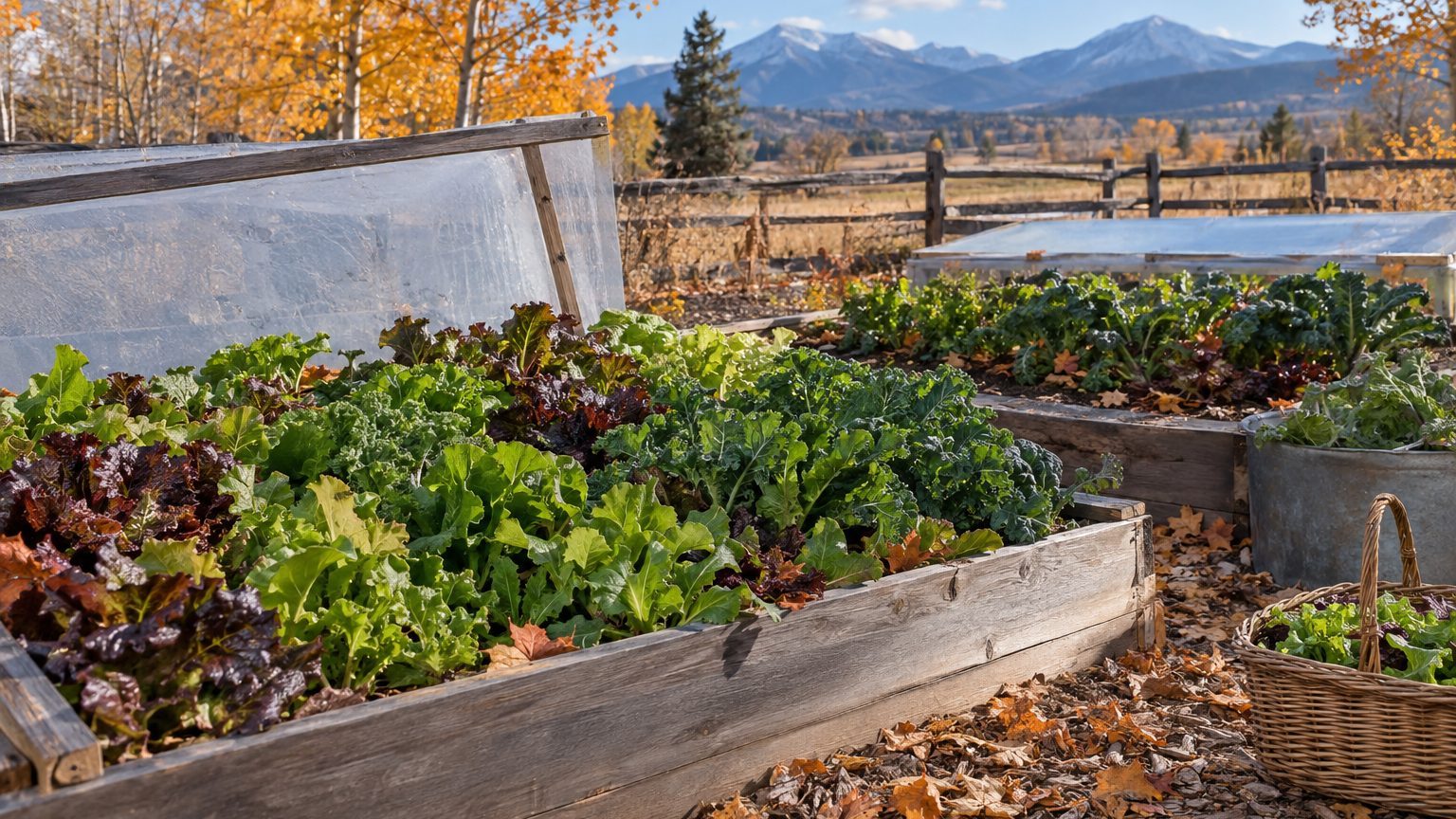

Montana will not let a salad green grow in January, and that is fine, because winter salads here are sown in late summer and early fall, grown to size before the light fails, then held in the bed under cover for cutting. The cold arrives after the plants are ready for it. Find your first fall freeze, count back from it, and sow your first batch by that count rather than by the date on a seed packet.
When the soil is warm enough in Montana

NOAA’s 1991-2020 climate normals for Billings put the last spring 32F freeze between April 29 and May 10. Billings is one of the milder valleys in the state, so treat that range as a reference point and not as your date. Mountain valleys elsewhere in Montana can frost in any month, and a garden at a higher elevation or in a cold pocket will run later. A frost date is a probability, not a promise, and a hard freeze after the range has passed is always possible.
Frost is a stand-in for soil
A frost date tells you about the air on a clear night. Winter salad seed cares about the soil, and the soil warms after the frost risk ends, not at the same moment. A bed can be frost-free on paper and still be cold, wet and slow at seed depth.
Cool-season greens are the exception to the usual rule. Spinach, mâche and arugula germinate in soil that would rot a bean seed, so a spring sowing of these does not have to wait for the end of the Billings range. What it has to wait for is soil that is workable. Squeeze a handful from the top few inches. If it stays in a sodden ball, wait. If it crumbles when you poke it, sow.
Put a soil thermometer at seed depth in the morning, when the reading is at its lowest, and compare it with the minimum germination temperature printed on the packet. That comparison is more reliable than any date, because a cold spring and a warm one can be three weeks apart in the same garden.
The other direction: late summer
The sowing that matters most for winter eating happens when the soil is warm, not cold. Late-summer beds can be hot enough at the surface that lettuce seed sits and refuses to sprout. Sow in the evening, water the row before and after, and lay a board or a strip of shade cloth over it until the seedlings show. Take it off the day they appear.
This page does not name varieties, because the ones proven in Montana trials are a question for the state’s extension service, and the section on types below says where to look. For now, plan around the soil reading and the first fall freeze, and let the spring frost range serve only as an outer limit for tender crops.
How long the season lasts here
Take NOAA’s 1991-2020 normals for Billings. The last spring freeze falls between April 29 and May 10, and the first fall freeze between October 1 and October 14. Count from the late end of spring to the early end of fall and you get roughly 144 days. Count from the early end of spring to the late end of fall and you get roughly 168 days. So the frost-free window at Billings runs about 144 to 168 days, and the spread between those two numbers is bigger than most seed packets allow for.
Other parts of Montana differ, often a great deal. A gardener in a high mountain valley may have a window a fraction of that length. Use the Billings figure to see how the arithmetic works, then substitute the dates from your nearest weather station.
What a window like this allows
A window in this range is enough for two rounds of salad. The first goes in as soon as the soil can be worked and is cut before summer heat pushes it to seed. The second goes in from late summer, timed so the plants reach cutting size before the first fall freeze, which at Billings falls between October 1 and October 14. After that, days shorten fast and growth slows to a crawl. What you have in the bed at that point is what you will be eating from, with only slow additions.
That is why the fall sowing is counted backward from the freeze and not forward from summer. Take the days to maturity from the packet, add a margin because catalogue figures shift by a week or two with the season, and subtract the total from the first fall freeze range. The result is a range of sowing dates, not one date. Sow at the early end if the summer has been cool.
A short window would change the picture. Where the first sowing is the only one you will get, transplanting stops paying for itself, since a transplant checked at the root loses days that a direct-sown row never loses. In a longer window like the one at Billings, transplanting fussy types such as heading lettuce is affordable, and starting flats in the shade of a fence in midsummer works well. A steady rhythm of small sowings, a week or two apart, does more for you than one big planting. The pillar guide, Winter Salads: What Grows When Lettuce Will Not, covers the basics of the crop if you are starting from nothing, and the principle of staggering sowings applies here exactly as it does anywhere.
Heat and water in Montana

This page carries no count of days above 90 F and no summer rainfall total, so it will not invent them. NOAA publishes both for every station in its climate normals, and you should look up the one nearest you. What can be said is how the two matter to a winter salad, and it is a smaller matter than the cold.
Summer decides only the sowing
Heat affects winter salads at one moment, the late-summer sowing. Hot soil delays germination, and a heatwave in the first weeks makes seedlings wilt or bolt. Shade cloth and evening watering handle most of it. A dry summer also means the bed needs steady water while the seedlings establish. Once fall arrives, the problem reverses and cool nights carry the crop.
Where a summer runs cool and damp instead, the trouble is not heat but slow growth, mildew and slugs. Downy mildew shows as yellow patches on the upper leaf with a gray fuzz beneath. The defense is practice, not product: wider spacing, water at the root in the morning, and picking off the worst leaves before they touch the healthy ones. Gardeners in humid states live with this all season, and Winter Salads for West Virginia Gardens shows what that pressure looks like when it never lets up.
Cold sorts the crop
Everything else here is decided by the cold. NOAA’s 1991-2020 normals for Billings put the mean daily minimum of the coldest month at 17.9 F. That is an average of the nightly lows, so real nights run colder, and the USDA Plant Hardiness Zone Map (2023) spreads Montana across zones 3a to 6a, which shows how much the state varies. Billings is the reference here, and your garden may sit well above or below it.
Read that number as a sorting tool. Some greens stand uncovered through a winter like this, holding in the bed and resuming growth when the light returns. Others stay edible only under a cover such as a cold frame or a low tunnel of row cover over hoops. A third group cannot manage at all, and that includes full-size heading lettuces and soft baby leaves left in the open. Treat those as fall crops and cut them before the hard freezes arrive.
The first fall freeze then sets the deadline. At Billings it falls between October 1 and October 14, and a sowing that has not reached useful size by then will sit at that size until spring. Late sowings are not wasted. They become the spring crop, but they do not feed you in November.
Which winter salads suit Montana
Choose by type, and choose for the cold first. The season is short, the winter low is real, and the earliest, hardiest types do the most for you. This page names no cultivars, and that is deliberate. The varieties that perform in Montana are the ones trialled here, and this page does not have those results. A name pulled from a catalogue would sound helpful and might fail in the first hard week of November. Montana State University Extension is the place to ask, and your county office can tell you what local growers actually use.
The table below sorts the main types by the role they play. It is a general guide to how these crops behave, not a set of trial results.
| Type | Role in a Montana winter bed | Cover |
|---|---|---|
| Mâche (corn salad) | Among the hardiest, slow growing, holds through cold | Often stands uncovered |
| Spinach | Sown late summer, cut in fall, resumes in early spring | Stands uncovered in most winters, cover improves quality |
| Claytonia | Cool-loving leaf crop for the coldest stretch | Cover helps in the hardest weeks |
| Kale, baby kale | Tough leaves that hold well in the bed | Usually uncovered |
| Arugula, mizuna, tatsoi | Fast growers for fall cutting | Need cover to last into winter |
| Loose-leaf lettuce | Fall crop, tender | Cover essential, cut before the hardest freezes |
Reasoning from the facts
A short season favors the fast types, arugula, mizuna and loose-leaf lettuce, because they reach size before the first freeze in early to mid October at Billings. A cold winter favors the slow, tough ones, mâche, spinach and kale, which do the actual wintering. A sensible bed uses both: fast types on the early sowing date for fall eating, slow types on the later date to stand through and resume in spring.
Disease resistance is the second criterion. In a cool damp stretch, mildew resistance printed on the seed packet is worth more than a marginal gain in earliness. Ask Extension which resistances matter locally. Gardeners in milder, wetter country weigh these choices differently, and Winter Salads for Oregon Gardens shows how far the list shifts when the winter low is gentler.
Grow all of these in beds, raised boxes or containers. Salad greens are for the garden, and this page does not cover gathering anything from the wild.
Common questions
Are the Billings frost dates right for Bozeman or Missoula?
No. The April 29 to May 10 range and the October 1 to October 14 range are NOAA’s 1991-2020 figures for Billings only. Other Montana valleys can be colder, and some frost in any month. Look up NOAA’s normals for the station closest to you, or ask your county Extension office.
Can I cut leaves that are frozen stiff?
Wait. Frozen leaves snap and bruise, and the damage shows as slime a day later. Let a cover thaw on a mild afternoon, then cut. Harvesting midday, when the air is warmest, gives the cleanest cuts.
Do I water under cover in winter?
Rarely, but check. A cold frame or tunnel keeps rain and snowmelt off the bed, so the soil can dry out even in cold weather. Push a finger in on a mild day and water lightly in the morning only if the soil is dry. Wet leaves that freeze overnight invite rot.
Should I direct sow or start in trays?
Direct sow the fast, small-seeded types like arugula, mizuna and spinach. Start heading lettuce in trays if the summer soil is hot, and move them out when they have a few leaves. The transplant takes a root check, but the seedlings avoid the worst of the heat and you gain a little time, which counts when the first fall freeze is a few weeks off.