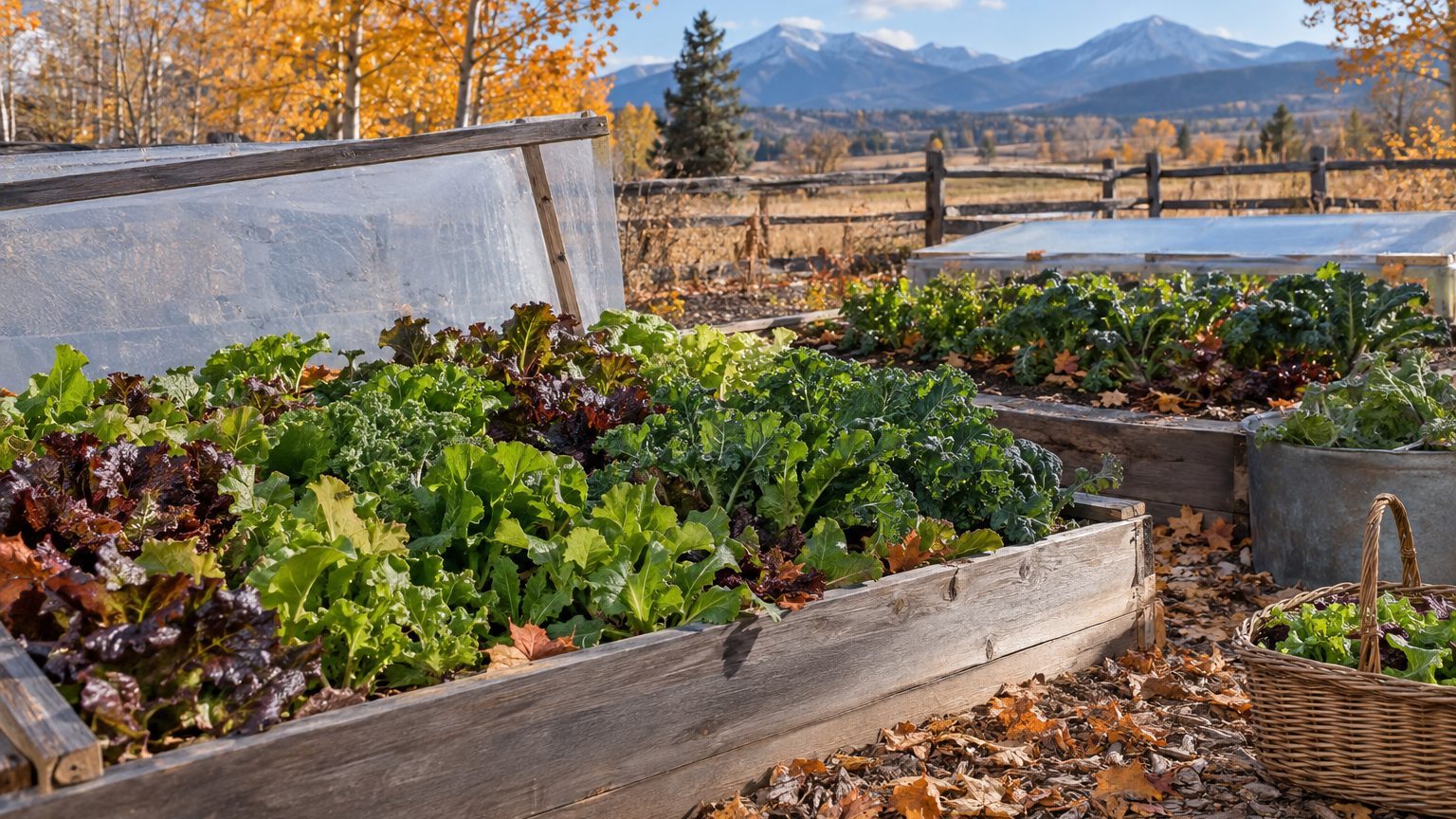

Winter salads in West Virginia are a late-summer and fall sowing, and the ground matters more than the calendar. At the Charleston reference station, the last spring freeze falls between April 9 and April 23, and the first fall freeze between October 18 and November 1. Those dates frame the plan, but soil condition, elevation and the type of green decide what actually survives.
When the soil is warm enough in West Virginia
April 9 to April 23: that is the last spring frost at Charleston (station USW00013866), taken from the NOAA NCEI 1991-2020 Climate Normals, in the band where the chance of a 32 F freeze runs between 30 and 70 percent. A frost date is a probability, not a promise, so some springs will freeze after the later date.
Treat that date as a proxy. Seed does not care when the last frost happened. It cares how warm the soil is, and soil warms after the frost risk ends, not alongside it. A bed that has just stopped freezing at night can still be cold and soggy two inches down, especially heavy clay in a shaded hollow. A raised bed or a patch of south-facing ground gets there sooner. A soil thermometer pushed in at seeding depth, checked in the morning, beats any date on a chart.
The same logic runs in reverse in late summer, which is when most winter salad gets sown. August soil is plenty warm, so germination is quick, and the trouble becomes keeping the seedbed cool and damp enough for seed to come up evenly. Shade cloth or a board laid over the row until sprouts show does a lot of that work.
Charleston sits in a river valley, and that matters in a state this hilly. Higher elevations across West Virginia freeze noticeably earlier in fall, and ridge-top gardens will likely warm later in spring as well. The USDA Plant Hardiness Zone Map 2023 (built on 1991-2020 normals) puts the state anywhere from 5a to 7a. That system rests on one variable, the average annual extreme minimum temperature, and it is a statewide range, so use Charleston as a reference point and adjust for your own hillside.
One house rule applies to everything on this page: salad here is grown in beds, containers and cold frames, never gathered from the wild. That goes double for watercress. Wild cress in water that livestock have grazed can carry liver fluke, and several wild plants that resemble young salad leaves are seriously toxic. For varieties, talk in types and check with West Virginia University Extension for what has been trialled in the state.
How long the season lasts here
Subtract the Charleston dates and the frost-free window comes out between 178 and 206 days. The short end runs from the later spring date (April 23) to the earlier fall date (October 18). The long end runs from April 9 to November 1. That is roughly 25 to 29 weeks, and it describes the valley floor, not a ridge.
What does a window that long allow? A second sowing, mainly. A gardener with only 90 frost-free days has one shot at the crop and makes the best of it. Here there is room for a cool-season spring planting of quick leaves, a gap through the worst of summer, and then a fall round started in late summer and repeated every couple of weeks while the light is still strong. Staggering sowings this way spreads the harvest out, so you are not facing forty heads of lettuce on the same weekend. The succession sowing guide on this site covers spacing the rounds in detail.
It also changes the transplanting question. Every transplant risks a root check, a stall while the plant repairs its damaged roots. In a short season, that stall can eat the margin, so direct sowing wins by default. With 178 days or more to work with, a stall costs less. Lettuce and kale tolerate being started in trays and moved to the bed, which is handy when August heat makes direct seeding a gamble. Spinach and mâche generally prefer to be sown where they will grow, and the long window means there is no hurry to force them.
Two cautions on the arithmetic. First, the window counts frost-free days, but winter salad is a crop that outlasts the first frost, so treat 178 to 206 days as a planning tool and not the end of the harvest. Second, a hillside garden with an earlier fall freeze loses days from the back end. If your first frost lands two weeks ahead of Charleston’s, your window shrinks by about the same, and the fall sowing dates move up with it.
Heat and water in West Virginia
This page does not carry a verified count of days above 90 F or a summer rainfall figure for the Charleston station, so it quotes neither. Guessing would be worse than leaving the gap. What can be said honestly is that August sowings in a humid mountain state ask for the same habits whatever the numbers turn out to be. Sow into shade or under cloth, water in the morning so leaves dry before evening, and leave space between plants for air. Damp, crowded foliage is where mildew and other leaf disease start, and a wet summer can also slow ripening and rot seedlings before they get going.
The deciding factor for winter salad is the cold. At the Charleston reference station, the mean daily minimum of the coldest month is 26.1 F (NOAA NCEI Climate Normals 1991-2020). That is an average of nightly lows, not a record, so expect colder nights, and expect colder still on higher ground. That single number sorts the crops into three groups.
| Group | Types | What to expect near 26 F nights |
|---|---|---|
| Usually stand uncovered | Mâche, spinach, claytonia, hardy kale | Growth slows or stops, plants hold, harvest continues by the leaf |
| Need a cover to stay edible | Loose-leaf lettuce, arugula, tender mustards, chicories | Leaves bruise and collapse without a row cover, low tunnel or cold frame |
| Cannot manage | Basil, tender summer lettuce heads, other warm-season herbs | Done at the first hard freeze, even with light cover |
Treat the table as a starting sort, not a guarantee. Individual varieties vary, and a sheltered valley bed behaves differently from an exposed ridge. Your extension office knows which ones came through local winters.
The first fall frost, October 18 to November 1 at Charleston, sets a different limit: how late you can still sow. Winter salad does not need to be full size by frost, but plants need enough size to survive and keep producing once days shorten and growth nearly stops. Seed sown too late sits tiny through winter and only starts moving again as light returns. Count backward from your own first-frost date and give yourself margin. A high-elevation garden should start sooner than a river-valley one.
Which winter salads suit West Virginia
Choose by type, and let the territory’s facts do the narrowing. A window of 178 to 206 days at Charleston is not short, so the very earliest-maturing types are a convenience here and not a requirement. Hillside gardens with earlier fall frost will want them more. The winter low of 26.1 F points toward the hardy group first: mâche, spinach, claytonia and hardy kale give you a salad bed that mostly looks after itself, and cover extends the list to loose-leaf lettuce, arugula and tender mustards.
Humidity is the third filter, and for many West Virginia gardeners it should come first. In a place where valleys hold moisture and fog, disease resistance is the first thing to look for on a seed packet, ahead of flavor or color. Leaf types that tolerate mildew and stay upright in wet weather save more salad than any clever protection. For August sowings in hot spells, favor types that resist bolting and give the root zone shade, a mulch of straw or a board over the row until seedlings emerge.
No variety names appear on this page, and that is deliberate. The only recommendation worth following is the one based on trials near you, and this page does not have those trial results. A variety that thrives in a mild coastal garden or a flat Midwest field can fail in a West Virginia hollow, and an invented recommendation is worse than none. West Virginia University Extension can point you to the varieties and sowing dates that have worked in your county.
For a wider view of which crops tolerate winter when lettuce quits, read Winter Salads: What Grows When Lettuce Will Not. Gardeners comparing climates can also see how the picture shifts in Winter Salads for Kentucky Gardens and Winter Salads for Missouri Gardens.
Common questions
When should I sow winter salads in West Virginia?
Most winter salad goes in from late summer into early fall, counting back from your first fall frost. At Charleston that frost falls between October 18 and November 1, and hillside gardens should plan for earlier. For a spring round, wait until the soil has warmed, which happens after the April 9 to April 23 last-frost band, not at it.
Will winter salads survive outdoors through a West Virginia winter?
Some will. With a coldest-month mean minimum of 26.1 F at Charleston, hardy types like mâche, spinach, claytonia and hardy kale often stand uncovered. Lettuce, arugula and tender mustards usually need a row cover, low tunnel or cold frame. Ridge-top gardens run colder than the valley, so lean toward cover there.
Does the Charleston frost date apply to my yard?
Only if you garden in a similar river valley. Charleston is a valley station, and higher elevations across the state freeze noticeably earlier in fall. Zones also vary across the state, from 5a to 7a on the 2023 USDA map, so keep notes on your own first and last freezes.
Is the first fall frost the end of the salad season?
No, it marks the start of the cold-hardy part. The October 18 to November 1 band is a 30 to 70 percent freeze probability, so a freeze can arrive on either side of it. Hardy greens keep producing after the first frost, and covered beds carry on longer still.