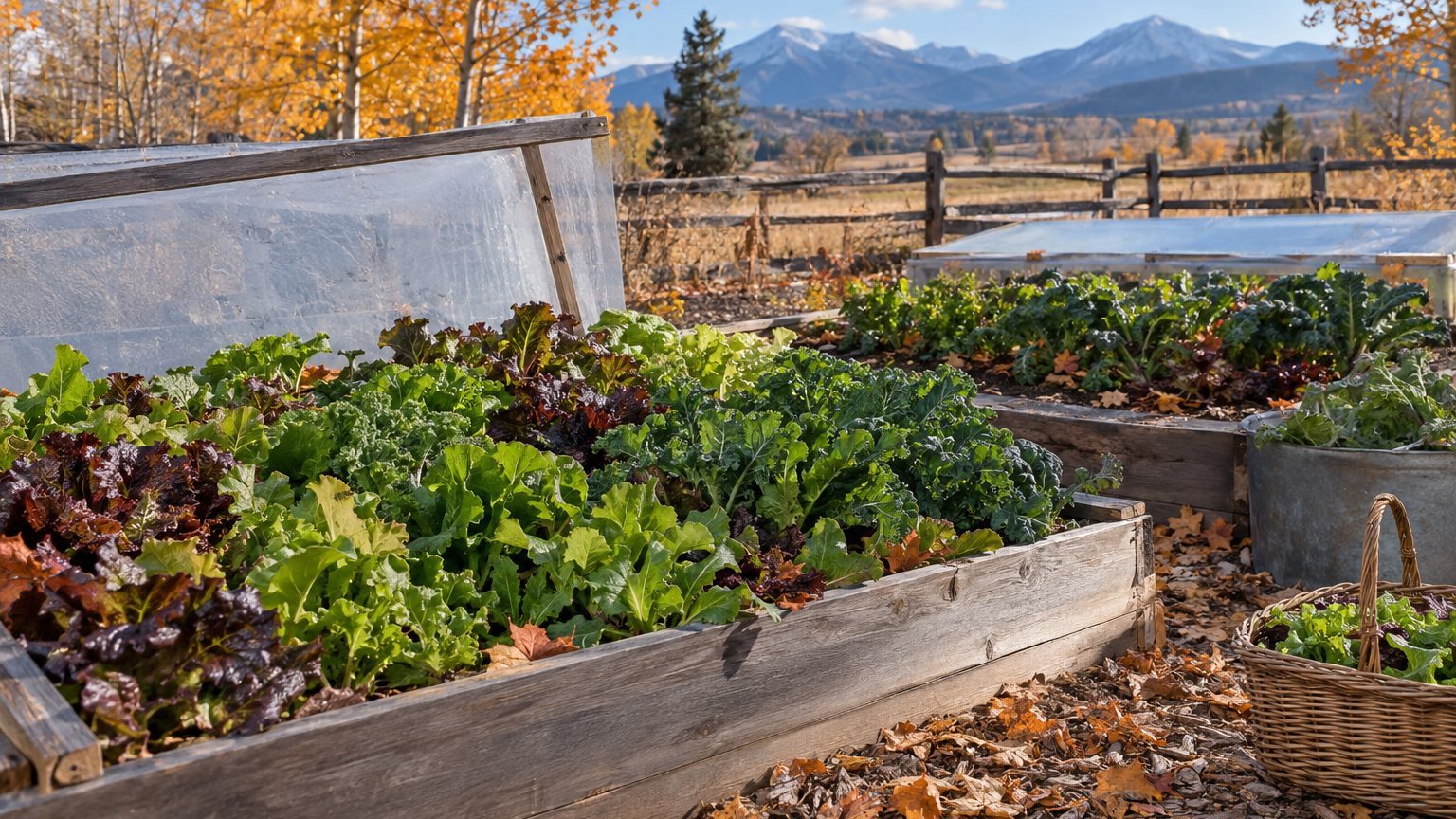

Winter salads in New York start in late summer, and the spring frost date you know from tomato planting has almost no say in that calendar. Count backward from your first fall frost instead, and leave enough weeks for the leaves to reach cutting size before the days shorten. Before you buy a packet, look up your own area’s first fall frost date and write it on the seed envelopes.
When the soil is warm enough in New York

Start with the frost date, since every seed packet points to it. NOAA’s 1991-2020 climate normals for Central Park in New York City put the last spring 32 F freeze between March 23 and April 3. That range is a probability band, not a promise, so a freeze after it is always possible. Central Park is a dense urban site. Upstate New York and the Adirondacks frost later in spring and earlier in fall, so read these as New York City dates and not as the state’s.
Frost is only a proxy for what these crops care about. Air and soil warm on different clocks, and soil warms after the frost risk ends, not with it. A bed that has just stopped freezing overnight is still cold at seed depth. Seed sitting in cold, wet soil germinates slowly and unevenly, and some of it rots.
Spring sowings of the hardiest types
Mâche, claytonia, spinach and arugula tolerate cold soil far better than lettuce does. You can sow them as soon as the bed is workable, sometimes before the frost range above has closed. Push a soil thermometer to seed depth in the morning and compare the reading with the minimum germination temperature printed on the packet. If a handful of soil squeezes into a sticky ball, wait.
The main sowing comes in late summer
For a crop you cut in winter, the soil question flips. In August and early September the soil is warm, often too warm. Lettuce seed in hot soil can refuse to germinate at all, so sow it in the shade of taller crops, water the row before and after sowing, or start it in trays and transplant. The basics of the crop, from bed preparation to the first cut, are in Winter Salads: What Grows When Lettuce Will Not.
This page names no varieties. The ones worth buying are those trialled where you garden, and your county’s extension office is the place to ask. Everything here is grown in beds and containers. Nothing on this page involves gathering plants from ditches, streams or woodland.
How long the season lasts here
NOAA’s 1991-2020 normals for Central Park also give the first fall 32 F freeze as falling between November 14 and November 27. Set that beside the spring range of March 23 to April 3 and you can work out the window yourself.
- Shortest gap: April 3 to November 14, about 225 days.
- Longest gap: March 23 to November 27, about 249 days.
That is roughly 32 to 35 weeks between freezes at the New York City station. Gardens upstate and in the Adirondacks get less, and by how much depends on your elevation and how far you are from the coast.
What a window this long allows
Winter salads only need the tail end of it. A window this size lets you sow more than once, and that changes how you plan. If the first late-summer sowing fails in a heat spell or gets eaten by slugs, a second sowing two or three weeks later can still make up the loss. Staggering several small sowings is also better than one big one, because a big one comes ready all together and then stalls when the light drops. Succession sowing works the same way for every leaf crop, and here you have the weeks to do it.
Transplanting also becomes worth the small root check. Lettuce, endive and radicchio handle being moved from trays, and starting them indoors or in shade gets around hot August soil. Mâche, arugula and claytonia resent disturbance and are better sown where they will grow.
Where the window closes sooner
In a colder inland garden the first sowing may be the only one you get, so it has to count. Sow the direct-seeded types on time, protect the bed early, and skip anything that needs a long stretch to size up. For a look at how a very different inland climate reshapes the same plan, see Winter Salads for Utah Gardens.
Heat and water in New York

This page has no sourced count of days above 90 F and no summer rainfall total for New York, so it gives none. NOAA’s climate normals for the station nearest your garden publish both, and they are worth a look because they vary a lot across the state. What matters for this crop is qualitative. Late-summer heat decides how you get seed up. A cool, damp summer brings downy mildew, damping-off, slugs and slow growth to seedlings, so give rows room for air and water at soil level in the morning.
The winter low decides the cover
Winter cold, more than summer heat, sorts this crop. NOAA’s 1991-2020 normals put the mean daily minimum of the coldest month at 27.9 F for New York City. That is an average, so the average coldest-month night is already below freezing, and single nights run colder. The USDA Plant Hardiness Zone Map 2023 spans zones 3b to 7b across the state, which tells you how much colder some gardens are than the city.
- Usually stand uncovered in the city: mâche, claytonia and spinach, though leaves can burn in a hard snap.
- Need a cover to stay edible: lettuce, arugula, mizuna and tatsoi.
- Cannot manage without protection: tender summer lettuces, and nearly everything in the Adirondacks.
Cover here means a cold frame, or a low tunnel of row cover over hoops. Both hold a few degrees, and they keep wind and wet off the leaves. In a milder-winter state, more of the list stands bare, as you can see in Winter Salads for Arkansas Gardens.
The first frost sets the last useful sowing
Growth slows sharply as the light fails, and under cover it nearly stops in midwinter. What you cut in January is mostly what grew in October. With the Central Park first freeze falling between November 14 and November 27, a sowing must be well up and close to cutting size before then. Plants that are still tiny at that point sit and wait for spring, and some do not survive the wait.
Which winter salads suit New York
Choose by type. The cold decides the first cut, and the table sets the common types against what New York winters ask of them. The ratings are relative, so check them against your own conditions.
| Type | Cold tolerance | What it needs |
|---|---|---|
| Mâche | High | Direct sowing, steady moisture |
| Claytonia | High | Direct sowing, cool weather |
| Spinach | High | Mildew resistance, airflow |
| Arugula, mizuna, tatsoi | Moderate | Cover in hard snaps |
| Endive, escarole, radicchio | Moderate | Transplants, cover late |
| Lettuce | Lower | Cold frame, shade to germinate |
Reasoning from the climate
A limited window, especially upstate, favors the fastest leaf types, the mustards and arugula among them, because they reach a cuttable size soonest. Hot late-summer soil favors types you can start in shade or in trays. A damp climate makes disease resistance the first criterion. For spinach and lettuce that means downy mildew resistance, which seed companies list on the packet.
Why no cultivar names appear here
This page does not name a single variety, and that is deliberate. The only variety advice that means something is what has been trialled in your own conditions, and this page does not have those trials. Naming one from memory would be a guess dressed as a recommendation. Cornell Cooperative Extension works through county offices, so ask the one that covers your garden. The USDA hardiness range of 3b to 7b across the state means an answer for Long Island will not suit the Adirondacks.
Common questions
Can I sow winter salads in spring instead?
Yes, but only the hardy types, and they will bolt as the days lengthen. Spinach, arugula and mâche sown at the first workable soil give a short spring cut. They are a different crop from the winter one, which is sown in late summer to be ready as the light fades.
Do I need a cold frame in New York City?
Not always, but it keeps more types edible. Mâche, claytonia and spinach often stand uncovered in the city. A cold frame or low tunnel matters for the rest. Vent it on sunny days, because a closed frame overheats fast and encourages rot.
Can I grow winter salads in containers on a balcony?
Yes, with one caution. A pot freezes through faster than the ground, so use a large, deep container and set it against a south-facing wall. Raise it off cold concrete and water only when the mix is dry a finger deep, since wet, frozen roots suffer most.
Why did my mâche not come up?
Mâche is slow and fussy in warm soil. Seed sown in hot weather often sits for weeks, and if the surface dries the seed stalls. Sow it on a cool day, firm the soil after sowing, and keep the surface damp until you see seedlings. A sheet of burlap or board laid over the row helps hold moisture until the seed sprouts. Take it off as soon as seedlings show.