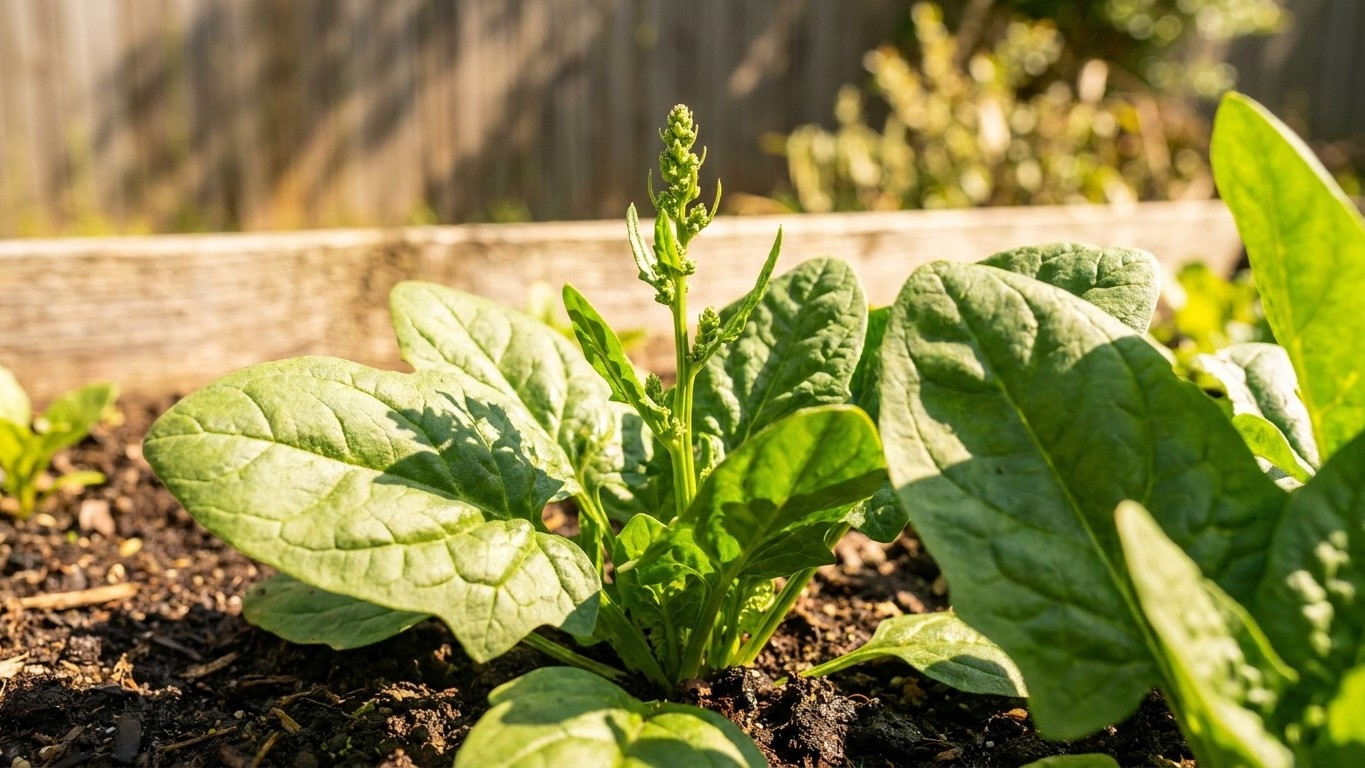

On Prince Edward Island, cut spinach young and early. Sow the spring crop from about April 25 to May 2, counted back from the average last frost, and eat it before long days and warm afternoons push it to flower. A second sowing in August can carry you to the first frost. Once cut, spinach is a short-lived crop. Even at 32°F it will not hold good quality past two weeks, and in a fridge door it fades in days.
The short answer
The longest day of the year at Charlottetown brings 15 h 36 of daylight. That number matters more for spinach than any thermometer reading, because Utah State University Extension is clear that spinach bolts during long days as well as warm temperatures. Length of day alone is enough to start the flowering process. A cool summer does not buy extra weeks of leaf, because the sun still stays up for more than fifteen hours around the solstice, whatever the air is doing.
So is the limit here the day length, the heat, or both? Both, and they work in different ways. Day length is the one you cannot negotiate with. It follows the calendar and ignores the weather, so a gray, breezy June on the Island still delivers the same long days that tell the plant to throw up a flower stalk. Heat is the second brake. Spinach grows best where temperatures do not exceed 75 F, and that same figure is where leaves turn bitter, so one number carries two penalties.
Island summers rarely get dramatic, which tempts people to relax about heat. At the Charlottetown A station, which sits at the airport and not in your yard, the normals count 0.93 days a year above 30 °C and just 0.03 days a year above 32 °C. Those are counts of extreme days, though, and spinach does not wait for extremes. The 75 F ceiling is roughly 24 °C, well below 30 °C, so the scarcity of scorching days tells you very little about how many ordinary summer afternoons pass the line that matters to a spinach plant.
What does this mean for the knife? Cut when the leaves are big enough to be worth eating, and don’t wait for them to look impressive. The plant is racing a clock you cannot see, and the moment the center starts to lengthen into a stalk, harvest everything. After that, the leaves go bitter and tough. The Will Spinach Bolt Early in Prince Edward Island? page covers the warning signs in more detail, and the broader Growing Spinach in Prince Edward Island guide covers the rest of the season.
Then comes the part people get wrong: the fridge. The UC Davis Postharvest Technology Center puts the ideal at 32°F with 95 to 98 percent relative humidity, and even then says spinach is highly perishable and will not maintain good quality for more than 2 weeks. Read that as a ceiling, not a plan. Wilting, yellowing and decay increase after 10 to 14 days, and they come faster at 41 to 50°F, which is about what a home fridge door holds. The coldest, steadiest spot is the back of the bottom shelf, so that is where a bag of freshly cut leaves belongs.
How long the spring window really is
Spring spinach has a start date you can calculate and an end date you have to watch for. The start comes from the standard advice to sow two to three weeks before the last frost. For this province the reference is Charlottetown A, where the last spring frost falls on average on May 16. Counting back gives sowing from about April 25 to May 2. That average is a midpoint, not a safe date: in one year out of two, the last frost lands later than May 16. Northern and upland districts of the Island run weeks behind the airport station, so your own calendar may shift.
Here is how the window works out in practice:
- Late April to early May: Sow. Spinach is meant to go in before the last frost, so sowing around the average date counts as on time, not early.
- Through May: The crop grows while afternoons stay below 75 F. Days are already long and getting longer, so the plant is on the clock even when the weather feels like early spring.
- Late May into June: Days approach the 15 h 36 peak. Any afternoon that pushes past 75 F now adds a second trigger on top of the long day, and growth stops being good.
- Whenever you see the center lengthen: Cut the whole plant. Do not wait for a better moment, because there is not one.
Notice the gap in step two. The source behind these figures publishes no days-to-maturity for spinach, and I will not borrow a number from another crop to fill it. It also gives no date for when the Island’s afternoons cross 75 F. Both are things you track yourself, with a thermometer in the shade and a look at the plants every few days.
Even so, the shape of the window is clear. It opens in the last days of April or the first days of May. It closes somewhere in late spring or early summer, when warmth joins a day that is already long. That leaves a matter of weeks of good cutting, not months. Island gardeners who treat spinach as a sprint, sown early, cut young and finished before the solstice, tend to get the best of it. Pest timing is a separate matter and has its own page, What Eats Spinach in Prince Edward Island, and When.
The autumn crop, and when the soil lets you sow
Autumn spinach is the better bet on the Island, and the reason is the same one that hurts the spring crop. Days that are shortening instead of lengthening take away the flowering trigger, and the heat has mostly gone. The difficulty is getting the seed to come up in the first place, then getting the crop to size before the season ends.
Warm soil blocks the sowing, not cold
Seed germination drops off once the soil rises above 80 F. That is the catch with a late-summer sowing: the right dates on the calendar often fall while the ground is still holding the summer’s heat. The obstacle is warmth, not cold, which surprises people who assume autumn planting is a race against chilly soil. In a hot region the sowing window opens when the soil cools. On the Island, extreme heat is rare (recall the 0.93 days a year above 30 °C at Charlottetown A), but the soil can still sit warm in early August, so I would not trust the calendar alone. Push a soil thermometer a couple of inches into the bed in the morning. If it reads above 80 F, wait a few days, or try the shade of taller plants for the seed row. The source gives no further detail on cooling a seedbed, so treat those as common-sense steps, not tested fixes.
The frost that ends the season
The other end of the window is the first fall frost, which at Charlottetown A averages October 17. Again, that is a midpoint. Half of all years bring frost earlier, and districts away from the airport station can be earlier still. The only guidance on timing is to plant 50 to 75 days before the date you want to harvest, so count back from a realistic harvest date.
If you picked the average frost date itself as your harvest target, October 17 minus 50 days is August 28, and minus 75 days is August 3. That gives a sowing window of roughly August 3 to August 28. Because the frost comes before that date in half of years, I would aim for the early part of the window and treat late August as the last call. Sow in the first week or two of August, if the soil allows, and you are betting with the odds in your favor. Sow on August 28 and you are betting on a late frost.
On varieties, the source names four, Bloomsdale, Melody, Teton and Olympia, but gives no data about any of them. Nothing is published on their days to maturity, their bolt resistance or their cold tolerance, so I will not describe them. Pick by what your seed supplier lists on the packet, and keep records of your own sowing and cutting dates so next year’s calendar rests on something better than averages.
Common questions
Can I leave spinach in the garden and cut it later in summer?
Not reliably. Long days trigger flowering, and Island days are at their longest in June, with 15 h 36 of daylight at the solstice. Plants left standing into that stretch are likely to bolt, and warm afternoons above 75 F make the leaves bitter as well. Cut spring spinach young and plan the next sowing for August. The main spinach guide for the Island lays out the whole season.
Does a cool summer let me stretch the spring harvest?
Cool weather helps with the heat side of the problem, but it does nothing about day length. Spinach flowers in response to long days alone, and the days here are very long around the solstice. A cool June may protect leaf quality a little, but it will not buy you weeks.
How long does cut spinach actually keep?
Two weeks is the ceiling, and only at 32°F with 95 to 98 percent humidity. Quality declines after 10 to 14 days, and faster at 41 to 50°F, the range of a typical fridge door. Store it at the back of the bottom shelf and plan to eat it within days, not at the two-week mark.
What is the latest I can sow for a fall crop?
Count back 50 to 75 days from the date you want to harvest. Using the average first frost of October 17 at Charlottetown A, that points to August 3 through August 28. Because half of years see frost earlier than average, the early part of that range is safer, and the soil must be at or below 80 F for the seed to germinate well. Frost dates run later or earlier depending on where you are on the Island, so use the airport figure only as a starting point.