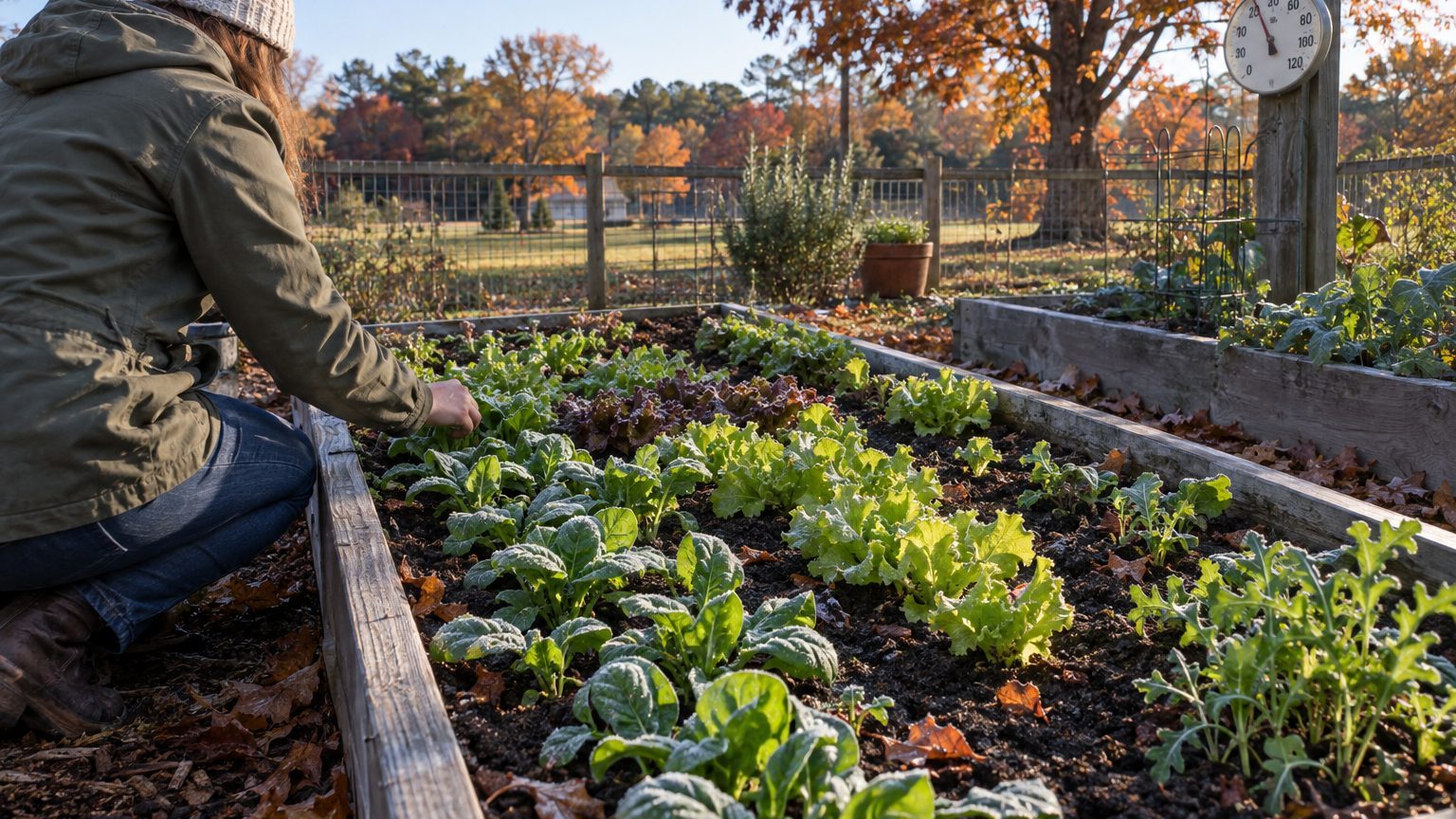

Sow cold-hardy winter salads in the weeks leading up to September 30, the early edge of the Denver-area fall freeze window, and sow again under cover once the spring window of May 1 to May 11 has passed. Those dates come from NOAA’s Denver reference station, so they describe the Front Range plains. Today is October 5, which puts this year’s fall window already underway.
The short answer for Colorado
Winter salads in Colorado are built around two anchor dates, and both are probabilities rather than promises. NOAA’s 1991-2020 Climate Normals for the Denver reference station list the last spring 32°F freeze as May 1 to May 11, and the first fall 32°F freeze as September 30 to October 12. Both ranges sit inside the 30-70% probability band for a freeze at that threshold. A date in the band is a coin flip, not a deadline.
| Marker | Denver reference window | What it means for sowing |
|---|---|---|
| Last spring 32°F freeze | May 1 to May 11 | Uncovered tender seedlings are safe to move out after this window |
| First fall 32°F freeze | September 30 to October 12 | Outdoor sowing for winter harvest should be done before it, with the seed packet’s days to maturity counted backward |
What the dates are a probability of
The thing being measured is a single event: the air temperature at the station dropping to 32°F. The band says that between those calendar dates, the odds of that freeze (still to come in spring, or arriving in fall) run between 30 and 70 percent. Before the spring window, a freeze is more likely than not. After the fall window, it has probably already happened. Nothing in the data says the soil, a cold frame, or a south-facing wall is also at 32°F.
Turning the dates into a sowing window
The fall date works as a finish line. Take the days to maturity printed on the seed packet, count backward from September 30, and you have the latest sensible sowing date for outdoor plants meant to reach size before growth slows. Sow later and the plants hold small and wait out the winter, which suits some hardy greens and ruins others.
The coldest-month figure explains why. The mean daily minimum of the coldest month is 18.4°F at the reference station, which is 13.6 degrees below freezing on an average night. It is an average of the lows, not the record low, so some nights are colder. That number decides whether a plant survives winter here at all, and it is why the best choices lean toward the hardy types covered in The Best Winter Salads for Colorado. For the wider picture of how these crops fit together, see Winter Salads for Colorado Gardens.
What will not work here
Waiting until the frost has already arrived. Colorado’s freeze-free stretch between the two windows runs roughly five months, and the fall edge arrives quickly. Seed sown after the first freeze lands in cooling soil under shortening days, and the seedlings may never reach harvest size outdoors. A calendar borrowed from a milder state will tell you to sow in October or November. Here, that advice arrives after the window has closed.
Tender lettuce heads left uncovered fail next. With an average coldest-month night of 18.4°F, soft-leaved lettuce planted in an open bed is a gamble, because the average hides colder nights. The slowest, tenderest types are the first to go. What survives uncovered is a short list of hardy greens, and even those do better with a row cover or cold frame on the coldest nights.
Dry weather is its own trap. Late summer and early fall sowing means getting seed to germinate while the ground is still warm and the air is dry, and Colorado’s semi-arid climate does not forgive a weekly soak. A shallow seedbed dries out between waterings, and a failed germination in September costs you the whole window, because there may not be time to resow. Small seeds need the top inch kept consistently damp, which means a quick look and a light watering daily until they sprout.
A single Denver calendar applied to a mountain town fails most dramatically. The data for this page notes that mountain towns run far shorter seasons and can frost in July. A gardener at altitude who sows on the Front Range dates is planting into a season that has already ended, or never really begun. The western slope runs on another clock again, so the Denver dates should not be carried across the Divide.
Last, waiting for May 11 for every sowing wastes the cool weather salads like. The spring window marks when tender plants are safe uncovered. Hardy greens do not need it, and sowing them late pushes their harvest into warmth, which sends them to seed. Spring salads should be sown early under cover, and the window works best as a guide for when to pull the covers off.
What changes across Colorado
There is no single Colorado answer. The USDA Plant Hardiness Zone Map (2023, built on 1991-2020 normals) places the state in zones 3b to 7b. That is five full zones, a bigger spread than many states have in total. The zone system uses one variable only, the average annual extreme minimum temperature, so it tells you about winter cold and nothing about frost dates, summer heat, wind, or how fast spring arrives.
This page uses Denver as its reference city for every dated recommendation, and other parts of the state differ. If you garden in the north or at altitude, the practical moves go in one direction: sow earlier, expect the fall freeze earlier than September 30, and plan on protection from the first cold nights. If you are on the western slope, the Denver dates are a starting point only.
| Area | What the facts say | What to shift |
|---|---|---|
| Front Range plains (Denver reference, 5,280 feet) | Last spring freeze May 1 to May 11; first fall freeze September 30 to October 12 | Use the dates as written |
| Mountain towns | Far shorter seasons, frost possible in July | Move sowing earlier, rely on cold frames, treat fall dates as earlier than Denver’s |
| Western slope | Differs again from both | Do not borrow Denver’s dates; check local data |
Which zone you are in is a question for the map, not for this page. Look up your address on the USDA Plant Hardiness Zone Map and read it as a measure of winter cold only. Even inside one zone, a sheltered yard and a windy hilltop can behave very differently.
Where to check this for your own county
Your state extension service is the next stop. Colorado State University Extension is Colorado’s land-grant extension, and its county offices work from local conditions that a state page cannot see. Two things are worth looking for there: a planting calendar written for your county, and any vegetable varieties that have been trialled in your county. A variety that did well in a trial near you has already survived your wind, your soil, and your altitude.
A county recommendation beats a state one. This page is the state one. It gives Denver’s freeze windows as a reference and says plainly that the rest of Colorado departs from them. It does not have a county-level sowing calendar for winter salads, and it would be wrong to pretend that the Denver dates stretch to every valley.
When you reach the extension site, look for guidance on cool-season vegetables, season extension, and fall gardening for your county. Ask the county office which hardy greens perform in your area, and how they handle row covers and cold frames in winter. Then compare what they say against the varieties in The Best Winter Salads for Colorado, which sorts choices by type for the Front Range reference conditions.
Checking this against your own garden
Your own observation outranks every date on this page. Three things are worth watching, and none needs an instrument.
- Soil warmth by feel. Push your fingers a couple of inches into the bed in the morning. Soil that feels cool and damp is holding cold, and soil that feels warm and dry may be too hot for good germination. Comparing a shaded bed with a sunny one tells you how much your microclimate varies across a single yard.
- First true leaves. The first pair after the seed leaves tells you how fast a seedling is growing. If seedlings reach that stage quickly, your site is running warm, and if they stall, it is running cold. Either way, it tells you whether the seed packet’s days to maturity are realistic for your spot.
- The first male flowers on spinach. Spinach plants are male or female, and males often start bolting first. When that first flush of flower stalks appears in spring, the season has tipped from cool to warm in your garden. Note the date, because it is your real end of spring salad season.
Write those three dates in a notebook for a year. Next season they will be a better guide than any statewide window, and they carry your own wind, slope, and soil.
Common questions
Can I still sow winter salads after the first fall frost in Colorado?
Outdoors in an open bed, the odds are poor. After the Denver reference window of September 30 to October 12, soil is cooling and days are shortening, and seedlings may not reach harvest size. Under a cold frame or similar cover, the answer is more forgiving, but check the days to maturity before you count on a harvest.
Do Denver’s frost dates apply to mountain towns?
No. Denver sits at 5,280 feet on the plains, and mountain towns run far shorter seasons and can frost in July. The western slope differs again. Treat Denver’s dates as a Front Range reference and use your county extension office for anything else.
What does the May 1 to May 11 window actually mean?
It is the band in which NOAA’s 1991-2020 normals put the probability of a last 32°F freeze between 30 and 70 percent. A freeze after May 11 is still possible. The window describes odds, so a cover on hand for a late cold night is cheap insurance.
Is a cold frame necessary with an 18.4°F coldest-month minimum?
Not for every crop, but it widens the choices considerably. The 18.4°F figure is the mean daily minimum of the coldest month, so nights below it happen. It was measured at the Denver reference station, and gardens at altitude will run colder than that figure suggests.