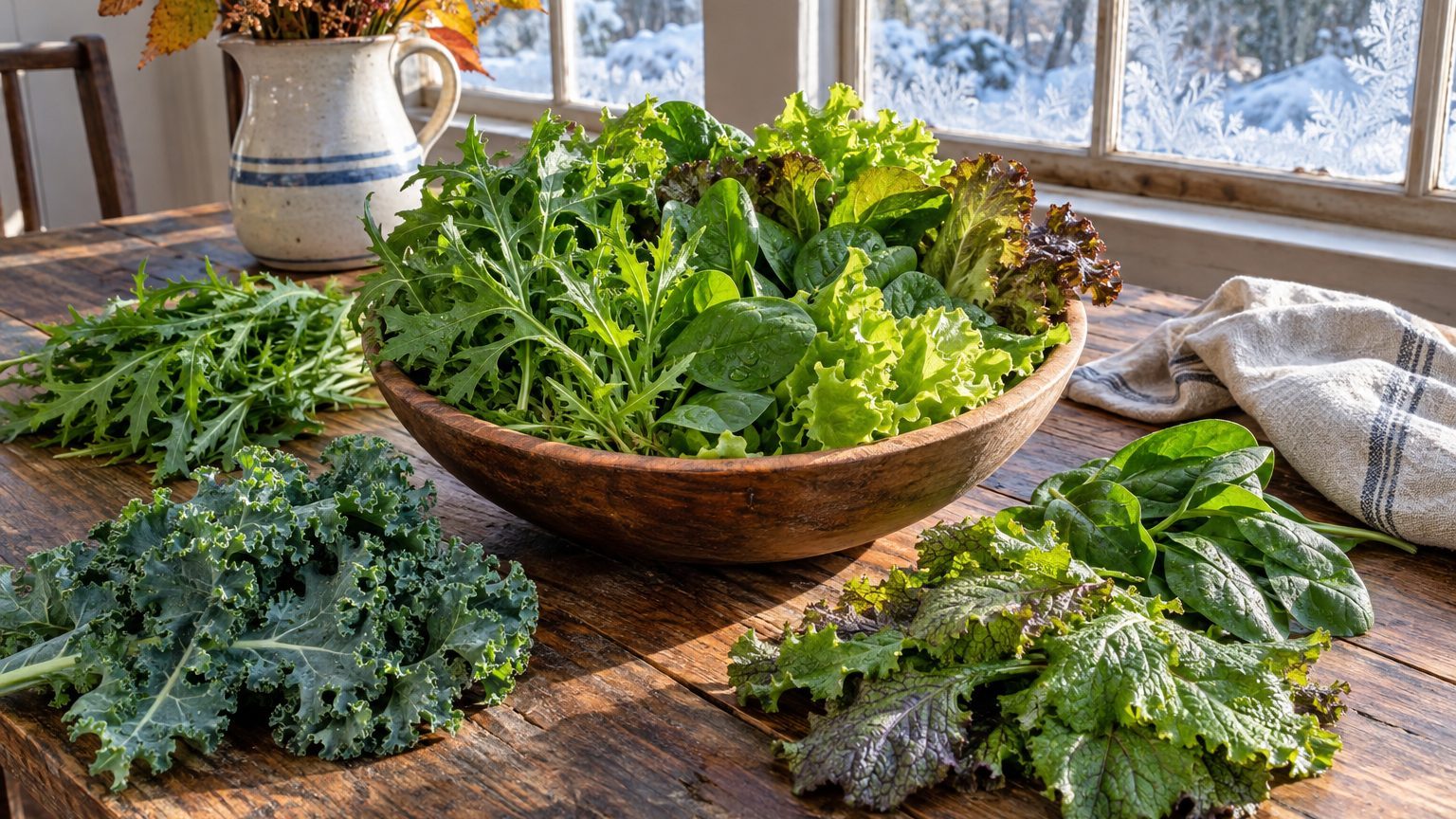

The best winter salads for Delaware are the cold-tolerant greens: spinach, mâche, claytonia, arugula, mustard greens, tatsoi and baby kale. Hardy leaf lettuces come next. Tender head lettuce is the weak link. The reference frost dates leave a long autumn window, and a coldest-month average low of 25.6°F is survivable for the hardy group. This page sorts varieties by type and says what to skip.
The short answer for Delaware
Plant spinach, mâche, claytonia and arugula first, add hardy lettuces and kale for volume, and treat butterhead and other tender lettuces as cover-only crops. That ranking comes from two numbers. The first is the reference-city frost window. At the Wilmington airport station, the last spring frost falls between April 3 and April 14, and the first fall frost between October 26 and November 7 (NOAA NCEI 1991-2020 Climate Normals). Those are not guaranteed dates. Each span is the band where the chance of a 32°F freeze sits between 30 and 70 percent.
The second number is the cold itself. The mean daily minimum of the coldest month is 25.6°F. It is an average, so plenty of January nights run colder. Hardy greens shrug that off, while tender lettuce turns to mush. The USDA Plant Hardiness Zone Map (2023) puts Delaware in zones 7a-8a, a range this page returns to below.
Hardy types that earn their bed space
Spinach is the anchor. Savoyed, crinkled types such as ‘Bloomsdale Long Standing’ have a long track record in the Mid-Atlantic. Mâche (corn salad) and claytonia (miner’s lettuce) are low, compact and nearly unbothered by freezes, and both taste mild enough to eat straight. Arugula, tatsoi and mustards grow fast, so they fill gaps. Kale, harvested young, brings the leaf size that spinach lacks.
Types that need help
Leaf lettuces bred for cold, ‘Winter Density’ among them, sit in the middle. They hold up with a cover over the coldest stretches. Butterhead and summer crisp types belong under fabric, in a cold frame, or not at all.
| Type | Examples | Delaware verdict |
|---|---|---|
| Hardy rosettes | Spinach, mâche, claytonia | First choice for open ground |
| Fast brassicas | Arugula, tatsoi, mustards, baby kale | Reliable, best harvested young |
| Cold-bred lettuce | ‘Winter Density’ and similar | Works with light cover on the coldest nights |
| Tender lettuce | Butterhead, summer crisp | Cold frame or tunnel only |
Sowing dates for each group are on When to Sow Winter Salads in Delaware.
What will not work here
Late sowing fails first. With the first fall frost landing between October 26 and November 7 at the reference station, a bed sown in early November has almost no growing time left before the days shorten and growth crawls. Winter salads are not grown in winter so much as grown beforehand and held there. A spinach plant that reaches decent size by the first frost will feed you for months. One that is still a seedling will mostly sit.
Trusting the airport date
The frost figures come from an airport station. Suburban and rural gardens typically see the last spring frost later and the first fall frost earlier, often by one to two weeks. A gardener in a rural yard who sows on the Wilmington schedule may lose most of the slow-growing crops to a frost that arrived early. Plan from the early end of the fall window, then subtract.
Tender lettuce in an open bed
With a coldest-month mean minimum of 25.6°F, a bed of butterhead lettuce left uncovered is a gamble most years. Even if the plants survive the first dip, repeated freeze and thaw damages leaves, and wet, frozen foliage rots from the edges. Hardy types handle it. Tender ones turn translucent and collapse.
Crowding and hot-soil sowing
Two failures belong to the shoulder of the season. Lettuce seed often refuses to germinate in hot late-summer soil, so a sowing that looks right on the calendar can come up patchy. And in a mild, damp winter, tightly packed leaf crops hold moisture and invite rot, so thin spinach and lettuce to a spacing that lets air move. This page does not carry Delaware humidity or rainfall figures, so treat that as a general rule rather than a measured threshold.
Slow heading crops also lose out. Head cabbage and large-headed lettuces need weeks of steady growth that the autumn window does not reliably supply, while baby leaves finish quickly.
What changes across Delaware
There is no single Delaware answer. The USDA Plant Hardiness Zone Map (2023) lists the state as 7a-8a, which spans three half-zone steps. Zone ratings are built on one variable, the average annual extreme minimum temperature, and each half zone is 5°F apart. A 7a garden and an 8a garden can therefore differ by about ten degrees in their typical coldest night.
That spread matters more for borderline crops than for spinach. Mâche and claytonia will probably be fine across the whole range. Lettuce, kale left to full size and any crop under marginal cover is where the zone gap shows up. Where a garden sits within the range usually tracks distance from the water, how open the site is, and how much heat the neighborhood holds. The milder end tends toward the coast and the colder end inland, but the map, not this page, shows where your address falls. Delaware has little elevation to speak of, so the swing comes more from those local factors than from altitude.
Practical shifts for a colder pocket are simple. Sow toward the early edge of your fall window rather than the late one. Put the cover on earlier and leave it on longer. Lean harder on the hardy rosette group and use the lettuce types sparingly. Gardeners in milder spots can stretch the sowing window a little and get away with more lettuce, but the later frost in spring also pushes bolting pressure earlier as days lengthen, so the benefit is not all one-way.
The wider logic of choosing crops by territory is laid out in Winter Salads for Delaware Gardens.
Where to check this for your own county
Delaware has three counties (New Castle, Kent and Sussex), and the University of Delaware Cooperative Extension is the place to see how this plays out in each. Look for two things there: the local vegetable planting calendar, and any varieties trialled in your county rather than somewhere far off. A cultivar that thrived in a trial plot in your own county is better evidence than any list written for the whole state.
A county recommendation beats a state one. This page is the state one, built around a single reference station, and it cannot see your soil, your frost pocket or your wind. Extension staff and Master Gardener volunteers can. Their local frost dates also tend to be tuned for non-airport sites, which matters given the one-to-two-week offset noted above.
One honest limit: this page does not have a Delaware extension winter-salad calendar to quote. It would be wrong to borrow a calendar from another state, because frost dates and hardiness zones differ across state lines. If you find a calendar at your county office, use that and let it override the general advice here.
Checking this against your own garden
Your own observation outranks every date on this page. Three things are worth watching, and none needs an instrument.
- Soil warmth by feel. In late summer, push your hand into the bed. If the soil feels hot, wait or shade the seedbed, because lettuce seed may not germinate. A soil that stays warm long after the air cools also tells you the site holds heat, a plus for late sowings.
- First true leaves. The seed leaves look alike across plants, but the first true leaves show real growth. If they appear quickly, your site is giving the crop enough warmth and light. If seedlings stall at the seed-leaf stage in October, you sowed late or the spot is shaded and cold.
- Your own first frost. Note when frost first whitens the grass or a car windshield in your yard, and compare it to the airport range. If yours arrives well before October 26, you are in a colder pocket and should move everything earlier.
Keep a simple note each year. Because the airport figures describe a 30-70 percent band, some winters will bring frost outside it in either direction, so a few seasons of your own dates will tell you more than any single average.
Common questions
Which winter salad is the safest first pick in Delaware?
Spinach. It tolerates a coldest-month mean minimum of 25.6°F, it has long-standing varieties suited to the Mid-Atlantic, and it holds in the garden for months once it reaches size before the first fall frost.
Do I need row cover or a cold frame?
For spinach, mâche and claytonia, often no. For cold-bred lettuce and anything tender, yes on the coldest nights. Cover earlier if you garden in a colder pocket or a rural spot where frost arrives sooner than at the airport.
Will the frost dates here match my garden?
Probably not exactly. The April 3 to April 14 and October 26 to November 7 ranges come from an airport station. Suburban and rural gardens typically see spring frost later and fall frost earlier, often by one to two weeks.
Is my USDA zone enough to pick varieties?
It helps, but it is built only on the average annual extreme minimum temperature. Delaware spans 7a-8a, and frost timing, site exposure and your county extension office add detail the zone cannot. Check the USDA map for your address, then check local recommendations.