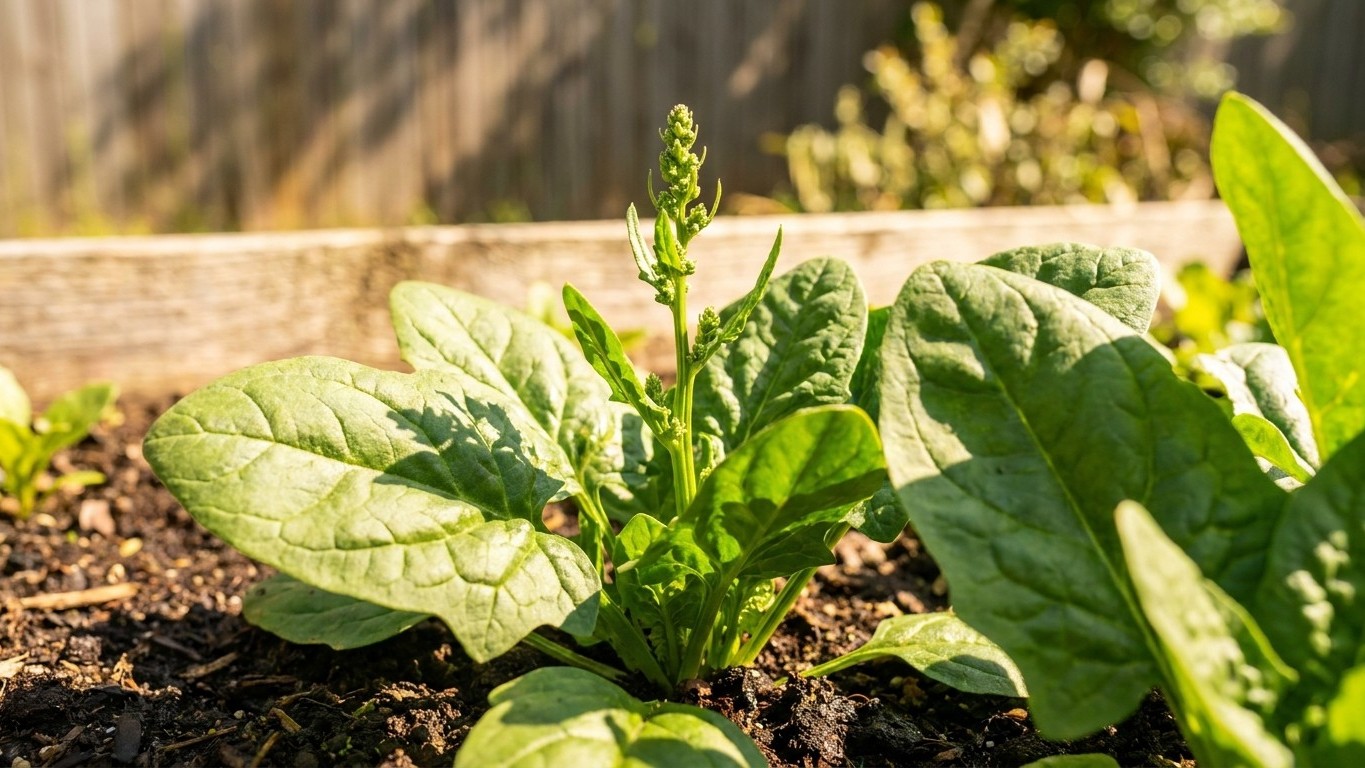

In Saskatchewan, cut spinach in two short bursts: late spring into early summer, and again in early autumn before the first frost. Midsummer is closed. At 16 h 31 of daylight on the longest day, spinach flowers no matter how mild the weather feels. Cut leaves keep two weeks at the very best, and only at 32°F. Most home fridges run warmer, so the real shelf life is shorter.
The short answer
Saskatoon gets 16 h 31 of daylight on the longest day of the year. Everything else on this page hangs on that number. Spinach flowers (bolts) in response to long days as well as warm temperatures, according to Utah State University Extension. Long days alone are enough. A cool, wet July does not change the sunrise or the sunset, so a mild summer here does not buy extra weeks of leaf. Once the days stretch toward that peak, the plant is heading for a seed stalk.
So is the limit day length or heat? Both, and they work differently. Day length is fixed by latitude and arrives on schedule every year. Heat is the part that varies. The same Utah State source says spinach grows best where temperatures stay at or below 75°F (about 24 °C), and that ceiling is also where the leaves turn bitter. At Saskatoon Diefenbaker Int’l A, the airport station, the count is 13.1 days a year above 30 °C and 4.98 days above 32 °C. Those are extreme days, though, and 75°F sits far below them. Ordinary summer afternoons cross it, so a low count of scorching days does not mean spinach is safe in July.
What that does to the cutting calendar
The practical result is two harvest periods. The first runs through late spring and into the start of summer, ahead of the long days and the heat. The second is a fall crop, sown in summer and cut before frost. For the sowing side of the story, see Growing Spinach in Saskatchewan, and for the flowering mechanism in more depth, Will Spinach Bolt Early in Saskatchewan?
The frost dates below come from Environment and Climate Change Canada, station Saskatoon SRC. They are averages, and in one year out of two the frost lands later than the date shown. Treat each as the middle of a window rather than a safe date. Northern and upland districts of the province run weeks behind this station, and the Canadian normals cover an older 30-year period than the US figures used elsewhere on this site.
How long it keeps once cut
The UC Davis Postharvest Technology Center puts the optimum at 32°F (0 °C) with 95 to 98 percent relative humidity. It states that spinach “will not maintain good quality for more than 2 weeks,” and that wilting, yellowing and decay increase after 10 to 14 days. At 41 to 50°F (5 to 10 °C), the range of ordinary distribution conditions, the decline is faster. You can read the full UC Davis spinach fact sheet for the original wording.
Two weeks is a ceiling, not a plan. At home, the coldest spot is the back of the bottom shelf, not the door, where temperatures swing every time it opens. Wrap the leaves dry in a container that holds some moisture and plan to eat them well inside that window.
How long the spring window really is
Spring guidance says to sow spinach two to three weeks before the last frost, and growth stops being good above 75°F. In Saskatoon the first number is a date you can calculate, while the second has no published calendar date. What follows is arithmetic on the frost date, with the unknowns left as unknowns.
Counting the weeks
- Start from May 18. That is the average last spring frost at Saskatoon SRC. It is the midpoint, so in a late year the frost comes after it.
- Count back two to three weeks. That puts the earliest sowing between about April 27 and May 4, as soon as the soil can be worked.
- Count forward to the longest day. From those sowing dates it is roughly seven to eight weeks to the late-June peak of 16 h 31. That is the outer limit of the spring crop, because by then the plants are being pushed to flower anyway.
- Subtract the growing time. The source publishes no days-to-maturity figure for spinach, so no honest number can go here. Whatever it is, it comes off the front of those seven or eight weeks.
- Subtract the heat. Once afternoons regularly pass 75°F, growth and flavor suffer. No date for when Saskatoon crosses that line is published here, and it moves from year to year.
What the arithmetic leaves
Seven to eight weeks of calendar, minus the time the plants need to size up, minus the stretch lost to heat. The usable cutting window is the tail end of that: a few weeks, not a season. A better way to see it is that the squeeze comes from one side only. A late spring pushes your sowing date later, but the long days do not budge. Every week the soil stays frozen or sodden is a week taken straight out of the harvest.
That is the argument for sowing the moment the ground is workable rather than waiting for May to feel settled. It is also why cutting steadily, before the weather turns, matters more than letting a row stand to get bigger. Once heat or long days take over, extra patience yields bitter or flowering plants. The main trouble before then is mostly animal rather than weather, which is covered in What Eats Spinach in Saskatchewan, and When.
The autumn crop, and when the soil lets you sow
A fall crop is the second chance, and the obstacle to it is the reverse of what most gardeners expect. Cold is not the first problem. Warm soil is. The calendar then closes from the other end with frost. The source says only to plant 50 to 75 days before the date you want to harvest, so the dates below come from counting back.
Obstacle one: soil too warm to germinate
Utah State University Extension reports that seed germination is reduced when the soil is above 80°F (about 27 °C). A bed that has been baking under summer sun can sit above that for weeks, and seed sown into it comes up poorly or not at all. The sowing window for autumn opens when the soil falls below that line, not on a particular date. A cheap soil thermometer pushed a couple of inches into the bed tells you more than the calendar does.
The soil does not follow the air exactly, and a cool night does not cool the ground. Hot spells that follow a cool start can reverse the trend, so check on the day you sow.
Obstacle two: the frost that ends the season
The average first fall frost at Saskatoon SRC is September 18. Take that as the last realistic harvest date and count back. Fifty days earlier is July 30, and 75 days earlier is July 5. That gives a sowing window of roughly July 5 to July 30, and it lands in the stretch when the days are past their peak but the soil is likely to be at its warmest.
Because September 18 is only the midpoint, half of all years bring frost sooner. Aim for a harvest date a little ahead of it, which moves your sowing earlier and into even warmer soil. This is the real tension of the fall crop, and no variety resolves it by itself. The source names four varieties (Bloomsdale, Melody, Teton and Olympia) but publishes no data on any of them, so there is nothing reliable to say about how they compare for bolting or heat. Check the seed packet for days to harvest, which the source does not supply.
Common questions
Is May 18 a safe planting date for spinach?
No, and you would not sow on it anyway. It is the average last spring frost at Saskatoon SRC, so frost comes later than that in roughly half of years. Spinach goes in two to three weeks ahead of it, from about April 27 to May 4.
Can a cool summer stretch the spring harvest?
Not much. Long days alone trigger flowering, and Saskatoon reaches 16 h 31 of daylight at the solstice whatever the thermometer says. A cool summer helps with bitterness and the 75°F ceiling, but it does not shorten the day.
How long does cut spinach last in the fridge?
UC Davis says it will not hold good quality for more than two weeks, and only at 32°F with 95 to 98 percent humidity. At 41 to 50°F it declines faster. Keep it at the back of the bottom shelf, not in the door, and use it early.
Which variety bolts last?
The source lists Bloomsdale, Melody, Teton and Olympia but publishes no data on bolting, heat tolerance or days to harvest for any of them. Anyone claiming a ranking is working from somewhere else. All the dates in this article come from one Saskatoon station, and districts farther north run weeks behind it.