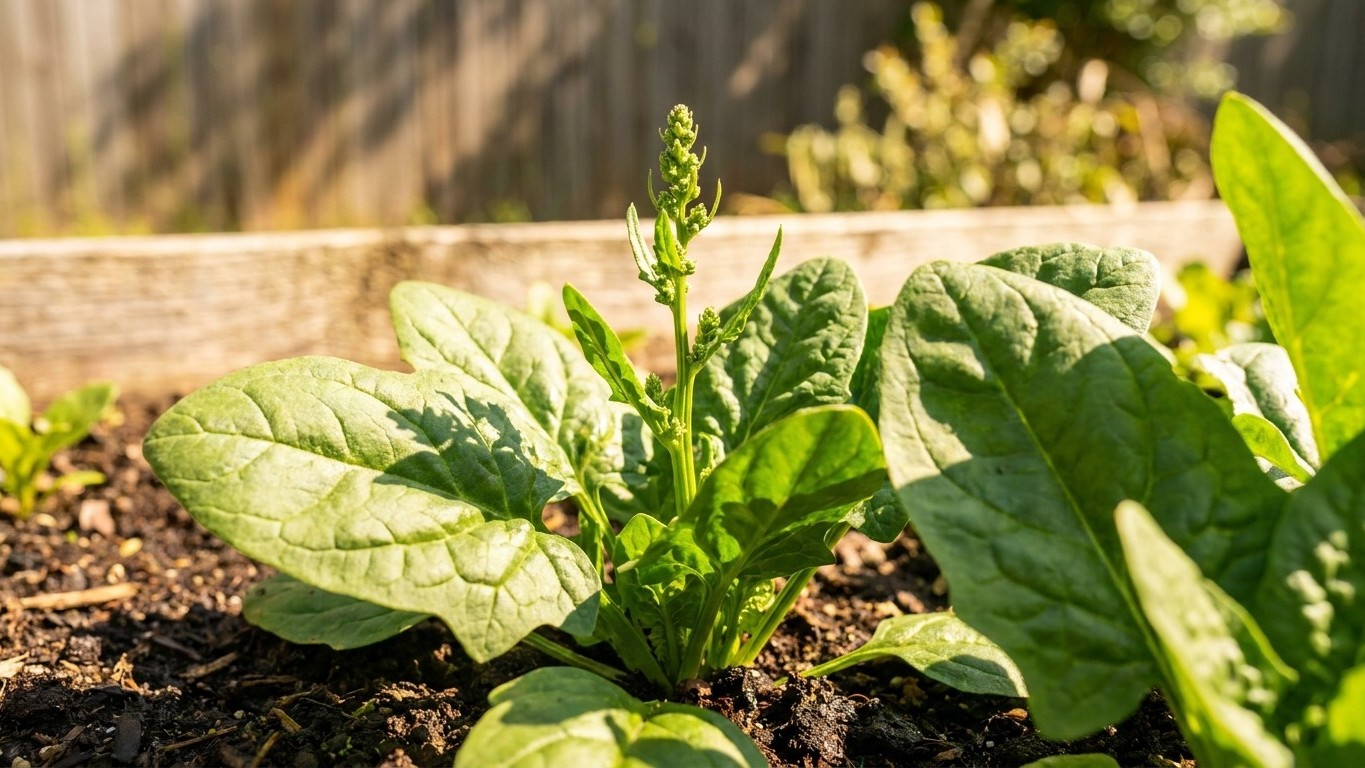

Cut spinach in Quebec from a spring sowing made around mid-to-late April, and again from a late-summer sowing, always before the flower stalk starts. Once cut, it keeps two weeks at the very best, and only at 32 °F (0 °C). Heat and day length both set the limit here. Afternoons above 75 F (about 24 °C) turn the crop bitter and shut down growth, while Montréal’s long June days push it to flower. The full calendar is in Growing Spinach in Quebec.
The short answer
Why a cool summer buys you nothing
On the longest day of the year, Montréal gets 15 h 29 of daylight. That figure matters more than any thermometer reading. Spinach bolts, meaning it throws up a flower stalk and stops making useful leaves, in response to long days as well as warm temperatures. Long days alone are enough to start the process. A cool, damp June does not rescue the crop the way it might rescue lettuce in a borderline year, because the trigger is the sun’s schedule, not the weather.
So the limit here is both. Day length closes the window from one side, and heat closes it from the other. Utah State University Extension puts the comfort zone at temperatures that do not exceed 75 F, and that same number is where growth slows and flavor turns bitter. Two consequences, one threshold. Montréal/Pierre Elliott Trudeau airport averages 9.3 days a year above 30 °C, and only 2.8 days above 32 °C, so the brutal days are rare. They are not the issue. Plenty of ordinary June afternoons will still clear 24 °C, and by then the days are almost at their longest.
Start watching the plants in the weeks before the solstice. If you want the detail on early flowering, Will Spinach Bolt Early in Quebec? covers the warning signs.
Cutting, and then keeping
Cut when the leaves are a size you would happily eat, and do not wait for them to get bigger. Waiting is the usual mistake. You can take the outer leaves and leave the center to keep producing, but once the center begins to rise into a stalk, pull or cut the whole plant. The source publishes no days-to-maturity figure for spinach, so judge by the plant, not by a count of days. Cooler mornings are the better time to cut.
After cutting, spinach is a short-lived crop. UC Davis Postharvest lists the optimum at 32 °F, with relative humidity of 95 to 98 percent, and says spinach “will not maintain good quality for more than 2 weeks.” Read that as a ceiling, not a plan. Wilting, yellowing and decay increase once storage passes 10 to 14 days, and they come faster at 41 to 50 °F (5 to 10 °C), which is about what a refrigerator door holds. A home fridge rarely reaches 32 °F anywhere, but the back of the bottom shelf is the coldest spot. Put the bag there, not in the door. Plan to eat it within a few days and treat anything beyond that as a bonus.
How long the spring window really is
Spring spinach is a race between two things you cannot control, the frost and the heat, and a sowing date you can. In Quebec the arithmetic leaves less room than most gardeners expect. Here is how to work it out, step by step.
- Find the frost date. At the Montréal/St-Hubert A station, the average last spring frost is May 6. That is the midpoint of a window, not a safe date: in one year out of two, the last frost falls later. The station also sits near the St. Lawrence lowlands, so northern and upland districts run weeks behind it. The normals behind this date come from an older 30-year period, not the latest one.
- Count back two to three weeks. Spinach is sown two to three weeks before the last frost. From May 6, that puts sowing between about April 15 and April 22, as soon as the soil can be worked. In a late year, expect to wait.
- Count forward to the solstice. From April 15 to the longest day in late June is roughly nine and a half weeks. From April 22 it is about eight and a half. That is the outer edge of the window, because bolting pressure peaks around the longest days.
- Subtract the heat. Growth stops being good above 75 F. This page has no date for when that arrives, and it will shift from year to year and from garden to garden. Whatever warm weeks fall before the solstice come off the window too.
- Allow for germination and growing time. Seed sown in mid-April does not become a harvest overnight, and the source gives no days-to-maturity for spinach. Count on the first cutting arriving well into the window, not at its start.
Put together, the usable spring runs from a mid-to-late April sowing to somewhere before the solstice, with the heat usually ending it earlier than the calendar does. Eight to nine weeks is the ceiling, and a typical year will deliver fewer. The practical answer is to sow the moment the ground thaws and drains, rather than waiting for a mild weekend in May. Every week of delay comes straight out of the harvest.
Cold is not the enemy at sowing time. Seed germination falls above 80 F soil, a problem that belongs to summer, not April.
The autumn crop, and when the soil lets you sow
A second crop is possible, and many Quebec gardeners find it the better one, because days are shortening and the bolting trigger fades. The catch is the sowing date, which lands in the hottest part of the year.
Obstacle one: soil that is too warm to germinate
The source says seed germination is reduced above 80 F (about 27 °C) soil. That is soil, not air, and soil in a sunny bed holds heat longer than the air above it. The extreme-heat count at Montréal/Pierre Elliott Trudeau, 2.8 days a year above 32 °C, tells you very little about this, since it counts scorching afternoons, not how warm a bed sits through a normal August week. The safe approach is to test the bed itself with a soil thermometer rather than trust the calendar. Shade the row, keep it watered, and sow when the soil has dropped below that line.
Late-summer sowing also puts young plants where pests are active. What Eats Spinach in Quebec, and When explains who shows up and when.
Obstacle two: the frost that ends the season
The average first fall frost at Montréal/St-Hubert A is October 5, again a midpoint. Half of years it comes later, half earlier, and colder districts get it sooner. Use it as the anchor for counting back.
The source’s rule is to plant 50 to 75 days before the date you want to harvest. If your target is October 5, count back 50 days and you reach August 16. Count back 75 days and you reach July 22. That makes late July to mid-August the sowing window, which is exactly when the soil is hardest to cool. If you would rather harvest earlier than the average frost, move the whole window earlier by the same number of days. A harvest planned for late September means sowing in late July at the latest.
Early sowings run into the warm soil, and late sowings run into the frost. Neither side forgives much. Aim for the middle, sow in the coolest part of the day, and keep the bed damp until seedlings are up.
Common questions
How do I know it is time to cut?
Cut when the leaves are big enough to eat, and keep cutting before the center of the plant starts to rise. The source publishes no days-to-maturity for spinach, so the plant is the better guide than a calendar count.
Is May 6 a safe date to sow?
No, and it is not meant to be. It is an average last frost at the Montréal/St-Hubert A station, so in one year out of two the last frost comes later. Spinach goes in two to three weeks before that date anyway, so the average is only a starting point.
Which variety should I grow?
The source names four: Bloomsdale, Melody, Teton and Olympia. It gives no data on any of them, such as bolt resistance or maturity, and this page has none either. Read the seed packet for the specifics.
Can I sow in August if the soil is still hot?
Wait until the bed cools. Germination drops above 80 F soil, so a sowing made into hot ground may simply fail, and the 50 to 75 days you counted back are lost. Shading and watering the row beforehand can bring the soil temperature down enough to try again.