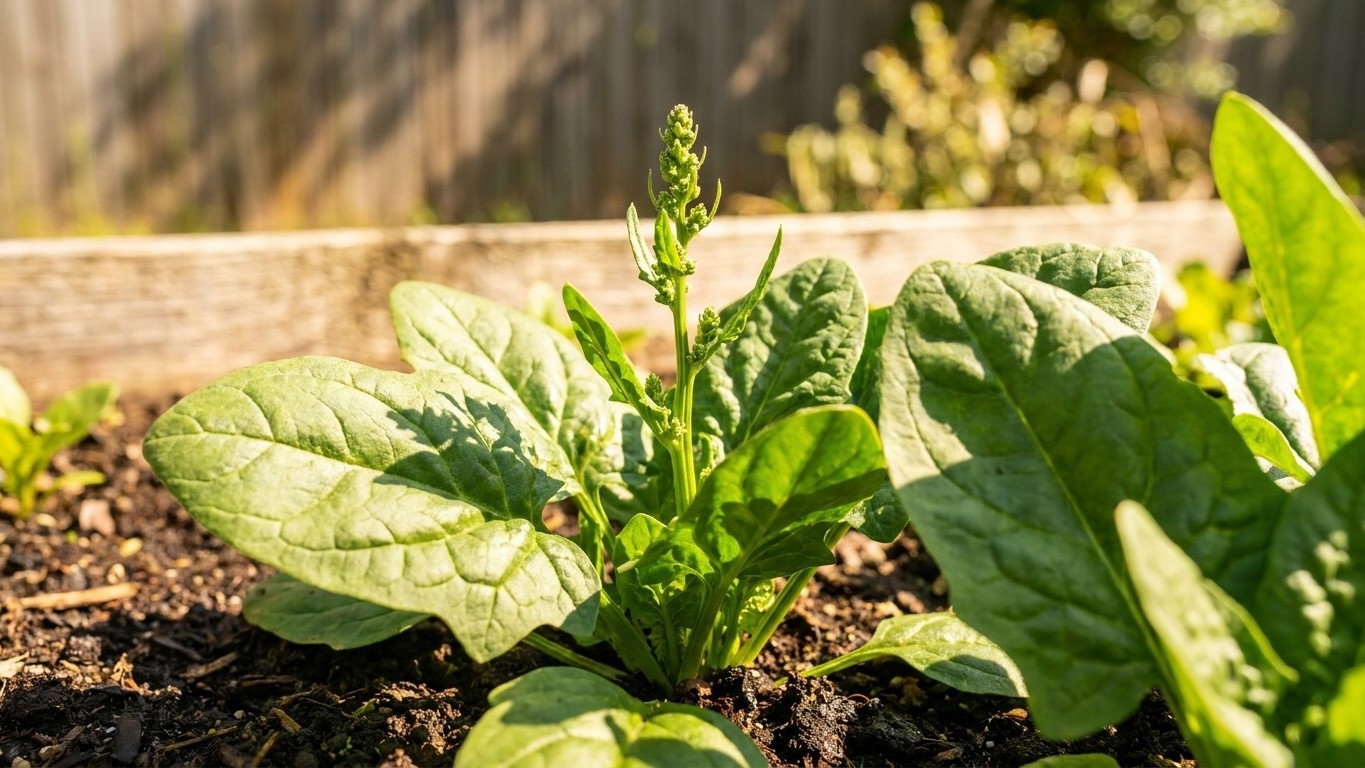

Spinach will bolt early almost everywhere in Quebec, and the reason has nothing to do with a hot summer. On the longest day of the year, this region sees 15 hours and 29 minutes of daylight, and that alone is enough to flip spinach into flowering mode. A mild, cloudy summer changes nothing about the calendar. The plant reads the clock, not the thermometer.
The short answer
Start with that number: 15 hours and 29 minutes of daylight on the summer solstice. That is a long day by any standard, and spinach treats long days as a signal to stop making leaves and start making seed. This is the opposite of what happens with onions on this site, where long days build the bulb. For spinach, long days destroy the crop by pushing it straight into bolting, and no amount of cool weather cancels that signal out.
Here is where it gets interesting for Quebec gardeners specifically. The reference station near Montreal averages 0.0 days a year above 90 F. Zero. That means the heat side of the bolting equation, the part where hot air temperatures push spinach past its 75 F growth ceiling, barely exists in a typical Quebec summer. Most years, the air itself never gets hot enough to be the main problem.
So which is it, day length or heat? In this territory, it is day length doing almost all the damage. Spinach grown here can be sailing along in perfectly comfortable air, well under 75 F, and still throw a flower stalk because the days themselves are long enough to trigger it. A gardener who blames a hot spell for early bolting in Quebec is usually blaming the wrong culprit. The clock, not the thermometer, is running this show.
That distinction matters for how you plan the season. If heat were the main driver, you could chase shade, extra mulch, or a cooler microclimate and buy real time. Those tricks still help a little, since 75 F is also the bitterness threshold and any cooling reduces flavor loss. But they will not stop the bolt itself once day length crosses whatever point triggers flowering in a given variety. The fix in Quebec is timing the crop around the short window when days are still short enough, not fighting the calendar with shade cloth.
The practical takeaway: treat spring and fall as two separate, short opportunities rather than one long growing season. Summer itself, oddly, is closer to being spinach’s enemy here than its friend, precisely because the days grow so long. A cool Quebec July does not rescue a June planting. It is the light, not the mercury, calling the shots.
How long the spring window really is
Working out the spring window means lining up two numbers that do not naturally cooperate: how early you can put seed in cold ground, and how fast the days lengthen toward that solstice peak of 15 hours 29 minutes. Here is how it breaks down step by step.
- Start with the mean last frost. Environment and Climate Change Canada puts the average last spring frost at the Montreal/St-Hubert station on May 6. That is a mean, not a guarantee. In one year out of two, frost arrives later than that date, so treat it as a midpoint, not a safe line to plant by.
- Back up two to three weeks for sowing. Spinach seed goes in the ground two to three weeks before the last frost, which lands sowing somewhere in mid to late April in a typical year, earlier if the season runs mild, later if it runs true to a colder-than-average spring.
- Track how fast daylight climbs after that. From mid-April onward, day length in this latitude increases quickly on the run-up to the June solstice, closing in on that 15 hour 29 minute peak within roughly two months.
- Recognize the growth ceiling. Spinach grows best where temperatures stay under 75 F. Given that Quebec averages 0.0 days above 90 F a year, the air temperature rarely forces the issue directly, but the 75 F mark is also when bitterness sets in, so quality slips even before the plant physically bolts.
- Add it up. That leaves a real spring window of only a handful of weeks, roughly from mid or late April sowing through late May or very early June, before the lengthening days push the crop toward flowering regardless of how the thermometer behaves.
None of this is a hard cutoff you can circle on a calendar. It is a shrinking margin, and every week you delay sowing past that mid to late April start eats directly into the harvest before bolting sets in.
The autumn crop, and when the soil lets you sow
Fall Spinach in Quebec runs into a different pair of obstacles than the spring crop does, and they bracket the sowing window from both ends.
Soil still too warm to germinate
Utah State University Extension notes that spinach seed germination drops off once soil temperature climbs above 80 F. That is a soil reading, not an air reading, and soil holds heat well after the hottest part of summer has passed. Given how rarely Quebec air itself reaches extreme heat, with an average of 0.0 days above 90 F a year, soil here likely cools toward that 80 F mark somewhat earlier in late summer than it would in a genuinely hot climate.
The frost that ends the season
On the other end, the mean first fall frost at the Montreal/St-Hubert station lands on October 5. Same caution applies here as with the spring date: this is a midpoint from Environment and Climate Change Canada’s 1981 to 2010 normals, not a promise, and frost can just as easily hold off past that date as arrive before it.
Counting backward from a harvest target near October 5, the source guidance to sow spinach 50 to 75 days ahead of the day you want to harvest puts the fall sowing window somewhere between roughly late July and mid-August. Sow around July 22 and you are near the 75-day mark; sow closer to August 16 and you are nearer the 50-day mark, cutting it closer to that frost risk. Splitting the difference and aiming for late July through the first half of August gives some buffer on both sides, soil cool enough to germinate reliably and enough calendar left before frost shuts things down.
Four spinach varieties commonly discussed for home gardens are Bloomsdale, Melody, Teton, and Olympia.
Common questions
Does a cool Quebec summer delay spinach bolting compared to a hotter US state?
Not by much. Because the trigger here is largely day length rather than heat, and Quebec’s long summer days (15 hours 29 minutes at the peak) arrive regardless of temperature, a cool summer does not buy the extra weeks a gardener might expect.
Can I plant spinach in early June once the frost risk is gone?
Technically the frost risk is lower by then, but June planting runs straight into the longest days of the year, which is exactly when bolting risk is highest. Spring sowing in mid to late April, well ahead of the June solstice, gives spinach more time to grow before day length turns against it.
Is the October 5 frost date safe to plan a harvest around?
No. It is a mean date from Environment and Climate Change Canada’s 1981-2010 normals for the Montreal/St-Hubert station, meaning frost arrives later than that in about half of all years. Treat it as a midpoint for planning, and watch local forecasts as the date approaches rather than relying on it as fixed.
Why does heat get blamed for bolting when Quebec barely has any hot days?
Because heat and long days both push spinach toward flowering, and gardeners tend to notice the thermometer more than the clock. With an average of 0.0 days above 90 F a year at the reference station, heat is rarely the actual cause here. Day length, quietly climbing toward 15 hours 29 minutes each summer, does most of the work.