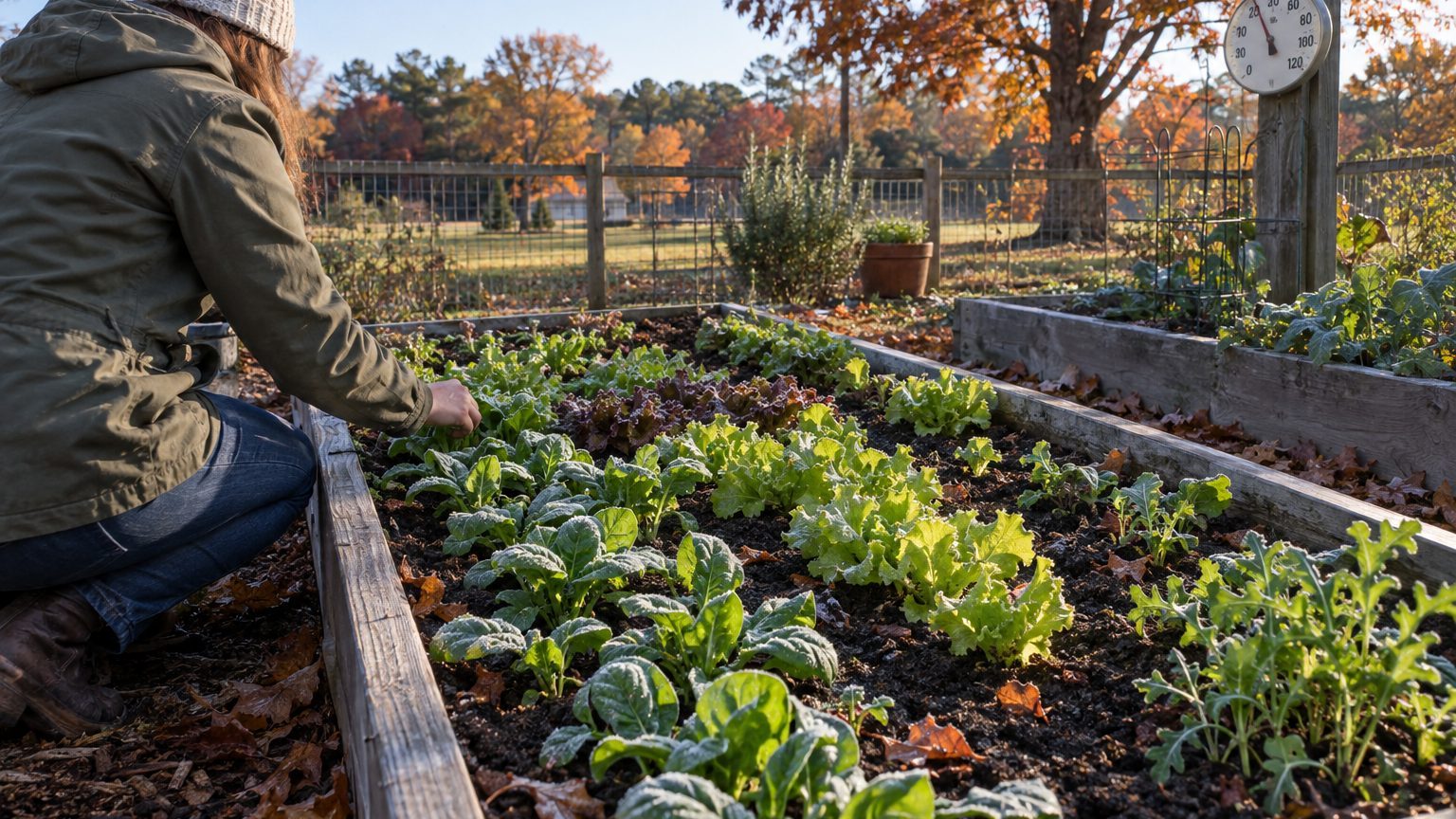

In Kentucky, sow winter salads from late summer into early fall, timed so the plants are established before the first 32°F freeze. At the Louisville reference station that freeze lands between November 2 and November 12. Spring sowings of the same crops begin once the last-freeze band, March 24 to April 4, has passed. Both are probabilities, not promises.
The short answer for Kentucky
The dates above come from NOAA’s 1991-2020 Climate Normals for Louisville, and they are probabilities of a 32°F freeze. The spring band marks where the chance of a freeze still to come sits between 30 and 70 percent. The fall band is the mirror image, the stretch when the chance that a freeze has already happened sits between 30 and 70 percent. Neither is a guarantee of a frost-free day.
| Marker (Louisville reference station) | Date band |
|---|---|
| Last spring 32°F freeze (30-70% band) | March 24 to April 4 |
| First fall 32°F freeze (30-70% band) | November 2 to November 12 |
Winter salads work backward from that fall band. Pick a crop, read the days to maturity on the seed packet, and count back from November 2. That gives the latest sensible sowing date for a plant you want at full size before the freeze arrives. Leafy greens that you cut young have more slack than anything meant to grow big. Sowing earlier than your count is usually safer than later, because growth slows as autumn light fades and the weeks you gain in September are weeks you cannot make up in December.
Spring runs on the other clock. Hardy greens can go in as the soil becomes workable, with the March 24 to April 4 band as your reminder that a freeze can still arrive. Cover or patience covers that risk.
One caution matters for anyone outside the city. NWS Louisville warns that this urban station runs later in spring and earlier in fall than the surrounding rural parts of Jefferson County. Rural gardens should expect a tighter window than the table suggests, so count back from a date a little earlier than November 2. This page does not have a rural-specific figure to replace it.
For the crops themselves, Winter Salads for Kentucky Gardens covers the full picture, and The Best Winter Salads for Kentucky sorts varieties by type.
What will not work here
Long-maturity crops sown late are the first casualty. With the freeze band beginning on November 2, a salad crop that needs many weeks to reach size and goes into the ground in October will arrive at winter as a seedling. Seedlings survive cold, but they do not grow in it. You will have a bed that looks planted and yields almost nothing until spring.
Hot soil in late summer is the opposite trap. The sowing window opens while Kentucky is still warm, and lettuce seed pushed into baking ground often germinates poorly or sulks. Sowing in the evening, shading the row, and keeping the seedbed moist matter more in August and early September than any fertilizer choice.
Cold itself is less of a threat than people expect, and that deserves its own number. The mean daily minimum of the coldest month at Louisville is 27.8°F. That is an average night, not the worst one, so colder nights will certainly come. Still, it means a typical Kentucky winter night sits only a few degrees below freezing. Hardy greens shrug that off. The tender ones, such as many loose-leaf lettuces, are the ones that need a row cover or a cold frame on the harder nights.
Close spacing fails here for a different reason. Kentucky’s humid climate keeps foliage wet, and tightly packed leaves dry slowly. Crowded rows of baby greens in a mild, damp fall are an invitation to rot and mildew. Thinning feels wasteful, but a bed with air moving through it outlasts a dense one.
Expecting steady harvests from December through February is another miscalculation. Plants sown on time reach size in fall, then hold in the cold with little new growth. Cut leaves lightly and early, because regrowth through midwinter is slow. The garden works more like a refrigerator you stocked in November than a production line.
Last, trusting the city dates in the countryside. The Louisville station is the only one this page uses, and NWS Louisville itself says the surrounding rural area behaves differently. A gardener who sows on the airport’s schedule in a cold hollow may lose a planting.
What changes across Kentucky
Kentucky is not one garden. The USDA Plant Hardiness Zone Map (2023, built on 1991-2020 normals) places the state across zones 6a to 7a. That range spans the whole territory, so there is no single answer for every county, and Louisville is the reference city for the dates on this page.
The zone system rests on one variable, the average annual extreme minimum temperature. It tells you about the coldest night of the year, not about the date of the first fall freeze. Two places can share a zone and still differ by a week or more on frost dates, and the reverse is also true. For sowing, the freeze dates matter more. For deciding whether a plant survives the winter outdoors, the zone matters more.
For readers in the cooler parts of the state, generally the higher ground and the northern edge, the direction is clear. Treat the November 2 to 12 band as a ceiling, sow earlier, and plan on covers for the hardier crops too. In the milder parts of the state the fall window may stretch later and winter losses may be fewer, but that is a tendency rather than a date.
Which zone you fall into is something this page will not guess. Look up your location on the USDA Plant Hardiness Zone Map, which is searchable by ZIP code, and then compare your own first freeze in past years against the Louisville band. If your garden has frozen earlier than November 2 more often than not, shift everything earlier to match.
Where to check this for your own county
A county recommendation beats a state one, and this page is the state one. It is built from a single reference station and a single zone range, which is the best it can do without local trial data. The place that holds the finer detail is the University of Kentucky Cooperative Extension service, which has an office in every county.
Two things are worth looking for there. The first is a local planting calendar, ideally one that lists cool-season vegetables with sowing windows for fall and spring in your area. The second is the list of varieties trialled in your county or a similar one, since a variety that thrives in one part of the state can bolt or rot in another. If a calendar for winter salads specifically is not published, ask the county office which cool-season crops they advise for fall sowing and what dates they work to.
The extension’s local knowledge also covers what no table can: which pests show up in your area, how long fall stays warm in your valley, and whether growers near you rely on cold frames or low tunnels. A staff member or Master Gardener volunteer will often know that in minutes.
When the county advice and this page disagree, go with the county. The frost-date bands here are a solid starting frame, and the extension is where you refine them. For crop choices once you have your dates, The Best Winter Salads for Kentucky picks up where this page leaves off.
Checking this against your own garden
Your own observations outrank every date above. Three are worth making, and none needs equipment.
- Soil warmth by feel. In late summer, press your hand flat into the seedbed in the morning and again in the afternoon. If it feels hot to the touch at noon, wait or shade it before sowing lettuce. A bed that stays cool late in the day has a gentler microclimate, such as a spot shaded by a fence or a north-facing wall.
- First true leaves. The first pair of leaves a seedling shows are seed leaves. The next pair, the true leaves, mark real growth. Note how many days that takes from sowing in September compared with October. If it lengthens sharply, your garden is losing light and warmth faster than the state numbers suggest.
- Where the first frost lands. On the first frosty morning, walk the yard and see which patches are white and which are green. Low spots collect cold air and freeze first. A wall or the south side of the house can hold off the frost for days. That map is your real planting map.
Keep notes for a season. Next year, the dates in your own journal will be worth more than any regional table, this one included.
Common questions
Is it too late to sow winter salads on October 5?
For anything that needs to reach full size outdoors, it is late, because the first-freeze band begins November 2 at the Louisville reference station. Count back from that date using the seed packet’s days to maturity. Fast baby-leaf crops under a cold frame or row cover are a more realistic bet this late in the season.
Do winter salads keep growing through January?
Mostly they hold. The coldest month at Louisville has a mean daily minimum of 27.8°F, which hardy greens tolerate, but short days slow growth sharply. Plan on harvesting what grew in fall, with only slow regrowth in midwinter.
Can I use the same dates for spring sowing?
The spring marker is different. The last-freeze band runs from March 24 to April 4, and it describes the odds of a 32°F freeze. Hardy greens can go in before it with cover, but tender ones should wait until the odds fall.
Why might my garden differ from the Louisville dates?
NWS Louisville notes that this urban station runs later in spring and earlier in fall than surrounding rural Jefferson County, so a rural garden should expect a tighter window. The state also spans zones 6a to 7a, and a county extension office is the better source for your own dates.