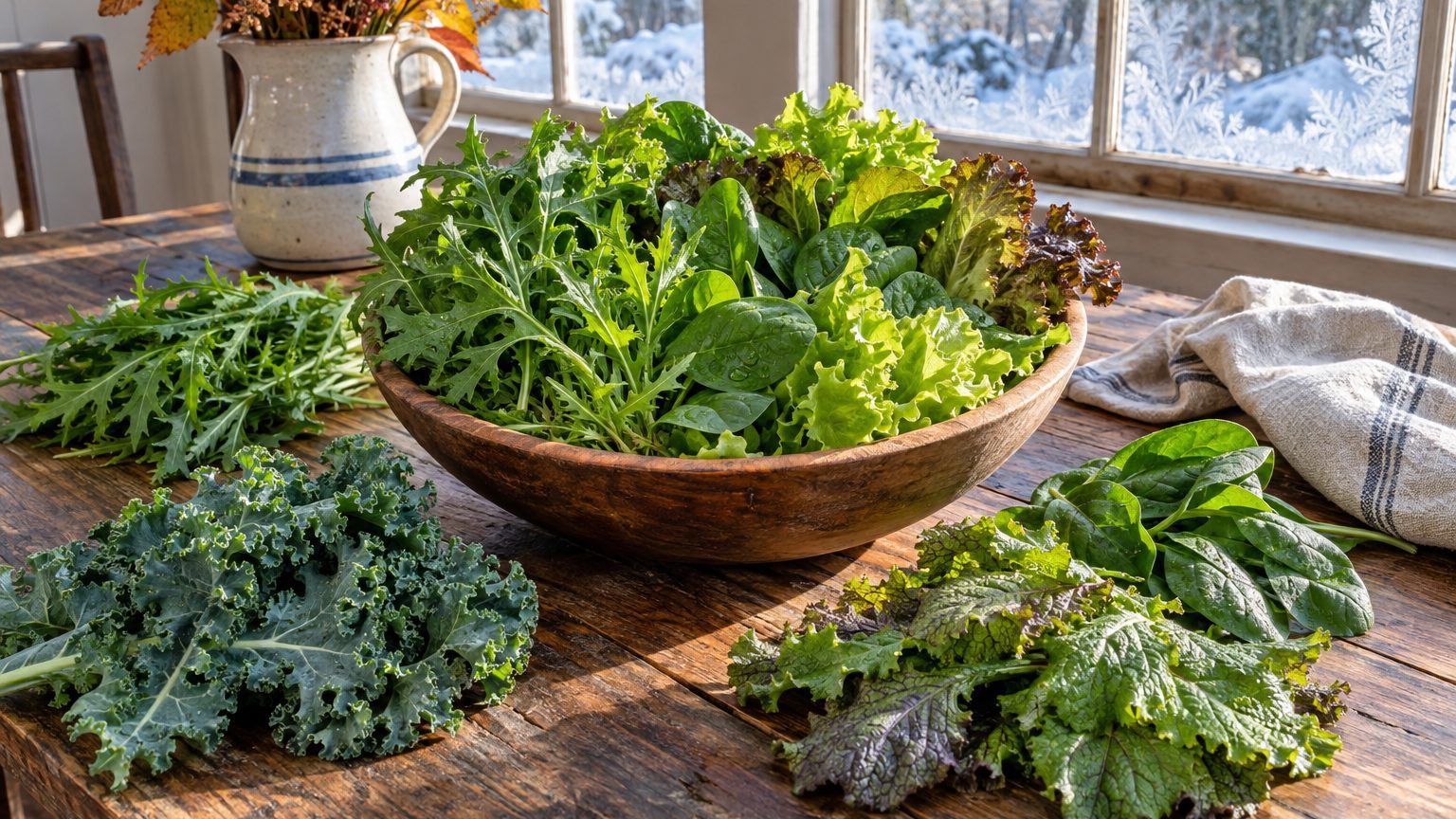

For Massachusetts, the best winter salads are cold-tolerant leaf crops: spinach, mâche, claytonia, kale, and hardy Asian greens such as tatsoi and mizuna. Heading lettuce and quick-growing arugula are the weak picks unless you can cover them. Zones run from 5a to 7b across the state, so details shift by location. The type decision holds everywhere: low, tough leaves, established well before the first hard freezes.
The short answer for Massachusetts
Two numbers drive the choice. The first is the fall frost window: November 3 to November 14, which is the band where the odds of a 32°F freeze run between 30 and 70 percent, per NOAA’s 1991-2020 Climate Normals. It is a probability, not a deadline. Some years the first freeze comes earlier, some later. The second number is 23.1°F, the mean daily minimum of the coldest month at the Boston reference station. That is an average of nights, so plenty of nights run colder, and it means ordinary winter here sits below freezing after dark.
Together they split winter salads into two jobs. Crops must grow quickly in the fall while light and warmth remain, then hold in the cold, since December and January growth is close to a standstill. Pick varieties that survive freezing nights as a matter of course, and sow them early enough to reach harvest size before growth slows. The sowing dates for winter salads in Massachusetts are covered on their own page.
| Type | Fit for Massachusetts | Notes |
|---|---|---|
| Spinach | Best all-around | Sweetens after frost; holds under a cover |
| Mâche (corn salad) | Excellent | Small rosettes, slow, very cold-tolerant |
| Claytonia | Excellent | Handles cold and low light; tender, mild leaves |
| Kale, tatsoi, mizuna | Very good | Baby-leaf harvests; tatsoi and mizuna also grow fast |
| Endive, escarole, radicchio | Good in fall | Handle light frost; fade in deep cold without cover |
| Heading lettuce, arugula | Needs protection | Fine in fall; struggles by midwinter in open beds |
What will not work here
Late sowing of slow crops. Because the first freeze is likely somewhere in early to mid November, anything still small in late October has little growth left to spend. Heading types, which need weeks of steady growth to form a heart, are the usual victims. The plants stall at seedling size, then sit through winter as a bed of survivors that never become a salad.
Open-bed tender lettuce fares badly too. When the average night in the coldest month reaches 23.1°F, leaves that shrug off a light frost in October get wrecked by repeated hard nights, wind, and the thaw-and-refreeze cycles typical of New England. Lettuce can work under a tunnel or cold frame. Standing bare in a raised bed in January, it mostly doesn’t.
Another failure is copying a Boston schedule inland. The frost dates in this article come from Logan, a waterfront urban station and the mildest spot in the state. Inland suburbs and the Berkshires frost noticeably earlier in fall and later in spring, so a gardener who sows by Logan’s dates in the hills starts the clock too late. Those extra weeks matter more than any variety choice.
Last, a sealed cover. A cold frame shut tight on a sunny day can overheat, and trapped damp air under a cover invites rot and mildew. Crowded plantings make it worse. Space leaf crops generously, vent on mild afternoons, and close the lid at dusk. Winter salad failures in a covered bed often come from too much shelter, not too little.
One more caution about the spring side. Boston’s last spring frost window runs April 1 to April 8 (the same 30-70 percent probability band), which is early for the state. Overwintered plants will bolt as days lengthen, so treat them as a bonus harvest rather than a permanent crop.
What changes across Massachusetts
The USDA Plant Hardiness Zone Map (2023 edition, built on 1991-2020 normals) places Massachusetts in zones 5a to 7b. That is a spread of three full zones, so there is no single answer for the state. The system rests on one variable, the average annual extreme minimum temperature, which tells you how cold the worst nights get. It does not tell you when frost arrives or how much daylight a bed receives.
Which zone you fall in is a question for the map, not for this page. Look up your own location on the USDA Plant Hardiness Zone Map and read the result against the spread above.
What to shift depends on where you land in that range. In the north, at altitude, and across the Berkshires, bring sowing earlier and expect covered beds to hold plants rather than grow them. Lean toward mâche, claytonia, spinach, and kale, and drop the endives and radicchio that tolerate frost but not sustained cold. Add a second layer of fabric inside a cold frame or tunnel.
Near the coast, where waterfront stations like Logan stay mildest, the margins widen. Fall growth runs a little longer, and a wider range of types, including the endive group, can make it to harvest. Even there, 23.1°F average winter lows apply, so the hardy list is still the safe choice. For a broader look at the whole season, see Winter Salads for Massachusetts Gardens.
Where to check this for your own county
Your state land-grant extension service is the next stop: UMass Extension. Two things are worth finding there. First, a local planting calendar, ideally one written for your part of the state, with fall sowing dates for leafy crops. Second, varieties that have been trialled in your county, meaning grown side by side in local conditions and compared. A named variety that did well in a county trial beats any generic type recommendation, including the ones on this page.
Some extension services publish one calendar per crop or species rather than one per state, so search by the crop you are actually growing, such as spinach or kale, and use that calendar rather than a neighboring crop’s. This page does not carry a Massachusetts winter-salad calendar from the extension service, so it gives types and frost windows rather than county dates.
Be plain about the hierarchy. A county recommendation beats a state one, because Massachusetts holds a coastal plain, inland hills, and a mountain county within a few hours’ drive. This page is the state one. It narrows the field to what is likely to work. The county guidance tells you what has.
Checking this against your own garden
Your own observations outrank every date above. Three are worth watching, and none needs a tool.
- Soil warmth by feel. Push your hand a couple of inches into the bed in the morning. Soil that feels cool but not numbing still supports germination and root growth. Soil that feels cold and stiff means growth has nearly stopped. Beds that reach that point sooner than a neighbor’s are your colder pockets.
- The first true leaves. Seedlings first show two seed leaves, then the first true leaves. If your plants have not made true leaves by early November, they are behind the frost window and need cover now.
- Where frost shows first. On a cold clear morning, notice which beds are white and which stay green. Low spots and open lawn frost first, while beds against a south-facing wall stay clear longest.
Over a season or two, these notes build a map more accurate than any station’s.
Common questions
Can winter salads grow outdoors in Massachusetts without any cover?
Some can. Spinach, mâche, claytonia, and kale tolerate freezing nights, and in milder spots they can hold without cover. With a mean coldest-month minimum of 23.1°F at the Boston reference station, though, a simple cover improves quality and survival, especially inland and in the hills.
What is the latest I can sow in the fall?
This page does not give a single cutoff, because it depends on your location and the crop. The Boston frost window of November 3 to November 14 shows when growth ends for most plants, so work backward from it. The sowing calendar page and your county extension office can refine that.
Can I grow lettuce through winter?
Heading lettuce grows well in fall and survives light frost, but it struggles through midwinter in open beds. Under a tunnel or cold frame it can work. If you want dependable winter harvests without much fuss, choose the hardier types in the table above.
Do the Boston frost dates apply to my garden?
Only if you garden near the water. The dates come from Logan, the mildest station in the state, so inland suburbs and the Berkshires typically see frost earlier in fall and later in spring. Treat the Boston window as the best case and adjust earlier for fall sowing.